
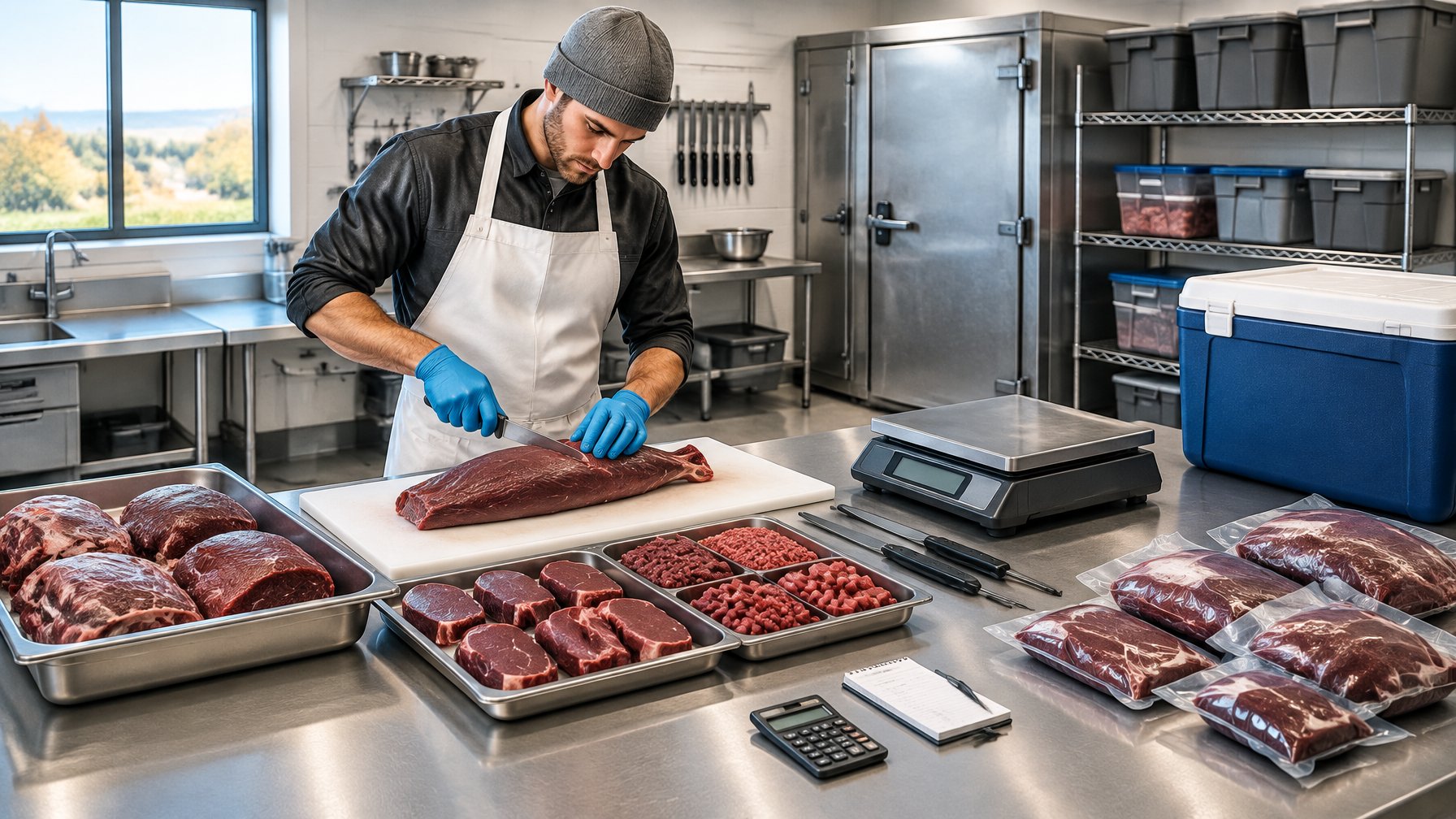
Basic deer processing at a butcher shop commonly runs about $90 to $150 for a whole deer, covering cutting, grinding, and wrapping. Add sausage, snack sticks, jerky, or a cape for taxidermy, and the same deer can cost $300 or more. Vacuum packaging often costs extra, and deposits of $50 to $100 are standard at drop-off.
How Much Does It Cost to Process a Deer?
Break-Even Calculator
You spend $300 on processing every year.
Recommended Setup: Starter Kit (est. $550)
Pays for itself in: 1.8 seasons
On This Page
Hiring a deer processing service takes the heavy lifting out of harvest care, but the cost to process a deer varies widely by region and cut choices.
Understanding the deer processing cost helps you budget before the hunt begins. The overall cost to process a deer depends heavily on the finished weight and which specialty items you select.
By the end of this guide, you will be able to read a processor’s price sheet line by line, spot surprise charges, and protect your deer meat. We evaluate published 2026 price lists from working shops, USDA food-safety guidance, and key questions about yields and jerky pricing.
The Short Answer: What to Budget for a Processor
Three factors set your total cost of processing a deer: the base cutting fee, the add-ons you order on the cut sheet, and local demand during peak season.
Comparing prices across butchers is tricky because every shop calculates deer processing cost differently. Knowing these variables helps you accurately project the true cost to process a deer.
Basic Processing Usually Starts With Cutting, Grinding, and Wrapping
Base processing means the shop turns your carcass into labeled, wrapped packages of steaks, roasts, and ground venison.
For a hunter dropping off a whole carcass, the basic cost to process a deer remains fairly predictable across most states.
Published 2026 price lists land in a tight band. A whitetail quartered at a Georgia shop runs $100 for ground meat, steaks, roasts and freezer wrap. A Michigan shop lists a standard cut at $90. A Kentucky shop charges $150 for a whole deer including skinning and vacuum packaging.
| Shop model | Base fee | What it covers |
|---|---|---|
| Flat whole-deer fee | $90 to $150 | Skinning (sometimes), cutting, grinding, wrapping |
| Per-pound, quartered | $1.65 to $2.20/lb | Cut, grind, package |
| Per-pound, boneless | $1.00 to $2.50/lb | Cut, grind, package |
| Tiered by weight | $95 to $110 | Basic processing, 0 to 110 lbs |
Why a Base Price Is Not Your Final Total
The base fee covers plain cuts. Everything cooked, smoked, cured, or stuffed is priced separately by the pound.
Skinning is often its own line. One Texas shop lists an $80 skinning charge on top of a $150 minimum processing fee. Vacuum packing can add $1.00 a pound at shops that treat it as an upgrade.
How Regional Demand and Peak Hunting Season Affect Rates
During deer hunting season, turnaround stretches when the coolers fill. A Minnesota shop asks hunters to expect an 8 to 12 week turnaround, with the long end during holidays.
Rush service costs money. One shop charges $125 for a rush order of 10 days or less against a $90 standard cut, plus $15 if you need it on a specific date further out.
[[RESEARCH: regional base-fee spread for whole-deer processing across at least five states, with shop names and 2026 published prices]]
What Does a Basic Processing Fee Usually Include?
The standard package covers intake and chilling, breaking the carcass down, and wrapping the result. What differs between shops is how backstrap is cut and whether packaging is paper or vacuum sealed.
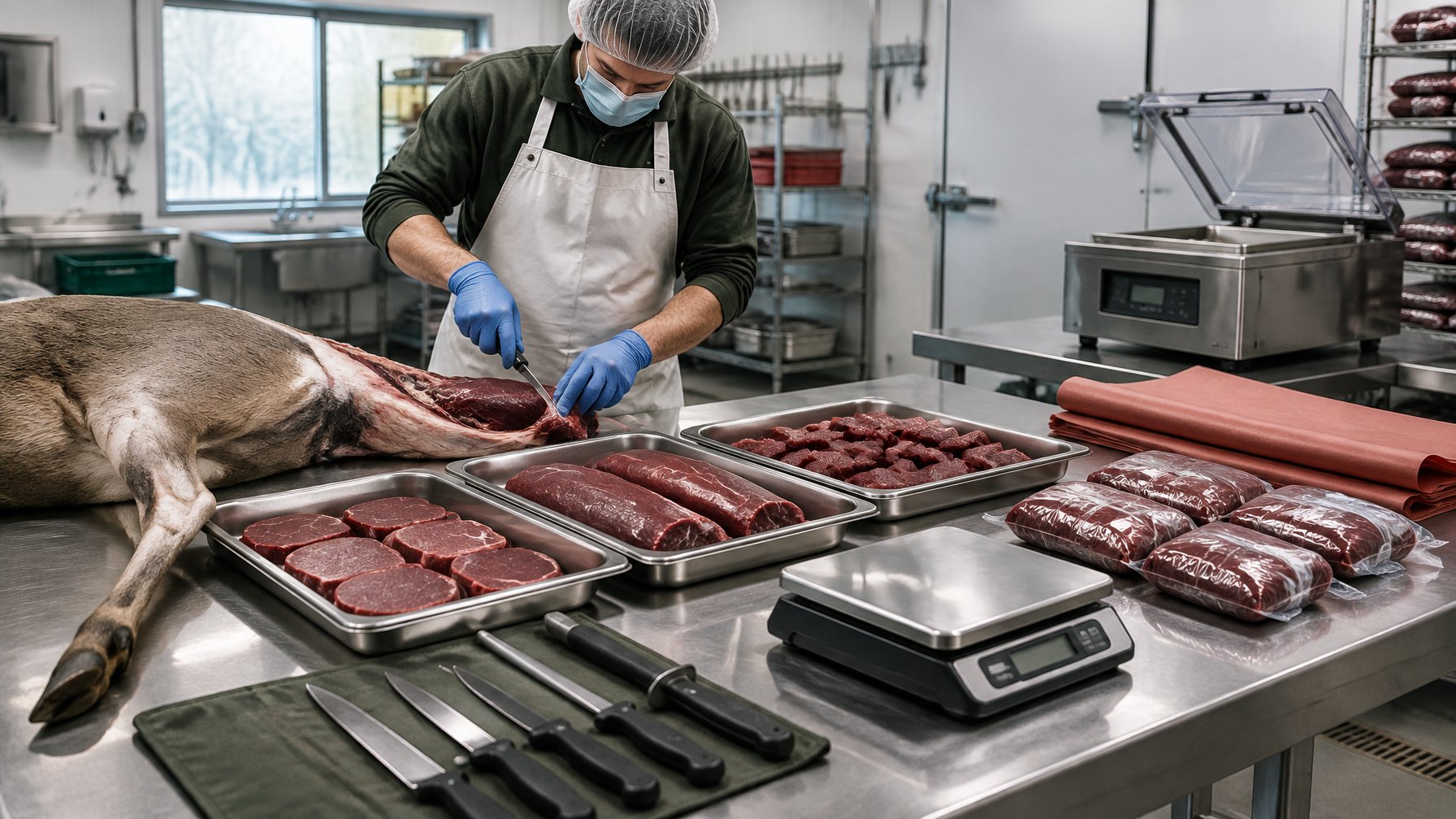
Intake, Tagging, Skinning, and Chilling
Every shop starts with paperwork. One Missouri butcher requires a confirmation number from the state where the deer was hunted before they will accept it.
Skinning is not always included. Some shops fold it into the whole-deer fee. Others charge $35 to $80 as a separate line, and one Kentucky shop charges $25 extra if you skin it yourself, because a hunter-skinned carcass usually needs cleaning.
Quartering, Deboning, and Standard Cuts
Proper quartering breaks down the deer into primal cuts, saving cooler space and butchering time. Many processors charge lower fees when quartering is already completed before drop-off.
Standard cuts mean steaks, roasts, stew meat, and trim headed for the grinder. Requesting custom cuts like specialty roasts, medallions, or bone-in chops takes extra labor and increases your total.
One Michigan shop prices boneless meat at $0.90 a pound and bone-in at $1.00 a pound. Expect fees to rise when your cut sheet specifies multiple custom cuts.
Ground Venison, Roasts, and Backstrap Options
Ground venison is the biggest share of most deer. How the shop handles your deer meat will determine your final yield of roasts and trim.
Plain grind is often included in the base fee, while fat or pork added to the mix is charged separately.
Backstrap gets one choice per deer at most shops: whole, butterflied, or cut into steaks. Plan on roughly 5 pounds of backstrap per deer after boning and trimming. The tenderloin is usually pulled whole during deboning.
Paper Wrap vs. Vacuum Packaging
Vacuum sealing costs about $1.00 per pound at shops that treat it as an add-on, and some shops will not vacuum pack fresh wild game at all.
| Packaging | Typical cost | Freezer life note |
|---|---|---|
| Freezer paper wrap | Usually included | Air permeable; overwrap for long storage |
| Vacuum sealed | About $1.00/lb extra, or included at some shops | Blocks air contact, limits freezer burn |
Freezer burn is a quality problem, not a safety one. USDA FSIS notes that food stored constantly at 0 °F is always safe, and freezer burn just leaves dry gray spots you cut away.
Which Add-Ons Raise the Final Bill?
Sausage, snack sticks, jerky, and cape work are where a $100 drop-off becomes a $350 pickup. Batch minimums and raw-versus-finished weight pricing decide how much of that you control.
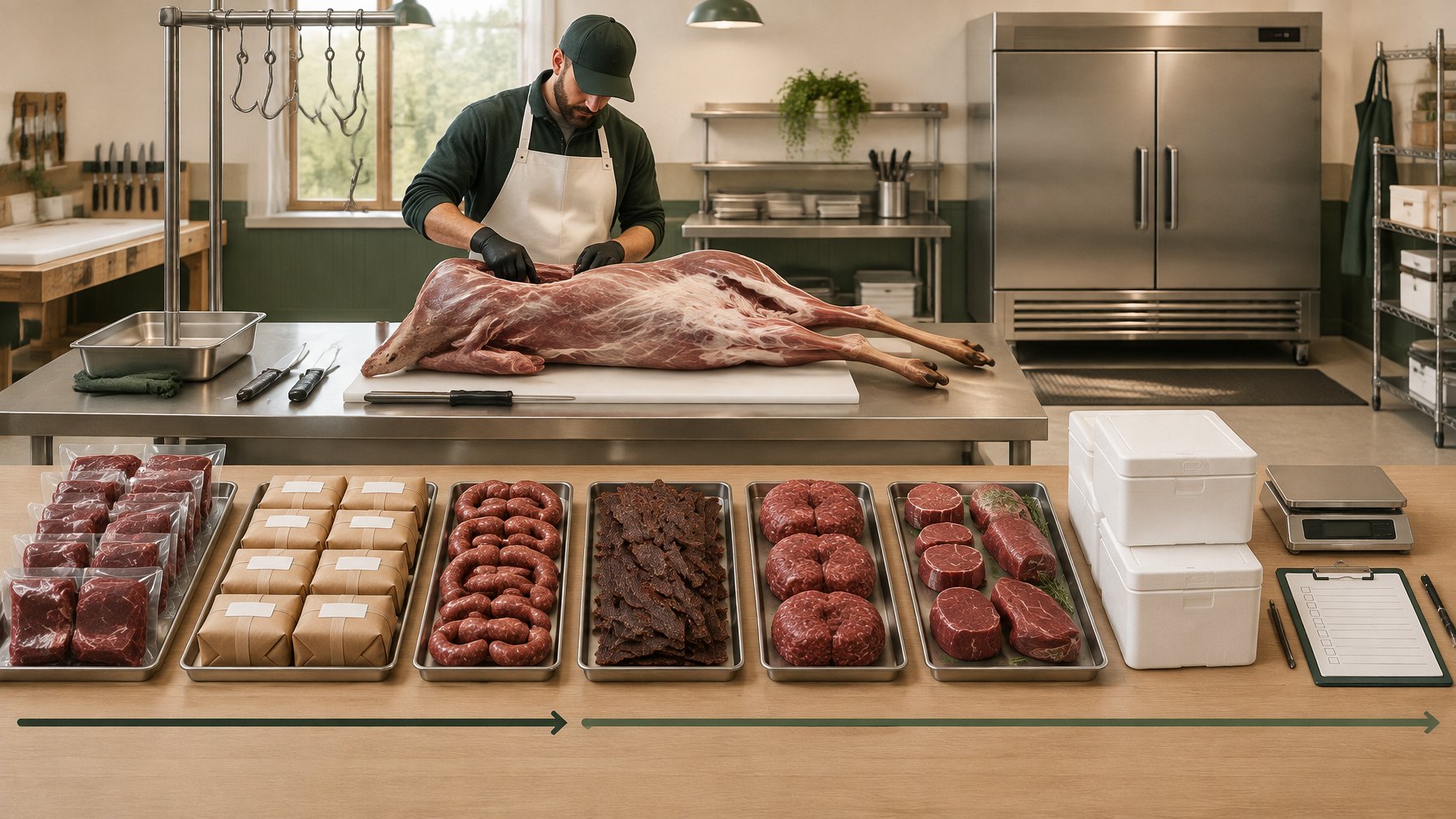
Sausage, Breakfast Sausage, and Smoked Sausage
Commercial sausage making requires precise fat blends, as wild game trim is very lean. Fresh and smoked sausage is priced per pound of finished product, and most recipes add pork or beef fat.
One Georgia shop lists breakfast sausage at $3.99 a pound and smoked link sausage at $5.99 a pound, and notes that adding fat roughly doubles your poundage: 5 pounds of trim yields about 10 pounds of finished sausage. Beef fat runs $4.50 a pound there, with 20% recommended.
Summer Sausage and Snack Sticks
Summer sausage and sticks carry batch minimums because a smokehouse run has a floor.
An Indiana shop requires a 10 pound minimum for summer sausage at $4.75 a pound and hunter snack sticks at $7.25 a pound, both with 20% pork added. A Minnesota shop needs 17 pounds of trim for a private stick batch and 25 pounds for any private batch.
Many specialty processors also craft venison bacon, cured meats, and hot dogs from seasoned grind. Venison bacon has become one of the most requested specialty items at modern wild game butcher shops.
Processors often blend pork bacon ends into lean trim to keep cured loaves tender. These specialty options typically carry minimum weight limits as well.
Jerky and the Raw-Weight vs. Finished-Weight Question
Jerky is the single most misread line on a price list, because a shop pricing at finished weight charges for less than half the meat you dropped off.
Commercial jerky production requires slow dehydration that cuts finished volume in half. One Minnesota list states jerky shrinks approximately 50% and is priced per pound on finished weight at $10.49. An Indiana shop prices regular deer jerky at $14.25 per pound of finished weight with a 5 pound raw minimum. Other shops price jerky on raw or wet weight instead, so the same order totals differently.
| Pricing basis | What you are charged for | Example |
|---|---|---|
| Finished weight | Dried product you take home | $10.49/lb, ~50% shrink |
| Raw or wet weight | Meat you handed over | $6.95/lb raw weight |
Caping, Hide Work, and Shoulder Mount Preparation
Caping for a shoulder mount is a separate charge with a short pickup clock.
Prices published for 2026 run from $30 extra for shoulder mounts at one Kentucky shop to $100 cash for a cape at a Minnesota shop, with pickup required within 2 days of completion.
After-Hours Drop-Off, Storage, and Transportation Fees
Late arrival and late pickup both cost money.
One Texas shop adds $20 to skinning for after-hours service, $35 becoming $55. A North Dakota shop may add a $50 storage fee if an order sits more than 10 days after notification. Georgia’s Findley’s treats meat as abandoned after 3 days past notification.
How to Read a Deer Processor Price List
Price sheets hide their real total in four places: the pricing model, the weight being charged, the batch minimums, and the questions nobody prints on the form.
Flat-Rate vs. Per-Pound Pricing
A flat rate caps your risk on a heavy buck. A per-pound rate rewards you for bringing in a small doe or clean boneless trim.
A Texas shop charges $2.00 per pound for a whole animal, $2.20 quartered, and $2.50 for boneless clean meat, with a $150 minimum. That shop lists buck hanging weights of 100 to 160 pounds, so a 140 pound buck runs $280 in processing before skinning or any add-ons.
What Weight Is the Shop Charging For?
Hanging weight, boneless weight, and finished weight are three different numbers, and the gap between them is large.
That same Texas shop publishes typical boneless yields on a whole carcass: 55% for a very clean animal, 50% average, and 45% for a dirty or shoulder-shot deer.
| Weight term | What it means | Rough share of a 140 lb hanging buck |
|---|---|---|
| Hanging weight | Carcass after field dressing and skinning | 140 lb |
| Boneless yield | Usable meat off the bone | 63 to 77 lb |
| Finished jerky weight | Dried product | About half the raw jerky meat |
Minimum Orders, Deposits, and Specialty Batch Sizes
Deposits are near universal. Published 2026 figures include $50 at a Missouri shop, $100 nonrefundable at a Texas shop, and $100 per whole deer at a North Dakota plant with $50 for boneless trim orders.
Batch minimums vary widely. One shop sets a 20 pound minimum per sausage flavor, including snack sticks, and caps a doe order at 2 to 3 specialty items.
Questions to Ask Before You Drive Over
- Do I get my own deer back? Some shops keep every order separate. Others grind in large batches and mix your meat with other hunters’ meat.
- Is jerky priced on raw weight or finished weight? A 50% shrink rate doubles the effective cost of finished-weight pricing.
- What is the per-pound weight based on? Hanging, quartered, or boneless changes the bill by hundreds on a big buck.
- Is skinning included? It ranges from free to $80 as a separate charge.
- How long until pickup, and what happens if I am late? Storage fees and abandonment rules start at 3 days at some shops.
- Do you accept my deer in the condition I will bring it? Some plants take hide-on whole deer and boneless trim only, and refuse quarters.
DIY Deer Processing: Startup Cost and Per-Deer Supplies
Home processing trades a one-time equipment cost for cheap per-deer supplies. The gear splits into knives and a saw, grinding and packaging machines, and consumables you replace every season.
What You Need to Cut and Package a Deer at Home
Here is the checklist by equipment type.
- Cutting: a 6 inch boning knife, a steel or sharpener, a 25 inch meat hand saw
- Surface: a large poly or wood cutting board, food-safe bus tubs or coolers
- Grinding: an electric grinder sized to your volume, plus a spare plate and knife
- Packaging: a vacuum sealer with bags or rolls, or freezer paper and tape
- Storage: a chest or upright freezer holding 0 °F
- Optional: sausage casings, seasonings, a stuffer, a dehydrator for jerky
Knives, a Bone Saw, and a Clean Cutting Surface
A sharp boning knife and a real meat saw do most of the work. Academy lists the LEM 25 in Meat Hand Saw at $84.99 and a 6 inch curved boning butcher knife at $29.99.
Keep the blade sharp. A dull edge tears muscle and pushes you toward the saw when you should be boning.
When a Meat Grinder and Vacuum Sealer Pay Off
A grinder pays for itself fastest if you shoot more than one deer a year or buy beef in bulk.
LEM prices its #8 MightyBite aluminum grinder at $279.99 and its #22 BigBite at $759.99 with a 1 HP motor rated at 13 lbs per minute. In a commercial kitchen, motor rating is what separates a grinder that finishes the job from one that stalls halfway through a hindquarter.
[[RESEARCH: what owners report about grinder motor size versus deer per season, from hunting and charcuterie forums]]
Consumables and Freezer Space to Budget for Each Deer
Per-deer supply cost is small. Packaging your fresh deer meat in freezer-grade barrier bags prevents oxidation during extended storage.
Walton’s sells 100 6×10 vacuum bags for $16.99 and an 8×50 vacuum bag roll for $15.99.
| Item | Published price | Covers |
|---|---|---|
| 100 6×10 vac bags | $16.99 | Steaks, roasts, 1 lb grind packs |
| 8×50 vac bag roll | $15.99 | Custom lengths |
| Beef fat at a processor | $0.50 to $4.50/lb | 10 to 20% of grind weight |
A boned-out deer yielding 63 to 77 pounds of meat takes roughly 3 to 4 cubic feet of freezer space.
When Home Processing Makes Financial Sense
Run the math on your own deer count. A $279.99 grinder plus a $100 sealer and $35 in bags is about $415, which is close to what one deer with sausage and jerky costs at a shop.
Two deer a year and you are ahead in season one. One deer every few years and the shop wins on time alone.
Choose the Right Processing Route for Your Deer
The choice comes down to time, equipment, and whether you want smoked products. Some hunters split the job, and some need to confirm they get their own animal back.
Use a Processor When Time, Equipment, or Specialty Products Matter
Smokehouse products are hard to match at home. Summer sausage, snack sticks, and cooked salami need cure, controlled heat, and a smoker you can hold steady for hours.
A shop will also take the deer off your hands within an hour of arrival, which matters during a warm early season.
Process at Home When You Want Control Over Every Cut
Home processing means your backstrap stays whole if you want it whole, and nothing hits the grinder that you would rather roast.
Handling butchering at home gives you total freedom to make custom cuts tailored to your favorite recipes.
You also control grind ratio. Most processors recommend 10 to 20% pork or beef fat in ground venison; at home you can run 10% on one batch and 20% on another.
Split the Work by Bringing in Boneless Trim for Sausage
Boning at home and hauling trim to a shop is the cheapest route to specialty products.
One North Dakota plant charges $30 per order for boneless trim up to 100 lbs and $60 over 100 lbs, against $140 for a hide-on deer. A Minnesota shop lists $25 per quarter to completely bone for sausage versus $35 per quarter to cut and package.
Ask Whether You Will Receive Meat From Your Own Deer
Ask this before you sign the cut sheet, because published policies go both ways.
One Kentucky shop states plainly that all ground venison is produced in large batches and your ground products will be mixed with other meat. A North Dakota plant states it keeps your animal separate from others in all stages. A Georgia shop says the meat you pick up will be your meat.
Handle the Deer Safely Before Drop-Off or Butchering
Cooling, cleanliness, drop-off condition, and CWD rules all affect whether a shop accepts your deer and what you pay. Proper field dressing directly in the woods protects meat quality from the moment of harvest.
Field Dress and Cool the Carcass Promptly
Get the heat out fast. Careful field dressing keeps digestive bacteria away from prime muscle groups.
Processors advise filling the cavity with ice and propping the rib cage open, and warn against storing the carcass in a covered pickup bed.
Hanging in cool conditions of 34 to 40 °F for 3 to 7 days improves texture, per a processor-planning guide for hunters.
SAFETY: USDA FSIS notes that venison can carry heavy bacterial contamination because deer carcasses are often held at ambient temperatures, unlike beef which is chilled fast. FSIS recommends keeping meat at 40 °F or below and heating jerky meat to 160 °F before dehydrating, then drying at 130 to 140 °F.
Know Whether the Shop Accepts Whole, Skinned, or Quartered Deer
Intake rules are strict and they vary. Field quartering makes transport simpler, but check shop rules first.
One North Dakota plant accepts hide-on whole deer and boneless trim only, no quarters and no skinned deer. An Indiana shop is accepting boneless venison only for the 2026 to 2027 season.
Bag choice matters too. Shops reject scented trash bags and ask for coolers, food-safe pails, or sturdy disposable boxes.
Keep Shot-Damaged and Contaminated Meat Out of the Cooler
Trim bloodshot and dirty meat before it goes in the cooler. Any spoiled or dirt-caked deer meat must be removed promptly to keep surrounding cuts wholesome.
Shops dispose of bloodshot meat anyway, and cleaning fees run from $10 to $40 at one Georgia shop and a flat $25 at an Indiana shop.
Follow State Guidance for CWD Testing and Carcass Transport
Chronic wasting disease is a fatal prion disease in deer, elk, moose and reindeer, reported in animals in at least 36 US states.
The CDC states that as of August 2025, CWD has been reported in at least 36 US states and five Canadian provinces, and that prions persist in soil and water for years. Transport rules follow from that. Georgia law bars out-of-state bones of any species, and Texas rules allow a deer to be skinned and quartered for transport if tagged with proof of sex.
Frequently Asked Questions
Six questions hunters ask most about processing cost, yield, turnaround, and packaging.
How much does it cost to pay someone to process a deer?
Basic whole-deer processing runs about $90 to $150 at shops publishing 2026 prices, covering cutting, grinding, and wrapping. Per-pound shops charge roughly $1.00 to $2.50 per pound depending on whether the meat is whole, quartered, or boneless. Sausage, snack sticks, jerky, and caping are separate line items that often double the bill.
How much meat should you get from a 100 lb deer?
Expect 45 to 55 pounds of boneless meat from a 100 pound hanging weight. One Texas processor publishes 55% yield on a very clean or head-shot deer, 50% average on a heart-shot animal, and 45% on a dirty or shoulder-shot carcass. Shot placement and how clean you keep the carcass move that number several pounds.
How long does it take to get deer meat back from a processor?
Turnaround ranges from a few days to three months. One Minnesota shop asks hunters to expect 8 to 12 weeks, closer to 12 during holidays. Rush service exists at some shops for a fee, such as $125 for a 10-day turnaround against a $90 standard cut. Ask before you drop off.
Is it worth processing your own deer?
It pays off at two or more deer a year. A $279.99 entry-level grinder plus a vacuum sealer and a box of bags runs close to what one deer with sausage and jerky costs at a shop. Below one deer a year, the shop wins on time. Smoked products are also hard to match without a smoker.
How much does deer processing cost in Texas?
One Texas shop publishes $2.00 per pound for a whole animal, $2.20 quartered, and $2.50 for boneless clean meat, with a $150 minimum and an $80 skinning charge. Another Texas shop lists $35 to skin a deer and $70 to process a quartered animal into sausage. Rates vary by shop and by animal size.
Should I vacuum seal venison or use butcher paper?
Vacuum sealing blocks air contact and limits freezer burn, which matters most for long storage. USDA FSIS says freezer burn does not make food unsafe, only dry in spots you cut away. Paper wrap is included at most shops; vacuum packing often adds about $1.00 per pound, and some shops decline to vacuum pack fresh wild game at all.
Next, size your gear against your season with our meat grinder and vacuum sealer roundups, where the specs are matched to deer per year rather than headline horsepower.
This is general guidance based on USDA recommendations. When in doubt, follow the USDA FSIS source linked above.