Smoke a pork shoulder low and slow with indirect heat, then cook it well past the 145°F safety mark. Texas A&M cooks pork butts at 200 to 250°F until they approach 200°F inside, where collagen has turned to gelatin and the meat pulls apart. USDA’s FSIS keeps smokers at 225 to 300°F. Expect roughly an hour per pound.
This guide compares Texas A&M Meat Science’s pages on the pork shoulder butt, cooking and smoking barbecue and barbecue science; USDA FSIS’s Smoking Meat and Poultry (updated August 13, 2024) and Fresh Pork from Farm to Table (December 10, 2024); a Purdue University meat scientist (June 30, 2023); Nebraska Extension’s BBQ IQ (2025); and Illinois Extension’s temperature chart. Their smoker temperatures differ, so each is shown with its source.
Which Cut: Boston Butt or Picnic?
Both come from the shoulder. Texas A&M explains that the Boston butt is the upper part of the shoulder, not the rear of the hog, and is usually sold bone-in with the blade bone. FSIS lists the shoulder’s retail cuts, including the blade Boston roast and the arm picnic. Purdue’s meat scientist says front cuts such as the pork shoulder have more fat than the back end, which helps them stay moist through a long cook. None of the sources gives a different smoking method for the picnic. For where these cuts come from, see how to butcher a pig and how much meat from a half hog.
What Smoker Temperature Should You Use?
| Source | Smoker air temperature |
|---|---|
| USDA FSIS (Smoking Meat and Poultry) | 225 to 300°F, held throughout |
| Nebraska Extension | 225 to 300°F throughout the cooking process |
| Texas A&M Meat Science | 200 to 250°F for large cuts such as pork butts |
| Purdue meat scientist | “around 200 to 220 degrees” |
SaltRail’s suggestion: 225 to 250°F falls inside both the FSIS range and the Texas A&M range. Texas A&M and Purdue run lower than FSIS’s minimum; those are their figures, not a recommendation from this page.
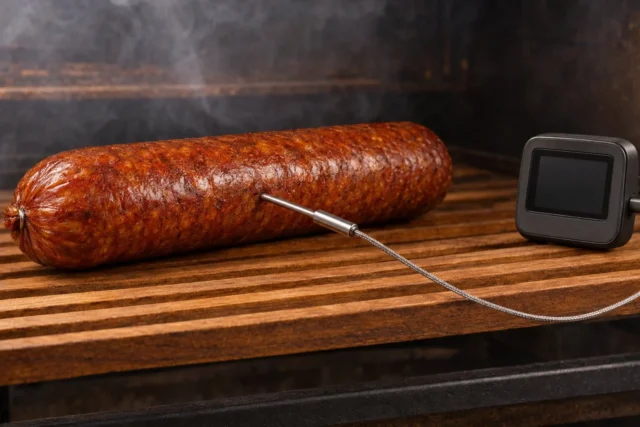
FSIS says to use two thermometers, one for the smoker air and one for the meat. For leave-in probes, see best meat thermometers for sausage and jerky; for the other FSIS smoking rules, how to smoke a turkey. For beef, see how to smoke a brisket.
What Internal Temperature: Safe vs Pulled?
| Purpose | Temperature | Source |
|---|---|---|
| Safe to eat | 145°F, then rest at least 3 minutes | FSIS; Illinois; Nebraska |
| Collagen turns to gelatin | 185 to 195°F | Texas A&M (Barbecue Science) |
| Ready to shred (“pulled”) | Approaching 200°F | Texas A&M (406 Pork Shoulder) |
A shoulder at 145°F is safe but still tough. Texas A&M explains that pork butts carry a lot of connective tissue, and that “Failure to reach this endpoint will result in tough barbecue.” Purdue’s line that “most meat” should reach 165 degrees is a general remark; the pork safety figure from FSIS is 145°F. To check your thermometer, see how to calibrate a meat thermometer.
How Do You Smoke a Pork Shoulder, Step by Step?
- Thaw it completely. Nebraska: “It is not safe to smoke frozen foods.” If you marinate, do it in the refrigerator (FSIS).
- Season it. Purdue says you don’t need to bring the meat to room temperature first.
- Heat the smoker for indirect cooking (Texas A&M) and hold it at your chosen temperature, checked with a smoker thermometer.
- Put the shoulder in with a probe in the thickest part, usually the center (Nebraska).
- Smoke it. Purdue says the meat picks up most of its smoke flavor and color in the first four hours, and sprays it with apple juice and water every 30 to 40 minutes during that time.
- After about four hours, Purdue wraps the meat in aluminum foil (or parchment paper) and leaves it for the rest of the cook. Wrapping is Purdue’s practice; the other sources don’t mention it.
- Cook until it approaches 200°F inside (Texas A&M), then rest it and pull it apart.
- If you use a sauce, FSIS says to add it in the last 15 to 30 minutes.
Why Does the Temperature Stall?
Texas A&M says the plateau in internal temperature near the end of cooking is caused by evaporative cooling: moisture evaporating from the surface cools the meat while it cooks. None of the sources gives a fix for it beyond time; Purdue’s foil wrap is its own practice.
How Long Does It Take?
Texas A&M says many guidelines for barbecuing large cuts use the rule of one hour of cooking per pound of raw cut. FSIS’s smoking page says smoking meat or poultry can take 4 to 8 hours in general. FSIS’s fresh pork chart gives 45 minutes per pound for a 3 to 6 pound Boston butt roasted in a 350°F oven, which is an oven figure, not a smoker one.
| Shoulder weight | At about 1 hour per pound (SaltRail arithmetic) |
|---|---|
| 6 lb | About 6 hours |
| 8 lb | About 8 hours |
| 10 lb | About 10 hours |
These are estimates from Texas A&M’s rule; the thermometer decides when it’s done.
What Wood Should You Use?
Texas A&M names the four main Texas woods: hickory, oak, pecan and mesquite. FSIS lists hickory, apple and maple. Texas A&M adds that too little smoke isn’t satisfying and too much overpowers the meat. See best wood for smoking bacon. For pork ribs, see how to smoke ribs. For extra smoke on a pellet grill, see best smoker tube for pellet grill.
SAFETY: FSIS says to refrigerate smoked meat within 2 hours of taking it out of the smoker, in shallow covered containers, and to use it within 4 days or freeze it.
What Do the Sources Not Say?
- How long to rest or hold a pulled pork shoulder after cooking, beyond the 3-minute safety rest.
- Rub, injection or mop recipes with amounts.
- Different smoking times for a picnic shoulder versus a Boston butt.
- Settings for electric or pellet smokers. See how to smoke sausage in an electric smoker for that equipment.
Frequently Asked Questions
What temperature should a smoked pork shoulder reach?
It is safe at 145°F with a 3-minute rest (FSIS). To pull it, Texas A&M takes pork butts to near 200°F; collagen turns to gelatin at 185 to 195°F.
How long does it take to smoke a pork shoulder?
Texas A&M cites a rule of about one hour per pound. FSIS gives 4 to 8 hours for smoking in general. Use a thermometer to decide.
What smoker temperature for pork butt?
FSIS and Nebraska say 225 to 300°F; Texas A&M cooks pork butts at 200 to 250°F. SaltRail suggests 225 to 250°F, which fits both.
Is pork shoulder safe at 145°F?
Yes, with a 3-minute rest (FSIS). It won’t be tender enough to pull until it is much hotter (Texas A&M).
Why is my pork shoulder stuck at the same temperature?
Texas A&M says that plateau near the end of cooking is evaporative cooling. Keep the smoker steady and give it time.