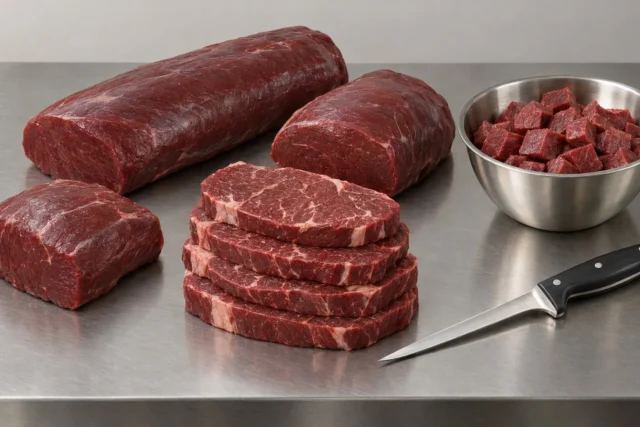
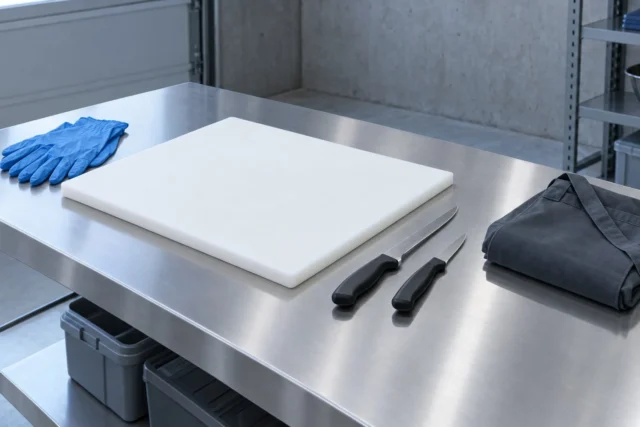
To butcher a pig at home, withhold feed 12 to 24 hours with water still available, stun and bleed the pig, hang it, then skin it or scald it at 145 to 150°F. Gut it without cutting the intestines, inspect the organs, rinse with a vinegar wash and chill it at 33 to 38°F or on ice for 24 hours (Purdue/SDSU). Never work alone.
These steps come from At-Home Hog Slaughter (AS-671-W, June 2020), written by Purdue Extension and South Dakota State University; SDSU keeps a web version updated in October 2023. The legal and food-safety points come from the University of Illinois Extension home slaughter FAQ (May 2020), and cooking temperatures from USDA FSIS. Both universities warn that this job carries real risk, so read the next section before you start.
Should You Butcher a Pig at Home?
Purdue/SDSU puts it plainly: “If not done correctly, this process can pose significant risks to personal safety, animal welfare and meat safety.” It asks you to check four skills first:
- Animal handling: humane handling and the ability to restrain the pig or keep it in a small area.
- Firearms: safe, accurate handling so the stun is proper and humane.
- Knives and saws: sharpening and handling them with confidence. A dull knife poses more danger than a sharp one, because it takes more pressure to cut.
- Patience: attention to every step that protects animal welfare and food safety.
Illinois Extension strongly recommends that a highly trained, skilled person lead the job, and says that without proper training, setup, equipment and facilities, personal safety and food safety risks may outweigh the benefits of home slaughter. It recommends a cutting glove on your non-cutting hand plus belly and wrist shields, and says having a local veterinarian on site is highly recommended. Purdue/SDSU adds: for safety reasons, do not perform home butchering alone.
On the legal side, Illinois describes a Producer’s Exemption under Illinois law: you must own the animal for 30 days before slaughter, slaughter it on your own property and eat the meat in your own household. You may not sell it; meat for sale has to come from a licensed, inspected facility. Rules differ by state, so check with your state’s agriculture department. The difference between custom exempt and USDA inspected meat explains the basics. If you would rather buy a hog than butcher one, see how to buy a whole hog.
Purdue/SDSU says a young, healthy pig weighing 240 to 300 pounds is ideal, because it produces the cuts and sizes most people want.
What You Need
Purdue/SDSU’s equipment list. Skinning needs less of it than scalding.
| Equipment | What it is for |
|---|---|
| .22 caliber rifle, sighted in for the range | Stunning; Purdue/SDSU says most people prefer a .22 caliber rifle for home butchering |
| Several sharp boning knives with 6-inch blades | Bleeding, skinning and gutting |
| Skinning knife or bell scraper | Removing the skin, or scraping hair after a scald |
| Clean fine-toothed bone saw, reciprocating saw or hacksaw | Head, breastbone, pelvis and splitting the carcass |
| Strong rope, chain or gambrel, and a tractor or pulley | Hoisting the carcass completely off the ground |
| Water source with a hose | Washing the animal, carcass and tools |
| 5- to 10-gallon container | Catching blood |
| 25- to 35-gallon tote or barrel | Organs and inedible parts |
| Four 48-quart or larger coolers with plenty of ice, or an empty, clean refrigerator | Getting the meat below 40°F as fast as possible |
| If scalding: a 55-gallon barrel or a 250-gallon tank cut in half, a heat source for about 150°F water and a propane torch | Scalding and singeing off hair |
| Gloves, hats and plastic aprons or garbage bags | Keeping you, and the carcass, clean |
| Packaging materials | Wrapping the cuts |
| A butcher buddy | Safety; never work alone |
Purdue/SDSU says to plan about one cubic foot of refrigerator or freezer space for every 20 pounds of meat, or 6 to 7 cubic feet for a hog. SaltRail’s arithmetic, not a source figure: Illinois’s top yield of 155 lb of bone-in cuts ÷ 20 is about 8 cubic feet, so check your freezer against both numbers before the day. Our roundups of the best chest freezer for meat, the best meat band saw for home use and the best knife for processing deer compare those tools.
How Do You Butcher a Pig, Step by Step?
This is Purdue/SDSU’s order, grouped into five stages. Each step gives the action, then the reason.
Before the Day
- Withhold feed 12 to 24 hours before slaughter, with plenty of clean water at all times. Purdue/SDSU says this reduces the chance of fecal contamination and makes gutting much easier.
- Check the weather. The cooler the temperature, the quicker the carcass chills, so Purdue/SDSU says to start early in the morning and avoid exceptionally hot days; wind can blow in dirt, debris and insects. Illinois is stricter: home slaughter should only take place when the outside temperature is below 40°F.
- Heat the water if you will scald. Fill a drum only half to two-thirds full, because the carcass displaces a lot of water, and bring it to about 150°F (Purdue/SDSU).
- Set up your stations in the order of the process, and clear any tractor loader of loose debris that could fall onto the carcass (Purdue/SDSU).
Stun, Bleed and Hang
- Move the hog into a small area where it cannot run from you and you can get a clear, close, accurate shot. A slight incline helps blood run away from the work area. Separate pigs and stun one at a time (Purdue/SDSU).
- Stun. Purdue/SDSU aims for the brain about 1½ inches above the eyes in the center of the forehead, not between the eyes, with the goal of one shot and a backup round ready. A properly stunned animal does not vocalize or blink when its eye is touched, its head hangs limp, and there is no rhythmic breathing. Leg kicking afterward is a nervous-system response, not a sign of consciousness.
- Bleed. Purdue/SDSU inserts the knife behind the end of the breastbone, pointed toward the tail, to sever the carotid artery. Always know where your knife is, because movement after the stun can be unpredictable.
- Hang. Use rope or chain behind the dewclaws, or a gambrel through the gambrel tendon, a pearly white tendon that runs from the toes to the hock. Do not cut into that tendon, or it may snap under the weight of the carcass. Rinse the carcass and scrub it with a bristled brush (Purdue/SDSU).
Skin or Scald
To skin, Purdue/SDSU says the job is similar to skinning a deer. Hold the knife in a “clean” hand and pull the hide with a “dirty” hand, and never switch them. Cut with the sharp side of the blade pointed up and away from the carcass so skin contaminants are not pushed into the meat. Cut around each leg above the knee or hock, follow the legs to the center, open the skin down the middle, then cut between skin and fat until it is off. Pulling the skin can be faster, but it can tear fat off and lower meat quality.
To scald, lower the carcass into 145 to 150°F water and keep it moving; if it sits near the heat source, the meat and skin will cook. After a few minutes, the hair should peel off easily. Hoist it out, scrape against the direction of hair growth with knives or bell scrapers, and singe any leftover hair with a propane torch held back from the skin. With no vat big enough, drape the carcass in old towels and pour the hot water over them (Purdue/SDSU).
Remove the Head, Gut and Inspect
- Remove the head at the base of the skull, with a saw or with a knife between the skull and first vertebra, then cut through the windpipe and esophagus above the Adam’s apple (Purdue/SDSU).
- On a barrow, remove the pizzle by cutting slightly off center so you do not cut into it and contaminate the carcass with urine (Purdue/SDSU).
- Loosen the bung. Cut about ½ to 1 inch around the anus without puncturing the rectum, then tie it off with string or a zip-tie to prevent fecal contamination (Purdue/SDSU).
- Open the belly from between the hind legs to the breastbone with the knife handle inside the cavity and the blade facing out, in one motion. Purdue/SDSU says: “It is critical to not remove your hand until you have made the full cut.” Stopping and restarting raises the chance of contamination.
- Remove the organs. Pull them down and out, cutting connective tissue as needed but never the intestines or stomach. Separate the esophagus from the windpipe at the diaphragm, then remove the heart, lungs and windpipe together. The abdominal cavity is lined with leaf fat, which can be used for lard (Purdue/SDSU).
- Inspect the organs. Feel the lungs for hard lumps, check the liver for small white lines or abscesses, and cut open the heart. If you keep the liver, remove the gallbladder (Purdue/SDSU).
Split, Trim, Rinse and Cool
- Split the carcass. Cut through the pelvic bone between the hind legs, using a saw if needed, split the breastbone, and saw down the backbone (Purdue/SDSU).
- Trim contamination. Cut off any dirt, hair, fecal matter or ingesta (Purdue/SDSU). Illinois lists fecal material, digestive contents and milk, and says to cut away any meat or fat they touched.
- Rinse. Spray the carcass with water, hot (about 150°F) if possible, from the hind legs toward the front, then spray it with a vinegar wash to help inhibit bacterial growth (Purdue/SDSU). The two universities mix the wash differently; see the table below.
- Cool. Hang the sides in a cooler set between 33 and 38°F, or cut them into pieces for iced coolers, as the chilling section shows (Purdue/SDSU).
SAFETY: Illinois Extension says bacteria grow and multiply easily above 40°F, and that because large cuts take time to chill, freezing is a safer choice than refrigerating. Purdue/SDSU says to get the meat below 40°F as fast as possible. Wash knives and saws often, preferably between strokes; Illinois recommends boiling water for sanitizing knives during slaughter. Cook pork chops, steaks and roasts to 145°F with a 3-minute rest, and ground pork to 160°F (USDA FSIS).
How Do You Chill a Whole Hog Without a Walk-In Cooler?
Purdue/SDSU says that without a cooler big enough for whole sides, you cut each side into four pieces that fit refrigerators or iced coolers:
- Shoulder: saw through the backbone and breastbone between the 2nd and 3rd ribs, counting from the head end, and through the shoulder blade, then finish with a boning knife.
- Ham: find the teardrop-shaped aitch bone and saw about 2 inches toward the head from it, through the last vertebrae and pelvic bone.
- Loin and belly: separate them along a line from the edge of the tenderloin at the ham end to a spot 1 to 2 inches toward the belly from where the ribs meet the backbone at the shoulder end.
Wrap each piece in plastic and put it into iced-down coolers for 24 hours, with 3 to 4 inches of ice on the bottom and space around each cut so the ice can work. Do not over-pack the coolers (Purdue/SDSU).
Once chilled, Purdue/SDSU says food kept frozen at 0°F will always be safe; for best quality, use raw ground meat within 3 to 4 months. Label and date every package. The folds are in how to wrap meat in freezer paper. For pressure canning stock (its sources cover beef and poultry bones only), see how to can bone broth.
Skin or Scald: Which Is Easier?
| Skinning | Scalding | |
|---|---|---|
| Hot water | Only enough to clean hands and tools | A barrel of about 150°F water; 145 to 150°F for the dip |
| Extra gear | Skinning knife | Barrel or tank, heat source, bell scraper, propane torch |
| Difficulty | Similar to skinning a deer | “Requires additional equipment and time, and is more challenging to properly complete than skinning” |
| Main risk | Pulling the skin can tear fat off | Meat and skin cook if the carcass sits near the heat |
All four rows come from Purdue/SDSU.
Where Do Purdue and Illinois Disagree?
| Point | Purdue/SDSU | Illinois |
|---|---|---|
| Outdoor temperature | Start early; avoid exceptionally hot days | Only when the outside temperature is below 40°F |
| Vinegar wash | 2% acetic acid: 1 gallon of white vinegar (most is 5%) to 1.5 gallons of water | 2.5% acetic acid: 5% vinegar diluted by half with water |
| Yield | More than half the live weight in hams, shoulders, loins, sausage and bacon (240 to 300 lb pig) | A 280 lb pig gives 135 to 155 lb of bone-in cuts or 95 to 115 lb boneless |
| Who should do it | Check four skills; never work alone | A highly trained, skilled person should lead; a vet on site is highly recommended |
SaltRail does not pick between the two vinegar mixes. For yields when a processor does the cutting, see how much meat you get from a half hog. To cook the shoulder, see how to smoke a pork shoulder. To cut the loin into chops, see how to cut pork chops.
What Signs Mean the Meat Should Not Be Eaten?
Purdue/SDSU’s organ check looks for hard lumps in the lungs, small white lines or abscesses on the liver, and anything else that appears suspicious, including inside the heart. Illinois says to look for obvious signs of disease on the head, the organs in the body cavity and the carcass. If you see any, Illinois says it is preferable not to use the carcass for human consumption, though a veterinarian may be able to examine it.
Common Problems and Fixes
Each fix comes from the Purdue/SDSU guide unless noted.
- Hair will not scrape off: pour more hot water on the carcass or dip it back into the vat, then singe what is left with the torch.
- The carcass will not fit in the vat: drape one side in old towels, pour hot water over them, wait a few minutes and scrape.
- An intestine was nicked: trim off any meat or fat the contents touched (Purdue/SDSU, Illinois).
- The gambrel tendon tore: it can snap if the cut goes into it, so expose it with a cut alongside, not across.
- Not enough cold space: cut each side into four pieces for iced coolers; Illinois says freezing is safer than refrigerating for large cuts.
What Do the Sources Not Say?
AS-671-W stops at four chilling pieces per side. Purdue says breaking the carcass into retail cuts is covered in later publications, which were not opened for this post; for cures, see how to cure bacon and how to dry cure a ham. No opened source covers aging pork at home. For offal disposal, Purdue gives Indiana’s rules only as an example, so check your own state’s rules.
Frequently Asked Questions
How long should a pig fast before butchering?
Purdue Extension and South Dakota State University say to withhold feed for 12 to 24 hours before slaughter while keeping plenty of clean water available. The fast reduces the chance of fecal contamination and makes gutting much easier.
What temperature should the scald water be for a hog?
Purdue/SDSU says to heat the water to about 150°F and dip the carcass at 145 to 150°F, keeping it moving so the meat and skin do not cook. After a few minutes the hair should peel off easily.
How much meat do you get from a pig?
Purdue/SDSU says a 240 to 300 lb pig yields more than half its live weight in hams, shoulders, loins, sausage and bacon. Illinois Extension says a 280 lb pig gives 135 to 155 lb of bone-in cuts or 95 to 115 lb boneless.
What temperature should home-butchered pork be cooked to?
USDA FSIS says to cook pork chops, steaks and roasts to 145°F and let them rest at least 3 minutes, and to cook ground pork to 160°F, measured with a food thermometer.
Can you sell pork from a pig you butcher at home?
Not under Illinois’s Producer’s Exemption, which covers meat eaten in your own household. Illinois says meat for sale must come from a licensed, inspected facility. Rules differ by state, so check with your state’s agriculture department.
If you would rather have a processor do the cutting, our guide to how much meat comes from a half hog shows what to expect. To butcher a goat at home, see how to butcher a goat. For wild pigs, see is wild hog meat safe to eat.
This is general guidance based on university extension and USDA FSIS recommendations. When in doubt, follow the sources linked above and your state’s rules.