
You check a meat thermometer in ice water. Fill a large glass with ice cubes, add drinking water, and stir. Put the stem at least 2 inches into the mix without touching the sides or bottom. Wait at least 30 seconds, then read it in the water. It should read 32°F.
After this guide, you’ll be able to check a dial or digital thermometer and adjust it if it’s off. If it can’t be adjusted, you’ll know how to work around the error. You’ll also see where USDA FSIS and University of Georgia Extension instructions differ, and how a small error changes a 160°F target.
What Do You Need to Calibrate a Meat Thermometer?
You need a short list of items, plus your thermometer’s manual. Two official instruction sets give slightly different wording for the same ice bath.
Gather the Ice, Water, Container, and Thermometer
- Ice: enough to fill a large glass.
- Drinking water: FSIS says to add drinking water to the ice.
- Container: a large glass, so the stem sits 2 inches deep without touching the sides or bottom.
- Thermometer: an analog dial or digital meat thermometer.
- Tool: a suitable tool for a dial’s calibration nut, if your thermometer has one.
Check Your Thermometer’s Range and Adjustment Instructions
Calibration is the process of checking a food thermometer’s accuracy against a known temperature, then adjusting it if the reading is off.
Read the manual before you start. Some types can’t be adjusted. FSIS notes that oven cord thermometers and thermometer forks cannot be calibrated.
Compare the USDA FSIS and UGA Ice-Bath Instructions
Both agencies agree on 32°F. They differ on prep and wait time. The UGA page is an extension news story dated Dec. 17, 2002, so check your own manual too.
| Point | USDA FSIS | UGA Extension |
|---|---|---|
| Preferred method | Ice water, best for most thermometers | Ice water, preferred |
| Prep | Large glass of ice cubes, add water, stir | 50/50 slush, at least half ice, water fills air gaps |
| Depth | At least 2 inches, no side or bottom contact | Whole sensing tip in the middle, no contact |
| Wait | At least 30 seconds | Until reading stops changing (5 to 10 minutes), then steady 3 full minutes |
| Target | 32°F | 32°F |
How Do You Check and Adjust a Thermometer With Ice Water?
Build the bath, read the thermometer, then adjust it. Dial thermometers use a nut; digital probes follow the maker’s steps.
Prepare the Bath and Take the Reading
- Pack a large glass with ice. UGA says the more ice the better, but water must fill the air spaces.
- Add cold water and stir well. Water fills the air spaces around the ice.
- Insert the stem at least 2 inches, centered.
- Keep the tip off the sides and bottom.
- Wait for the number to stop moving. UGA says this can take 5 to 10 minutes, then hold steady for 3 minutes.
- Read it with the stem still in the water.
Adjust an Analog Dial Thermometer
UGA says that if the dial does not read 32°F, turn the calibrating nut under the dial or face until it does. UGA also says to clean and sanitize the thermometer and its case before using it on food.
Check the Manual Before Adjusting a Digital Probe
UGA says digital thermometers have no calibration nut, but some have a means of calibration described on the package. If yours cannot be calibrated, UGA says to try changing the battery, and to replace the thermometer if it still reads wrong.
When Should You Use the Boiling Water Method?
FSIS lists boiling water for higher temperatures, and UGA gives it as the alternative to ice water. Confirm your local boiling point before you adjust anything.
Check Your Thermometer in Boiling Water
- Bring a pot of clean water to a full rolling boil. UGA says clean tap water; FSIS says distilled water must be used for true accuracy. The sources differ, so check your thermometer’s manual.
- Insert the stem at least 2 inches, off the sides and bottom.
- Wait at least 30 seconds and until the reading stops moving.
- Adjust, if needed, with the stem still in the water.
Confirm the Local Boiling Point Before Adjusting
Water boils at 212°F only at sea level. At high altitude, USDA FSIS says water boils at least 2°F lower and perhaps as much as 5°F lower. Ask your local Cooperative Extension office or health department for your exact number before turning the nut.
What if the Reading Still Looks Wrong?
Most bad readings trace to the bath, a slow sensor, a fixed thermometer, or probe placement.
The Ice-Bath Reading Is Unexpected
Check that the glass holds a 50/50 slush with at least half ice, and that the tip isn’t touching the glass.
The Reading Will Not Stabilize
Give it time. UGA says the reading may take 5 to 10 minutes to stop changing, then it should hold for 3 full minutes.
The Thermometer Cannot Be Adjusted
UGA says to take small errors into account and to replace the thermometer if it is more than a few degrees off. Its example: a thermometer that reads 214°F in boiling water is 2°F high, so cook ground beef patties, which must reach 160°F, to 162°F.
The Bath Check Passes but Meat Readings Seem Wrong
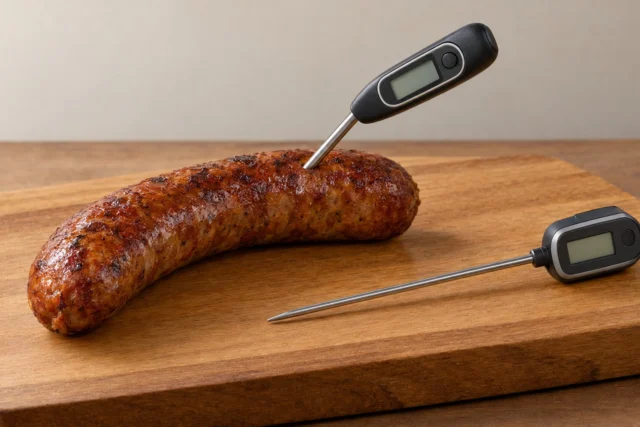
Check placement. FSIS says to put the tip in the thickest part of the food, away from bone, fat or gristle. SaltRail posts that depend on an accurate probe include how to cure bacon, venison summer sausage, deer jerky in a dehydrator and smoking sausage in an electric smoker.
SAFETY: USDA FSIS lists 165°F for poultry, and UGA gives 160°F for ground beef patties. FSIS says most food thermometers read within 2 to 4°F of true, so a thermometer that reads high can leave food short of these numbers.
Meat Thermometer Calibration: Quick Answers
How often should I calibrate my meat thermometer?
No source we opened gives a calibration schedule. UGA says to calibrate before checking temperatures, but neither it nor USDA FSIS says how often.
Does calibration differ for instant-read thermometers and leave-in probes?
The ice-bath check is the same for both: 2 inches deep, no contact, 32°F. The difference is adjustment. UGA says many food thermometers have a calibration nut and some digitals describe calibration on the package, while FSIS says oven cord thermometers and thermometer forks cannot be calibrated. Compare options in our meat thermometers for sausage and jerky roundup.
Is the ice water method accurate at high altitude?
UGA Extension calls the ice method “very accurate no matter where you live” and FSIS lists ice water as best for most thermometers. Altitude changes the boiling point of water, which is why the boiling method needs a local number.
What does a 4°F error mean when my thermometer reads 160°F?
Here’s the arithmetic. If your probe reads 4°F high in ice water, a display of 160°F means the food is only 156°F. That is 4°F short of 160°F. This is arithmetic, not a source claim. UGA says to replace a thermometer that is more than a few degrees off.
For a thermometer built for the job, see our meat thermometers for sausage and jerky roundup.