Applewood is the most-recommended starting point for smoking bacon, and hickory is also named as appropriate. Oregon State University Extension says applewood is often recommended for pork, with cherry and pecan also good, and hickory, mesquite and maple appropriate. Use any of these hardwoods. Keep pine and other resinous softwoods out of the smoker.
By the end, you can pick a wood with confidence, match it to your smoker, and read a store label the right way. You also get a wood-by-wood table drawn from four extension and meat science sources, a clear list of what those sources leave unranked, and a fix for each common smoke-flavor problem. None of it is invented flavor scoring.
Which Hardwoods Do the Sources Recommend?
The four sources that name woods all name hardwoods, and most name the same short list. The comparison table shows who names which wood. After it come the applewood vs. hickory question, what store labels mean, and the questions no source settles.
Compare the Woods Named by Extension and Meat Science Sources
Fruit woods, nut woods and classic hardwoods all appear on the sources’ lists. For bacon, Oregon State Extension says applewood is often recommended for pork, with cherry and pecan also good choices. The same guide calls hickory, mesquite and maple appropriate.
Mississippi State University Extension, in its home pork-curing guide, lists hickory, oak, maple, ash and mesquite as hardwoods to use. The American Meat Science Association lists hickory, mesquite, alder, maple, oak, cherry, poplar, apple and beech as hardwoods. It classes pine, cedar and spruce as softwoods.
| Wood | Who names it | What the source says |
|---|---|---|
| Apple | OSU, SDSU, AMSA | OSU: “often recommended for pork” |
| Cherry | OSU, SDSU, AMSA | OSU: “also good” |
| Pecan | OSU | OSU: “also good” |
| Hickory | OSU, SDSU, MSU, AMSA | OSU: “appropriate”; MSU lists it first |
| Maple | OSU, SDSU, MSU, AMSA | OSU: “appropriate” |
| Oak | MSU, AMSA | MSU: a hardwood to use |
| Mesquite | OSU, MSU, AMSA | OSU: “appropriate” |
| Alder | AMSA | Listed as a hardwood |
| Pine, cedar, spruce | MSU (pine), OSU (conifers), AMSA | Avoid (MSU); bitter conifer smoke (OSU) |
Hickory and maple are the only woods all four sources name. Applewood is the only named wood with a pork-specific recommendation (Oregon State). MSU also names ash, and AMSA also lists poplar and beech.
Applewood or Hickory: What Difference Do the Sources Describe?
The sources describe the difference as a matter of taste. South Dakota State University Extension answers this exact question. It says pork is milder than beef, so hardwoods with lighter flavors are generally chosen to avoid overpowering the meat.
SDSU also says each wood gives bacon a slightly different flavor, and the choice is up to you. It does not call hickory too strong or applewood too weak.
| Applewood | Hickory | |
|---|---|---|
| Named by OSU | Yes, “often recommended” | Yes, “appropriate” |
| Named by MSU | No | Yes |
| On SDSU’s label list | Yes | Yes |
| Source verdict | Personal preference | Personal preference |
What Do Applewood-Smoked and Hardwood-Smoked Labels Mean?
A wood name on a bacon package tells you which smoke flavor the maker advertises. SDSU lists hickory, apple, maple and cherry as common smoke types on US bacon packaging.
Smoked flavor on store bacon comes from two routes. USDA FSIS says bacon gets its smoke flavor from smoldering wood chips or from a sprayed liquid smoke extract. FSIS also lists wood smoke among bacon additives.
Liquid smoke is a smoke extract sprayed on meat to add smoke flavor without burning wood in a smoker. It is a commercial option. This guide covers real wood at home.
What Do the Sources Leave Unranked?
No source scores flavor strength or puts one wood against another in a side-by-side trial. Several practical questions get no answer from any of them:
- How much wood to use per load
- Whether to soak chips
- How dry or seasoned the wood should be
- Whether blends work better than one species
- How long to apply smoke
Any page that ranks woods on a 1-to-10 scale is offering opinion. Treat those numbers that way.
What You Need Before Loading the Smoker
You need a cured belly, the right fuel format for your smoker, and a clean line between flavor and safety. Avoiding softwoods comes last.
Start With Properly Cured Pork Belly
Bacon is cured pork belly, so the cure comes before any smoke. In these sources, wood choice is a flavor decision; the safety steps sit in the cure and cook process.
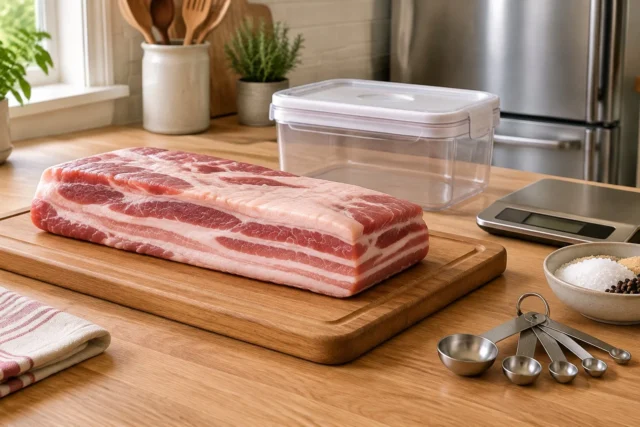
Weigh the belly and the cure. Cure amounts depend on belly weight and the cure product, so use a researched recipe and a gram scale. Our step-by-step bacon cure shows the math, and a scale built for curing meat reads small cure amounts accurately.
If you plan to skip curing salt, read up on making bacon without nitrite before you start.
Match Pellets, Chips, Sawdust or Logs to Your Equipment
Fuel format follows your smoker. Oregon State says all types of commercial wood pellets are suitable for smoking bacon. Mississippi State says natural wood smoke comes from hardwood sawdust, wood chips or logs. For tubes that add pellet smoke on a pellet grill, see best smoker tube for pellet grill.
| Smoker type | Fuel format |
|---|---|
| Pellet smoker | Commercial hardwood pellets (OSU) |
| Electric smoker | Wood chips or sawdust (MSU) |
| Charcoal or offset smoker | Wood chunks or logs (MSU names logs) |
The sources name the formats only. Matching them to smoker types is SaltRail’s suggestion, and no source names a flavor difference between formats. Pick the species first, then buy it in the form your smoker burns. Electric smoker owners can borrow the setup from our guide to smoking sausage in an electric smoker.
SAFETY: Keep Wood Choice Separate From Safe Curing and Cooking
SAFETY (USDA FSIS): Wood choice does not replace a researched cure. FSIS says to keep raw bacon refrigerated at 40°F or below and use it within 7 days, or freeze it at 0°F. Follow a researched cure and cook process for internal temperatures.
Use a meat thermometer to track the belly’s internal temperature.
Which Woods Should Stay Out of the Smoker?
Pine, cedar, spruce and other resinous softwoods stay out. Mississippi State says not to use resinous woods such as pine or other softwoods. Oregon State says conifer smoke can leave a bitter taste. For a whole turkey in the smoker, see how to smoke a turkey. For ham, see how to smoke a ham.
How Do You Put the Wood Choice Into Practice?
Pick applewood, confirm what you bought, and run your smoker by its manual. Each step below gives the action, then the reason.
Step 1: Choose Applewood as a Starting Point, Not a Universal Winner
- Buy applewood for your first batch. It is the only wood Oregon State calls often recommended for pork.
- Try hickory or cherry on a later batch. Both appear on the sources’ lists, and SDSU leaves the choice to you.
- SaltRail’s suggestion: change one thing at a time, so you know which change you tasted.
Step 2: Confirm the Wood Species and Fuel Format
- Read the bag for the species name. A named hardwood matches the source lists.
- Check the format against your smoker. A pellet grill needs pellets, and an electric smoker takes chips or sawdust.
- Reject anything with pine, cedar or spruce in it. Oregon State says conifer smoke can leave a bitter taste.
Step 3: Follow Your Equipment Instructions and a Separate Bacon Process
- Load and light the wood the way your smoker’s manual says. Fire management differs by smoker design, and no source gives a universal wood amount.
- Run the cure and cook steps from a researched bacon recipe. Wood choice changes flavor, and the recipe covers safety.
- Chill, slice and store the finished slab. A chest freezer sized for meat holds sealed bacon at 0°F.
Troubleshooting Your Wood Choice
Three wood problems come up often: a softwood, a heavy hand, or doubt about which hardwood to pick. Each has a plain fix.
Conifer Smoke Tastes Bitter: Replace It With a Recommended Hardwood
Oregon State says conifer smoke can leave a bitter taste, so check the fuel for softwood first.
Switch to a named hardwood such as apple, cherry, hickory or maple. Check mixed bags for pine, cedar or spruce before your next load.
Smoke Overpowers the Pork: Consider SDSU’s Lighter-Wood Advice
When smoke drowns out the pork, try a lighter wood. SDSU says lighter hardwoods are generally chosen because pork is mild, but it does not say which woods are lighter.
SaltRail’s suggestion: if hickory or mesquite tasted too strong to you, try applewood, the wood Oregon State calls often recommended for pork. Keep the cure the same so the wood is the only change.
Applewood or Hickory Still Seems Unclear: Choose by Preference, Not Rankings
Pick the one you like on store bacon. SDSU leaves the decision to you, and no source ranks the two.
SaltRail’s suggestion: buy a pack of each store label, cook them side by side, and smoke your own belly with the one you prefer.
Frequently Asked Questions
Is applewood or hickory better for smoking bacon?
Neither wins on the evidence. Oregon State calls applewood often recommended for pork and hickory appropriate, and SDSU says the choice is yours. Start with applewood, the one Oregon State calls often recommended for pork, then try hickory to compare.
What does applewood-smoked bacon taste like?
None of the sources here describes applewood’s flavor in detail. SDSU says lighter hardwoods are chosen for pork so the meat is not overpowered, and apple is one of the common woods named on bacon packaging.
Can you smoke bacon with pine or cedar?
No. Mississippi State says not to use resinous woods such as pine or other softwoods, and Oregon State says conifer smoke can leave a bitter taste. The American Meat Science Association classes pine, cedar and spruce as softwoods.
Can you use wood pellets for smoking bacon?
Yes. Oregon State says all types of commercial wood pellets are suitable for smoking bacon. Choose a bag that names a hardwood species such as apple, cherry or hickory, and use it in a smoker built for pellets.
Is mesquite too strong for bacon?
No source calls it too strong. Oregon State lists mesquite as appropriate for bacon. SaltRail’s suggestion: smoke a first batch with applewood, then try mesquite so you have a baseline to compare.
This is general guidance based on USDA recommendations. When in doubt, follow the USDA FSIS source linked above.
Your next step is the cure: our bacon curing guides walk you from raw belly to a slab ready for the smoker.