
As an Amazon Associate I earn from qualifying purchases.
Dry aging turns a good beef subprimal into something richer and more tender. Mastering the dry aging process requires steady cold, precise temperature regulation, and constant airflow.
The VEVOR 232 LBS Dry Aging Fridge is the most compact cabinet here: its maker page lists 34-77°F, 60-85% humidity and 6.07 cubic feet in a 50-inch-tall body. This post compares listed specs; it is not a safety endorsement of aging at home.
Commercial dry-aging limits for carcasses call for a cooler held at 41°F or colder for the six-day period and equipped with a fan to create air movement (UW-Madison Center for Meat Process Validation). That describes commercial carcass aging, not home primals.
Before buying, check usable capacity, footprint, and air filtration.
Before you buy
USDA FSIS: “Beef is aged to develop additional tenderness and flavor. It is done commercially under controlled temperatures and humidity. Since aging can take from 10 days to 6 weeks, USDA does not recommend aging beef in a home refrigerator.” (FSIS, Beef From Farm to Table)
How we ranked these
SaltRail did not run these cabinets. We compared each cabinet’s listed temperature and humidity range, capacity, power use, footprint and warranty from the maker page where one exists and the Amazon listing where not, and labelled which is which. We did not rank them on how safe home aging is: USDA does not recommend aging beef in a home refrigerator. Commission rates play no part in the order.
Best Dry Aging Fridges
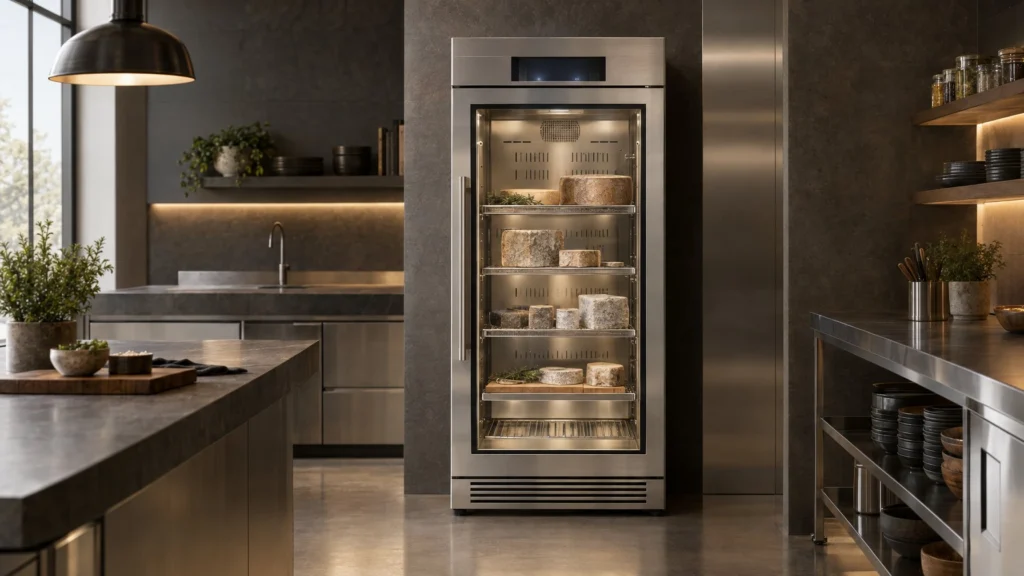
Best for most home dry agers: VEVOR 232 LBS Dry Aging Fridge
Best for large batches: VEVOR 298 LBS Dry Aging Fridge
Best for under-counter installs: Ca’Lefort 209 LBS Dry Ager
Best for odor and air control: KoolMore KM-AGER17
Best for butcher shops and restaurants: Everest EDA1
| Pick | Best for | Key spec | Listed spec |
|---|---|---|---|
| VEVOR 232 LBS | Most home users | 19.3″ W x 50″ H | 34–77°F, 60–85% RH |
| VEVOR 298 LBS | Large home batches | 4 shelves, lock | 298 lb load, 15.01 cu ft listed |
| Ca’Lefort 209 LBS | Built-in kitchens | 34.3″ tall | Amazon cites 1°F hold, inverter compressor |
| KoolMore KM-AGER17 | Odor control | Charcoal filter + UVC | 194 lb usable, 30–80% RH (per Amazon) |
| Everest EDA1 | Commercial use | NSF per Amazon | 22 cu ft, NSF per Amazon, 5-year compressor per Amazon |
VEVOR 232 LBS Dry Aging Fridge
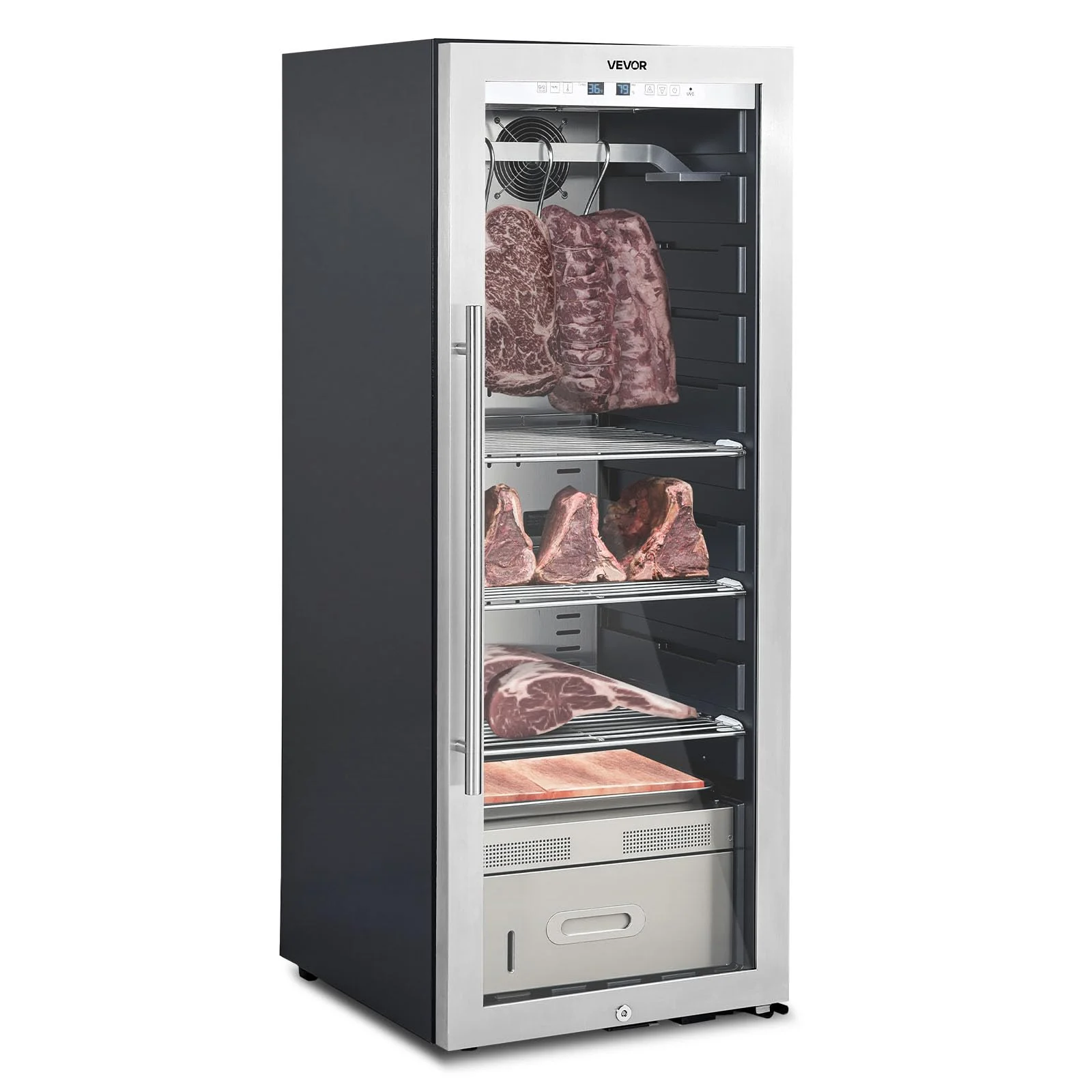
Buy this if you want a compact dry ager for beef roasts, salami or cheese at home.
Pros
- Owners generally praise the temperature and humidity control, though some report moisture pooling (VEVOR’s page summary)
- Small footprint at 19.3″ wide
- 304 stainless food-contact parts
Cons
- Salt block sold separately
VEVOR rates it at 34 to 77°F and 60 to 85% humidity, with three shelves rated at 66 lb each and hooks at 11 lb each. The listing gives 6.07 cubic feet of interior space.
VEVOR also lists a 99 lb model (3.88 cu ft, same 34-77°F range).
VEVOR lists a glass door and a UVC sterilizer, and the cabinet has a lock.
The interior is 304 stainless steel.
Skip it if you need more than the listed 6.07 cubic feet.
VEVOR 298 LBS Dry Aging Fridge
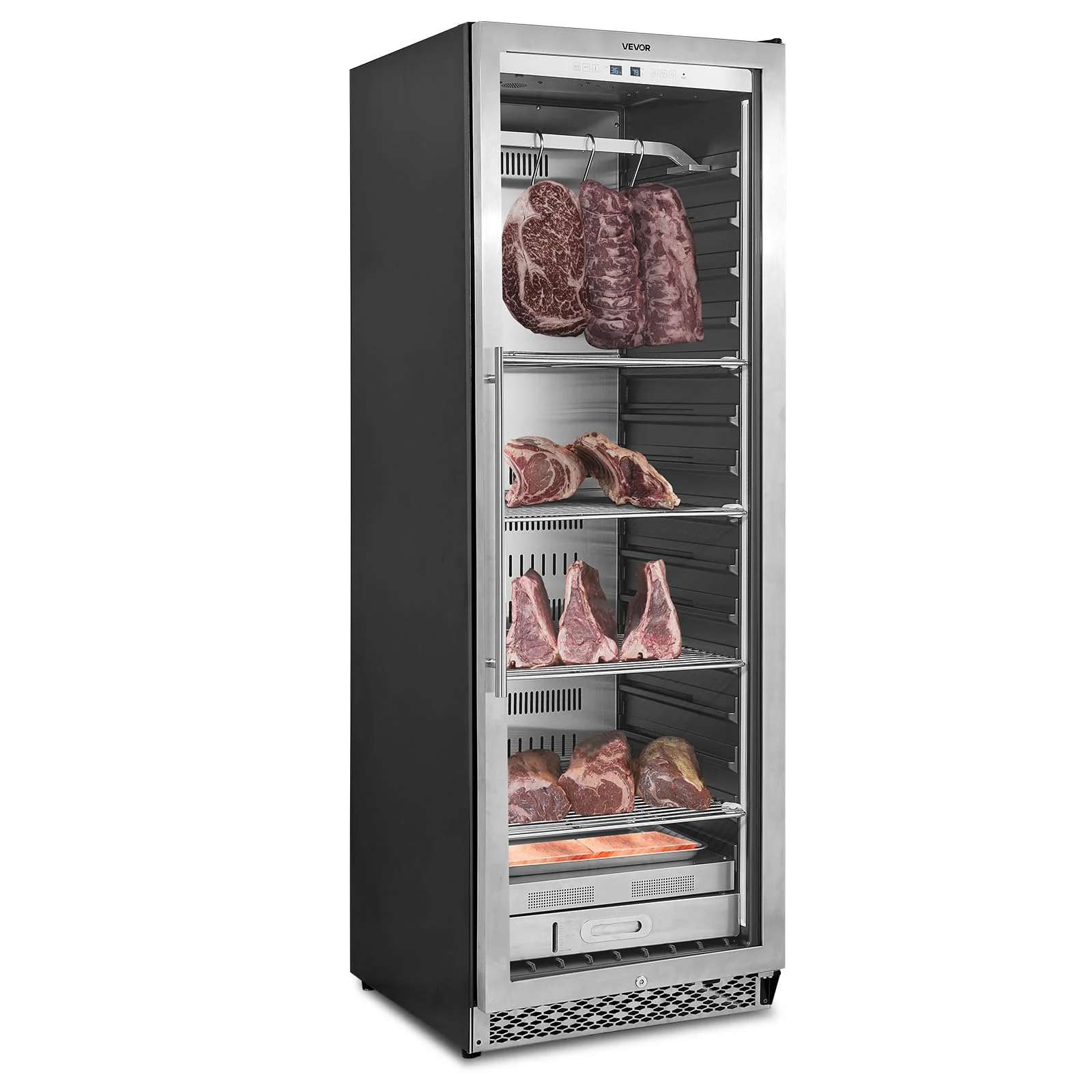
Pick this taller VEVOR when you need more shelf space per batch (298 lb listed capacity).
Pros
- Four shelves and a 298 lb rated load
- Air circulation fan and door lock
- Freestanding or built-in install
Cons
- Listed at 71.6″ tall and 211.6 lb
- Salt block sold separately
It shares the smaller model’s 34 to 77°F and 60 to 85% humidity range. VEVOR lists 15.01 cubic feet, and the cabinet measures 23.5″ W x 26.8″ D x 71.6″ H.
Skip it if your space can’t handle a near-6-foot cabinet.
Ca’Lefort 209 LBS Dry Ager
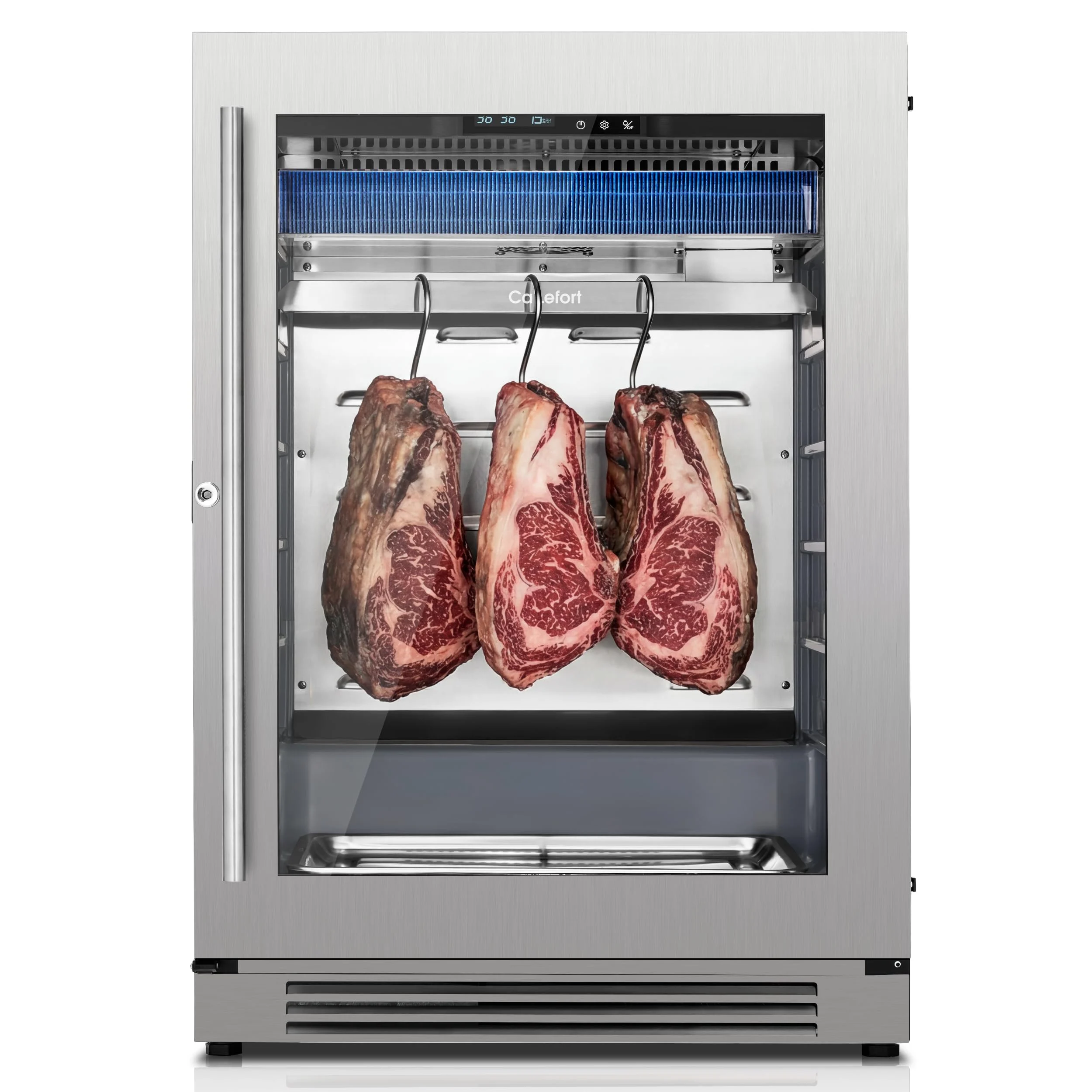
Choose this one if you want a dry ager that slides under a counter and shows off the meat. The Ca’Lefort dry age fridge is engineered specifically for sleek under-counter installations.
Pros
- 34.3″ tall, built-in rated
- Amazon’s listing cites a 1°F hold with an inverter compressor
- Dual-pane low-e glass door
Cons
- Only 3.78 cubic feet inside
- One shelf included
- Sources disagree on the compressor warranty (3 or 5 years); confirm with the seller
Ca’Lefort rates it at 34 to 77°F and 60 to 85% humidity, with a 360° fan, a lock, door and temperature alarms, and an ETL listing (per Amazon). Ca’Lefort lists 384 kWh a year; Amazon shows 200. It ships with a hanger, three hooks, a salt tray and one shelf.
The door is dual-pane low-e glass.
Sources disagree on the compressor warranty (3 or 5 years); confirm with the seller. Skip it if you need more than the listed 3.78 cubic feet.
KoolMore KM-AGER17
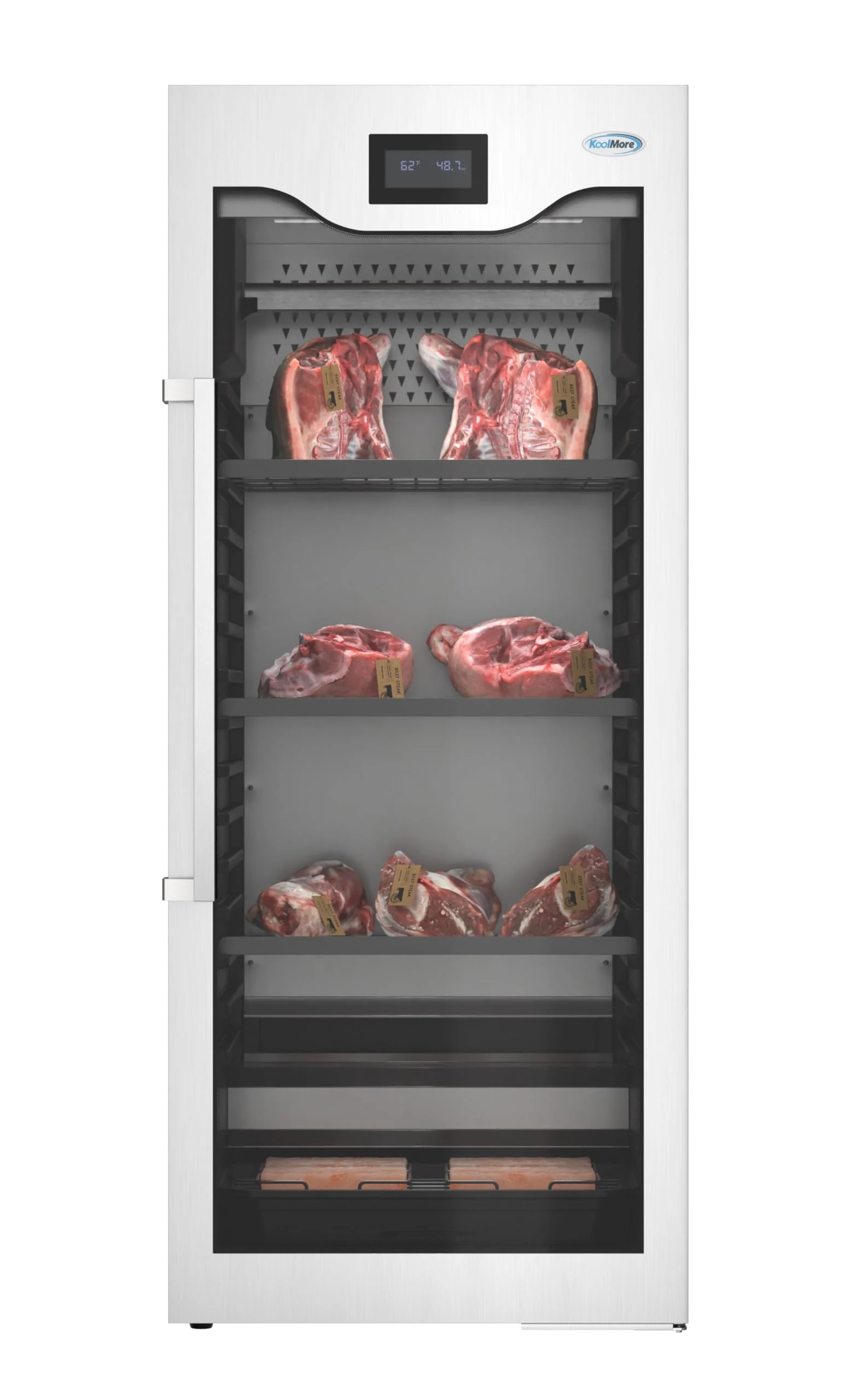
Get this if you age in a shared space and want strong air purification built in.
The listing describes carbon filtration and a UVC sterilizer. It is worth a look if odor control matters.
Pros
- Activated carbon filter and UVC sterilizer
- 194 lb usable capacity (per Amazon)
- Salt pieces included
Cons
- 984.77 kWh per year (per Amazon)
- 269 lb and 31.9″ deep (per Amazon)
- 1-year parts and labor warranty
Amazon lists 32 to 77°F, 30 to 80% humidity and 17 gross cubic feet, and lists it as ETL. It comes with a hanger, two swivel hooks, three shelves and four salt pieces. The anti-condensation glass door lets you check the bark without opening it.
Two casters help you move it, but the left-hinged door needs clearance. Skip it if power cost is a concern.
Everest EDA1
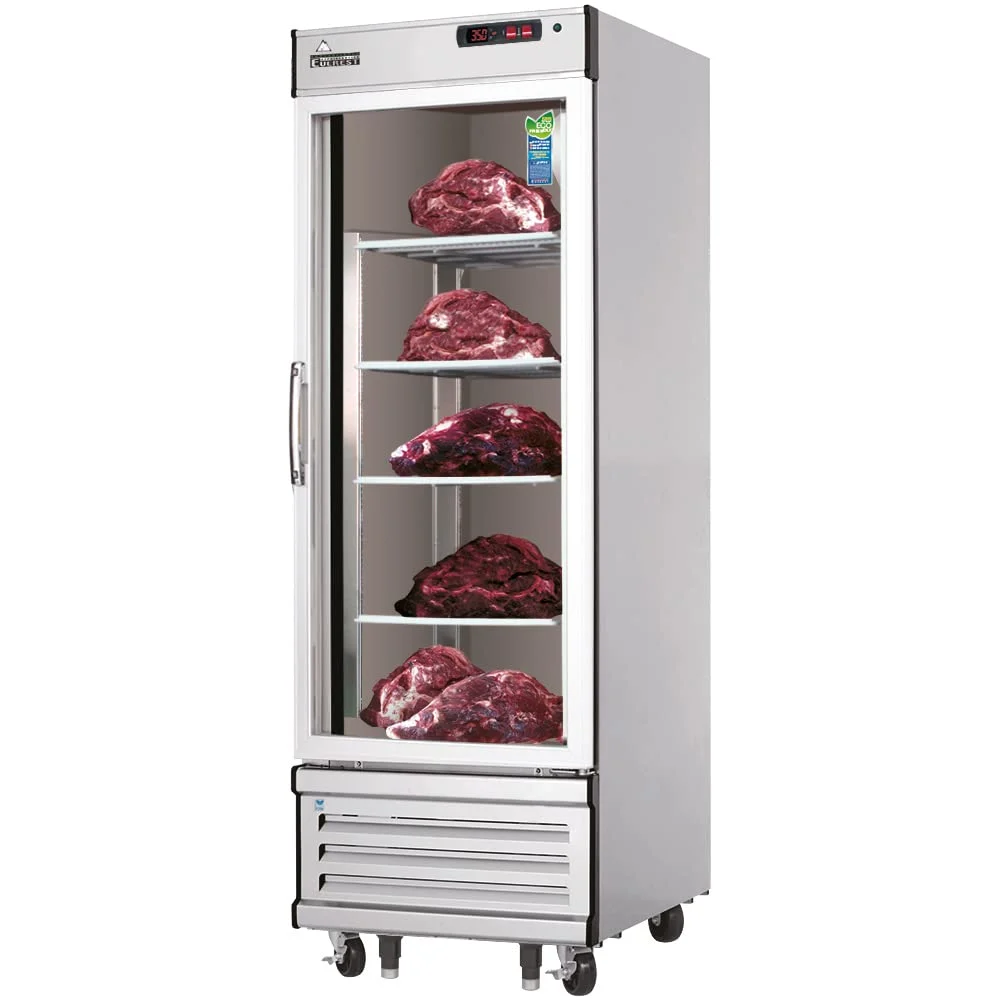
This is a commercial cabinet for shops and restaurants that sell dry-aged meat.
Pros
- Listed as NSF on Amazon
- 22 cubic feet with dry aging and thawing modes
- 3-year parts and labor, 5-year compressor (per Amazon)
Cons
- 29.25″ wide, 33.1″ deep, 77″ tall (82″ with casters)
- Built for commercial spaces
Everest uses a slide-out R290 cooling cartridge that swaps without on-site brazing. In a commercial kitchen, a fast compressor swap keeps a case of primals from going to waste. The cabinet has an electronic lock and a swing glass door.
Everest claims dry-aged results in 7 days. Treat that as a maker claim. Skip it unless you run a business with an NSF requirement.
Buying Guide
How we researched
We compared maker pages where one exists and Amazon listings where not. We read owner reviews on Amazon and maker sites. Premium units such as the Dry Ager DX 500 and the SteakAger PRO 40 sit in a different price tier and are not compared here. SaltRail did not run these fridges in-house.
Five specs that decide the job
- Temperature range. Tight temperature control, efficient compressor cooling, and dependable temperature stability are vital. FSIS says to keep cold food at or below 40°F; bacteria grow most rapidly between 40°F and 140°F and can double in as little as 20 minutes.
- Humidity range. Check the listed humidity range. We found no USDA or university source that gives a home-cabinet humidity setting.
- Display and controls. Check whether the screen shows live readings. Verify with your own sensor either way.
- Footprint. Measure width, depth, height and door swing. Tall units range from 50 to 77 inches.
- Airflow and filtration. A fan is part of the commercial dry-aging limits above. Built-in activated carbon filtration and UVC sterilization are listed on some units.
Listed temperature range against the 40°F line
| Cabinet | Listed range | Highest setting vs FSIS 40°F cold-hold line | Source |
|---|---|---|---|
| VEVOR 232 lb | 34-77°F, 60-85% RH | can be set far above 40°F | VEVOR maker page |
| VEVOR 298 lb | 34-77°F, 60-85% RH | same | VEVOR maker page |
| Ca’Lefort 209 lb | 34-77°F, 60-85% RH | same | Ca’Lefort maker spec tab |
| KoolMore KM-AGER17 | 32-77°F, 30-80% RH | same | per Amazon listing |
Every cabinet here can be set well above 40°F, the point FSIS gives for keeping cold food cold. A listed range describes what the machine can do, not what is safe.
Who this is not for
If you want USDA-backed guidance, the agency does not recommend aging beef in a home refrigerator. If you only want a tender steak, buying beef the shop has already aged avoids the question. If you have no space for a dedicated cabinet, none of these is a small purchase. Nothing here covers wild game, which this post does not research.
Raw-meat safety callout
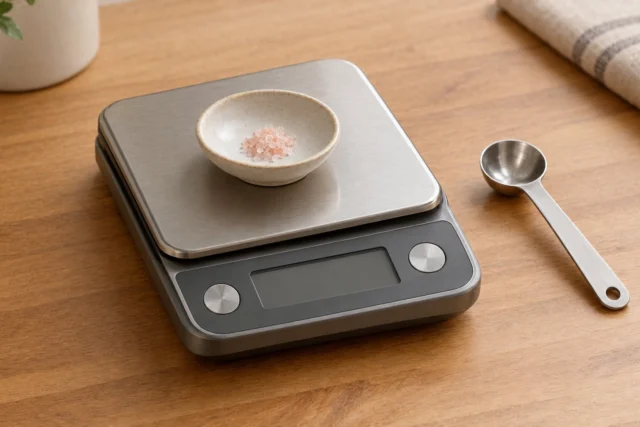
USDA does not recommend aging beef in a home refrigerator (FSIS). FSIS says to keep cold food at or below 40°F, and that bacteria grow most rapidly between 40°F and 140°F (FSIS). If you cure salami, weigh curing salt precisely on a scale built for curing meat, and check finished sausage with meat thermometers suited to sausage and jerky.
SaltRail’s processing guides cover trimming and packaging after aging, so you can plan the full job before the meat goes in.
Frequently Asked Questions
Do you need a special fridge for dry-aging meat?
USDA does not recommend aging beef in a home refrigerator. Commercial dry-aging limits for carcasses call for a cooler at 41°F or colder with a fan for air movement. A dedicated cabinet lists a set range and a fan, but a listed range describes what the machine can do, not what is safe.
What should you look for in the best dry aging fridge for home use?
Compare the listed temperature and humidity range, capacity, footprint, door clearance, power use and warranty. A fan is part of the commercial dry-aging limits. A listed range describes what the machine can do, not what is safe.
Which small dry aging fridge fits a home kitchen?
The Ca’Lefort 209 lb model fits best at 34.3 inches tall and built-in rated. The VEVOR 232 lb model is narrower at 19.3 inches but stands about 50 inches tall.
How do the VEVOR 232 lb and 298 lb dry aging fridges compare?
The 298 lb model adds a fourth shelf and much more interior space. Both share the same 34 to 77°F and 60 to 85% humidity range. VEVOR also lists a 99 lb model (3.88 cu ft, same 34-77°F range).
What should you check before buying a dry aging cabinet?
Check the warranty terms, whether salt is included and if the display shows live readings. Measure door clearance.
Where can you buy a dry-aging refrigerator?
All five picks here are sold through Amazon in the US. Check today’s price and the seller’s warranty terms on each listing before you order.