
Many shoppers ask: is buying a half cow worth it for an average family? Buying half a cow is worth it when your all-in cost per packaged pound beats retail prices for the same mix of cuts, and when your household eats all of it. For planning, expect roughly 140 lb of take-home beef per quarter from a 1,300 lb animal, or about 280 lb for a half; smaller animals yield less.
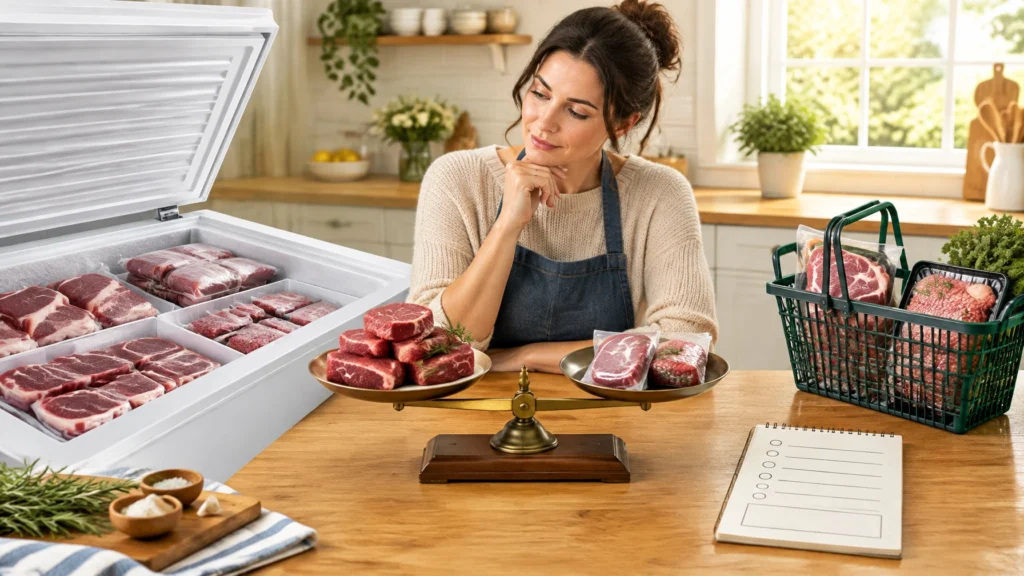
Bulk beef buying can deliver meaningful cost savings, but it requires upfront planning. What makes a half cow worth it is securing steady access to high-quality beef while avoiding retail markups. When evaluating is buying half a cow worth it, comparing the true half cow cost against regular grocery spending is essential.
Purchasing directly from local farmers allows families to support regional agriculture while securing nutritious cuts for the entire year.
After reading, you will be able to turn a farm quote into a true price per pound and compare it with a weighted grocery basket. You will also be able to size a freezer by cubic feet and plan your weekly use.
The guide includes USDA storage numbers, cut sheet trade-offs, and fixes for low yield or damaged packages. It also covers hidden costs like electricity, transport, and meat that goes unused.
How Much Will You Actually Pay per Pound?
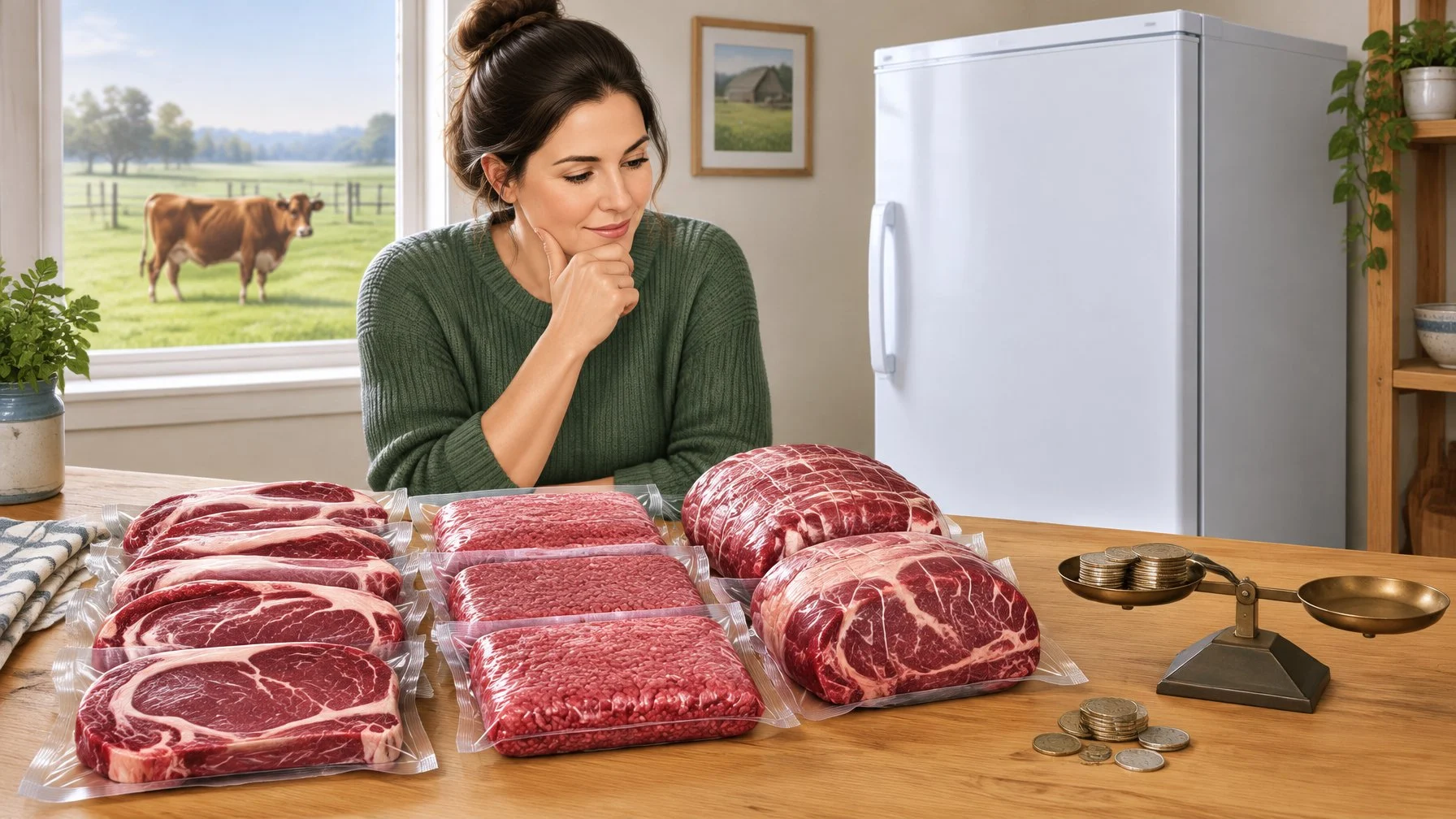
When buying a half cow, also referred to as a side of beef, your real price depends on four things. You need to know how farms weigh the beef, how to add up every fee, and how the result compares with store prices. It also depends on how fast your household eats the beef.
Determining whether is buying a half cow worth it requires calculating total upfront expenses against real grocery store alternatives.
What Is the Difference Between Live Weight, Hanging Weight, and Take-Home Weight?
Farms quote three different weights, and each one gives a different price per pound.
Hanging weight is the carcass weight after the head, hide, and organs are removed, measured before the beef is aged, trimmed, and cut.
| Weight | What it measures | Why it matters to you |
|---|---|---|
| Live weight | The animal before slaughter | Some farms price the animal this way |
| Hanging weight | The carcass after harvest | Most processing fees are based on this |
| Take-home weight | Packaged, frozen beef | This is what you eat and store |
You can estimate hanging weight from live weight. MU Extension shows a 1,100 lb steer at an average dressing percentage of 62% gives about 682 lb hanging weight. Take-home weight drops further after bone, fat, and moisture loss. Boneless cuts and lean ground beef lower it more.
K-State’s consumer guides explain why returns are less than the hanging weight you paid for. Read them before you assume the processor kept your meat.
How Do You Calculate the All-In Half Cow Cost?
Add every charge, then divide by the take-home weight. That number is the only fair basis for comparison. Your total half cow cost includes the meat itself plus slaughter, cut, and wrap fees.
Hypothetical example (not a real quote):
- Price the beef. 350 lb hanging × $5/lb = $1,750.
- Add processing. 350 lb × $1/lb = $350.
- Add other fees. Slaughter, disposal, and vacuum packing come to $100.
- Total it. $1,750 + $350 + $100 = $2,200.
- Divide by take-home weight. $2,200 ÷ 220 lb = $10 per packaged pound.
Ask for these numbers in writing. South Dakota State Extension notes that processors add charges for vacuum-sealed packaging, extra lean ground beef, keeping organ meats, or making patties. Each extra raises your per-pound cost.
Substantial cost savings happen when your blended price per pound beats retail prices for middle-meat cuts and roasts.
Does the Same Mix of Cuts Cost Less at the Grocery Store?
Sometimes it does. Price the same basket at retail before you commit.
The table uses advertised feature prices from the USDA AMS weekly grocery beef report dated October 16, 2026. These are sale prices for conventional beef, so treat them as a low benchmark.
| Cut group (hypothetical 220 lb mix) | Pounds | Retail feature price | Basket cost |
|---|---|---|---|
| Ground beef 80–89%, 2–4 lb packs | 100 | $4.90/lb | $490.00 |
| Boneless chuck roast | 50 | $7.01/lb | $350.50 |
| Boneless strip steak | 45 | $12.47/lb | $561.15 |
| Stew meat and other cuts | 25 | $8.46/lb | $211.50 |
| Total | 220 | $7.33/lb avg | $1,613.15 |
In this example, the $10/lb share costs more than conventional sale prices. The math changes if you compare against premium grass-fed beef or antibiotic-free beef. The same report lists boneless antibiotic-free ribeye at $21.99/lb, and that is a closer match for many farm shares.
Securing steady access to high-quality beef at a flat per-pound rate often generates impressive cost savings over retail specialty counters. If you regularly purchase grass-finished beef from specialty grocers, a beef share provides substantial savings.
Then add the costs that don’t show on the quote. Count a freezer purchase, its electricity, your fuel to the processor, and any meat you throw away.
How Much Beef Will Your Household Use Before Quality Declines?
Buy only what you can eat within your best-quality window. MU Extension advises estimating what your family can eat in three to six months. Divide your take-home weight by the number of weeks you plan to use it.
| Take-home weight | Use in 6 months | Use in 9 months | Use in 12 months |
|---|---|---|---|
| 110 lb (quarter) | 4.2 lb/week | 2.8 lb/week | 2.1 lb/week |
| 220 lb (half) | 8.5 lb/week | 5.6 lb/week | 4.2 lb/week |
| 280 lb (large half) | 10.8 lb/week | 7.2 lb/week | 5.4 lb/week |
Track one normal month of grocery receipts. If you buy 3 lb of beef a week, a half will outlast its best quality, and a quarter cow fits better.
What Cuts Will You Get, and Will You Use Them?
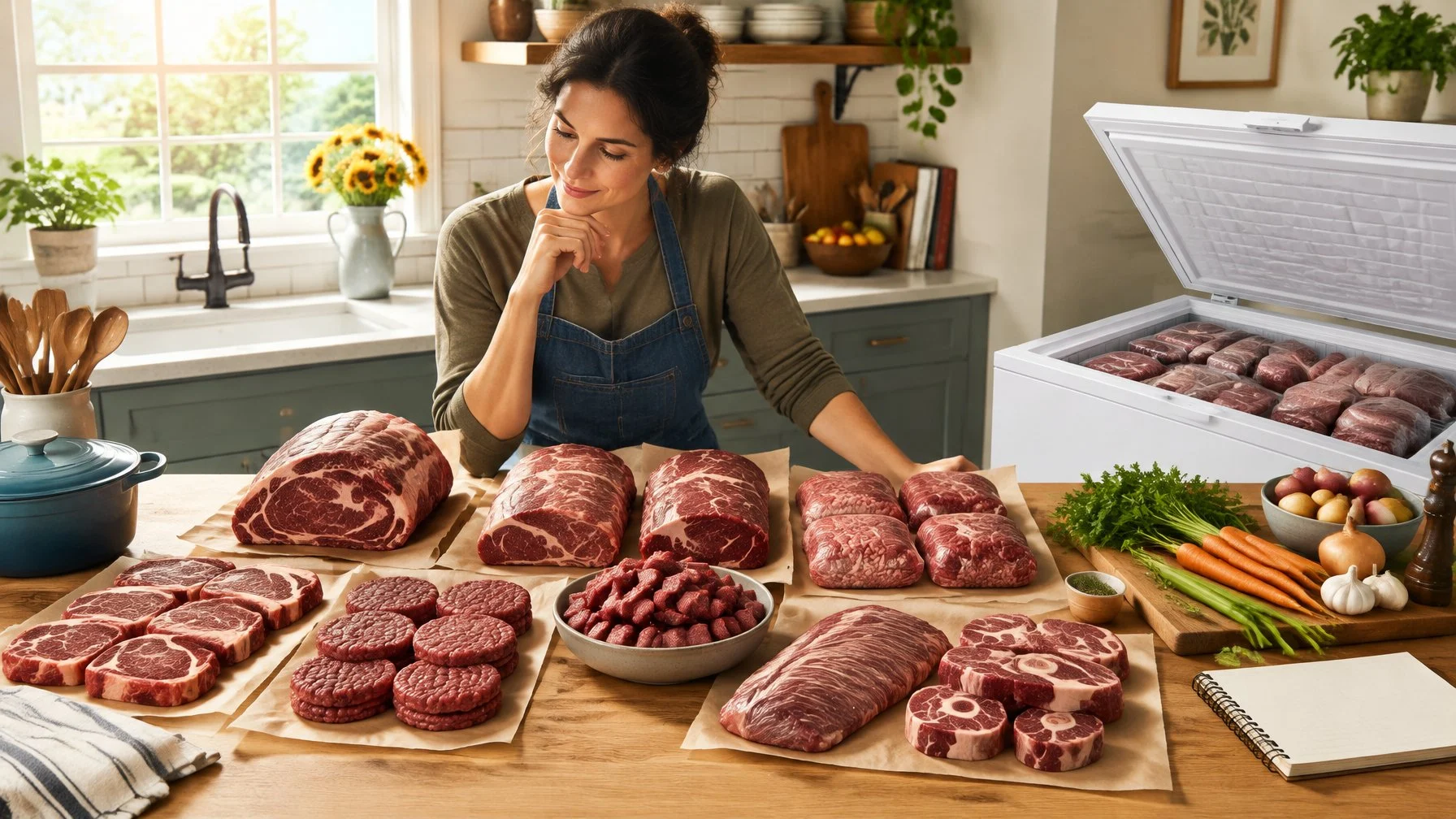
Three things decide whether your share earns its price: the ground beef to steak ratio, the cut sheet choices that cancel each other out, and whether to keep organs and bones. Filling your freezer with high-quality beef ensures dinner is always covered without sudden supermarket trips.
How Much of the Order Is Ground Beef, Steaks, and Roasts?
Ground beef is the largest single part of most shares. A typical quarter from a 1,300 lb animal yields 7 ribeye steaks, 6 T-bones, 6 roasts, and 35 to 60 lb of ground beef, along with sirloin and round steaks.
Double those counts for a half. That means about 14 ribeyes and 70 to 120 lb of ground beef.
Each side of beef supplies a fixed proportion of cuts. You cannot simply request more ribeye steak without ordering additional primals or buying a larger portion.
If your family mostly grills steaks, the steak count limits your value, because a half cow holds only so many ribeyes and strips. If you cook tacos, chili, and burgers weekly, the large ground portion works in your favor.
Some home processors also grind trim into custom blends. You can learn more about meat grinders if you want to make your own patties or sausage making from the roasts you don’t use.
Which Cut Sheet Choices Are Alternatives, Not Extras?
Many cut sheet boxes come from the same muscle. Checking one removes the other.
| If you choose | You give up |
|---|---|
| New York strip steaks and filet mignon | T-bone and porterhouse steaks |
| Flat iron, Denver, or chuck eye steaks | 7-bone and blade roasts |
| Tomahawk ribeye | Most short ribs and dinosaur ribs |
| More stew meat or cubed steak from the round | Round roasts and round steaks |
| Skirt steak and flank steak kept whole | More ground beef |
Pick boneless strip and filet if you cook steaks fast on a hot pan. Pick a New York strip steak or T-bones if you grill and like the bone. Keeping whole cuts like a skirt steak or flank steak also leaves slightly less trim for burger.
For roasts, South Dakota State Extension suggests ½ lb per serving, so a 2.5 to 3 lb roast covers four people plus leftovers.
Brisket, short ribs, and sirloin steak each come in small numbers from a half. A whole brisket can be split into flat and point portions or ground into burgers.
If you love barbecue, keeping a whole packer brisket gives you a prized cut for low-and-slow smoking. Alternatively, blending brisket into your ground beef adds rich flavor and juiciness to homemade patties.
A tender sirloin steak offers great grilling value, while trimmings can be portioned into stew meat. Ask your processor how many of each cut to expect before deciding.
Should You Request Organ Meats, Soup Bones, and Marrow Bones?
Request them only if you will cook them. Liver, heart, and tongue cost extra to package at many processors.
Organ meats have a short freezer window. USDA FSIS lists fresh liver and variety meats at 3 to 4 months in the freezer, compared with 6 to 12 months for steaks and roasts. Soup bones and marrow bones store well but take up awkward space.
Keeping soup bones is great for simmering rich broth, but only if you cook with them. If you skip them, ask the processor to note it. Saying no keeps your cost down and your freezer clear.
How Much Freezer Space Do You Need?
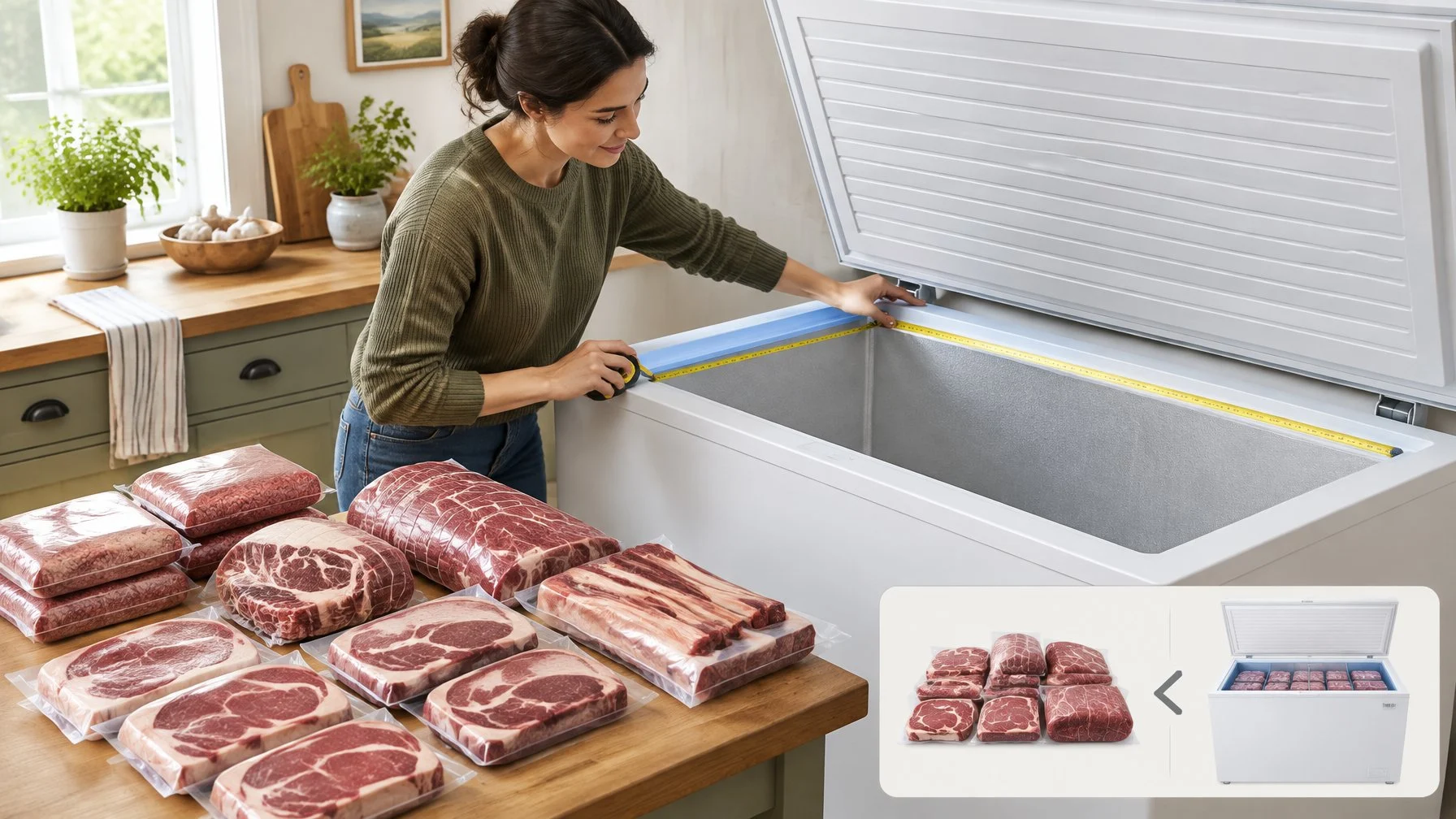
Storing bulk beef requires adequate freezer capacity and a solid organization system. The four freezer questions are sizing by cubic feet, getting the beef home cold, keeping quality, and fixing common owner problems.
How Do You Size a Chest Freezer or Upright Freezer for Your Order?
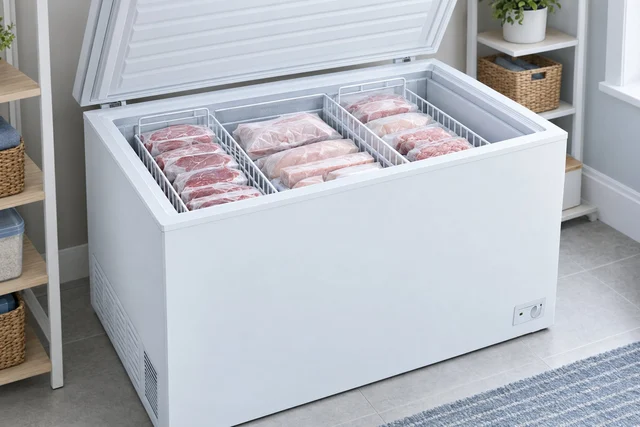
Plan on 1 cubic foot for every 35 to 40 lb of packaged beef. Uprights need more space than chests because shelves and door bins waste room.
| Order | Take-home beef | Chest freezer | Upright freezer |
|---|---|---|---|
| Quarter | ~142 lb | 4.5 cu ft | 5.5 cu ft |
| Half | ~220 lb | 7 cu ft | 8.5 cu ft |
| Large half | ~284 lb | 9 cu ft | 11 cu ft |
The quarter row comes from UMN Extension: 142 lb of beef from a quarter of a cow with a 1,300 lb live weight, which needs at least 4.5 cubic feet in a chest freezer or 5.5 in an upright. The half rows scale those numbers. Other extension sources assume different amounts of packaged beef for a half. Oklahoma State Extension puts usable meat at about 225 lb from a side, which is slightly over 300 lb hanging weight less about 25% trim loss. University of Maine Extension works from a 1,200 lb steer to 560 lb of boneless beef and sizes a half at 8 cubic feet. All three use 1 cubic foot for each 35 to 40 lb. Animal size, fat trim and packaging change the pounds, so size for your own cut sheet. Add a few cubic feet if you store other food in the same unit.
For a half cow, a 7 cu ft chest freezer is the smallest practical size, and 9 to 10 cu ft gives you room to reach packages. A chest freezer holds cold better when you open the lid. An upright is easier to sort. Compare current freezers by usable cubic feet, and skip the box size printed on the label.
How Should You Transport, Label, and Store the Beef Safely?
Keep the beef frozen from the processor’s door to your freezer.
- Bring insulated coolers. Frozen beef warms fast in a hot vehicle.
- Go straight home. USDA FSIS warns against leaving perishable food out over 2 hours, or 1 hour above 90°F.
- Check your freezer first. An appliance thermometer should read 0°F or below before you load.
- Sort by cut and date. Put ground beef and organs on top so you use them first.
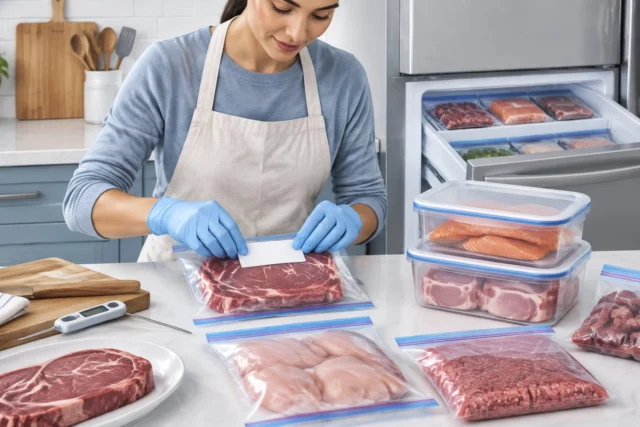
- Label anything you repack. Learning how to label frozen meat keeps your rotation simple.
- Keep an inventory sheet. Cross off each package as you use it.
Most processors deliver beef frozen in vacuum-sealed packaging. If yours arrives fresh, freeze only about 2 to 3 lb per cubic foot of freezer space in 24 hours, per MU Extension’s freezing guidance. Spread packages in one layer until solid.
How Long Does Frozen Beef Keep Its Quality?
Beef held at 0°F stays safe indefinitely. Only quality fades over time.
SAFETY: USDA FSIS states that food stored constantly at 0°F will always be safe, and storage times are for quality only. FSIS lists fresh beef roasts, steaks, and ribs at 6 to 12 months for best quality, and liver and variety meats at 3 to 4 months. Ground beef has a shorter quality window than whole steaks and roasts, so use it first. Thaw in the refrigerator, in cold water, or in the microwave, never on the counter. Vacuum sealing slows quality loss but does not sterilize meat.
A full freezer holds food for about 2 days with the door shut during a power outage. A half-full freezer lasts about a day.
What Can You Do About Limited Space, Broken Seals, or Freezer Burn?
Most problems have a quick fix.
- Not enough space: Split the order with another household, or take a quarter now and a second quarter later.
- Torn or opened package: The beef is still safe. Overwrap it in freezer paper or a freezer bag, or reseal it.
- Freezer burn: It shows as grayish-brown, leathery spots. It is a quality issue, not a safety issue. Trim the spots before or after cooking.
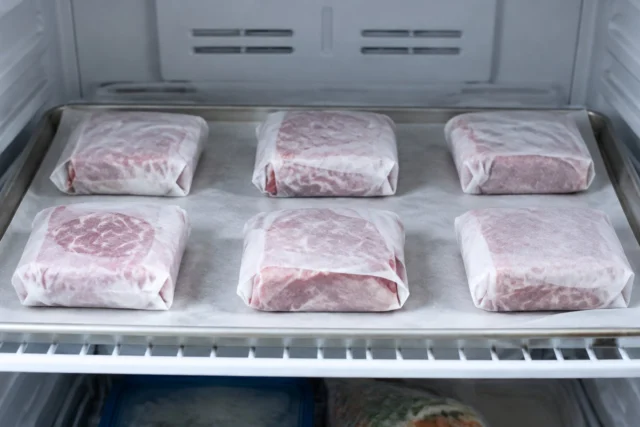
- Paper-wrapped cuts going dry: Overwrap them for storage past a few months.
Vacuum-sealed beef resists freezer burn longest. Using durable vacuum-sealed packaging protects against tiny punctures when cuts jostle together in the bin. The storage section covers bags and sealers if you plan to repack.
How Do You Buy a Beef Share Without Surprises?
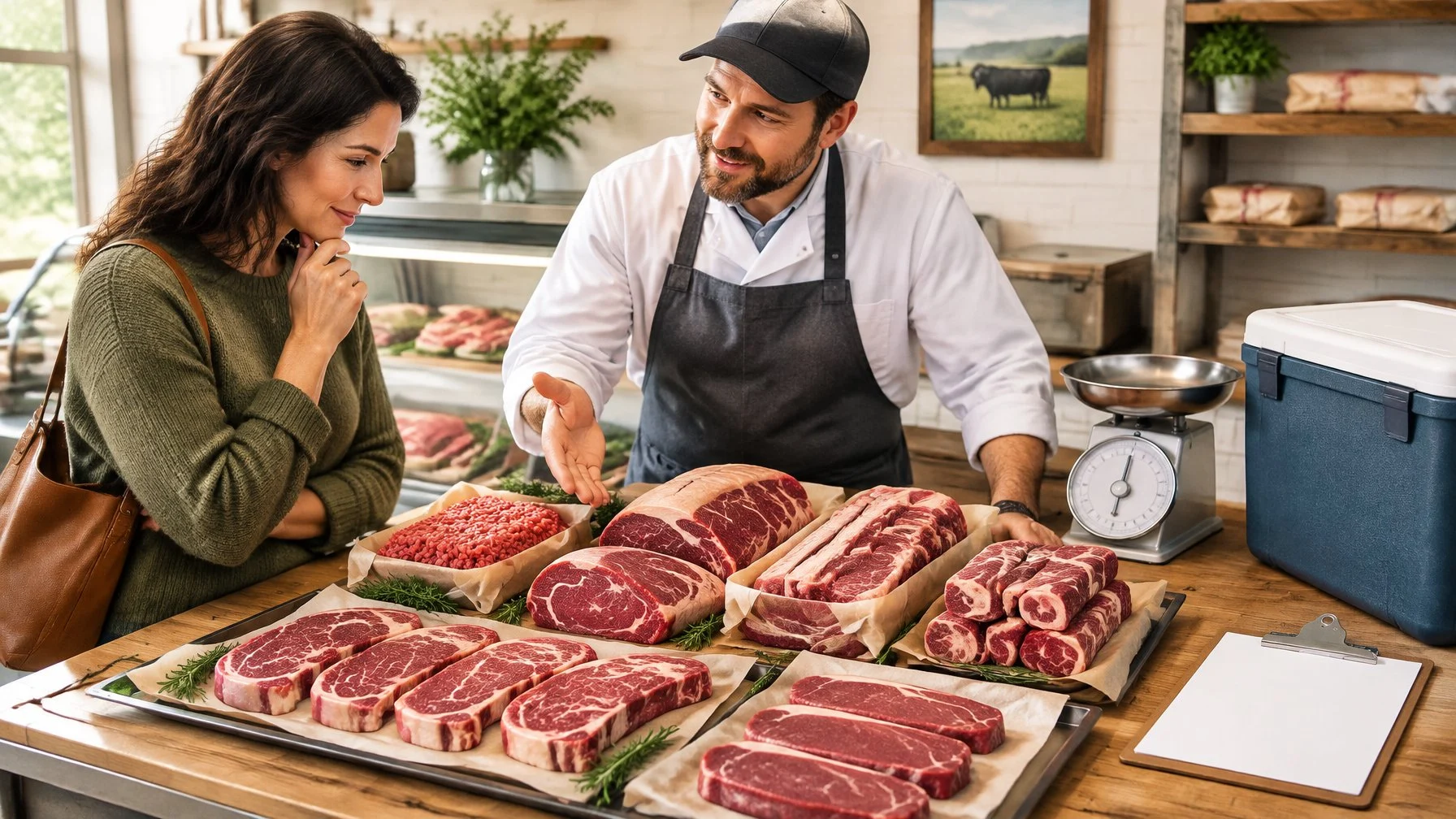
Investing in a cow share requires methodical planning to get the best return. Many local farmers schedule bookings months in advance of processing dates. Gather the right items before your deposit, compare farms and processors, and read beef labels carefully.
Then follow a clear order from quote to freezer, and know how to fix a short yield or wrong cuts.
What You Need Before Paying a Deposit
Have these items ready before money changes hands:
- A written quote showing price per pound, the weight basis, processing fees, and extras
- A cut sheet from the processor, filled out or reviewed with them
- An inventory plan in lb per week, based on your actual meals
- A freezer sized for the order, running and cold
- An appliance thermometer to confirm 0°F
- Insulated coolers for the drive home
No cure, salt, or recipe is needed. This is a buying job.
How Do You Find and Compare Local Farms and Processors?
Start with your state’s agriculture department farm directory, farmers markets, and neighbor referrals. Sourcing beef directly from local farmers or an established local ranch gives you full visibility into herd care. Working closely with local farmers also lets you confirm grazing practices and processing timelines. Ask each producer the same questions:
- How is the animal raised and finished?
- What is the expected hanging weight?
- Is the price by live weight, hanging weight, or a flat fee?
- Who pays the processor, and which processor?
- How large is the deposit, and is it refundable?
Know the plant type. USDA FSIS rules require custom-exempt beef to be marked “Not for Sale” and used only by the owner’s household and nonpaying guests. You cannot resell it. Federally inspected plants can sell across state lines. States run their own programs under cooperative agreements with FSIS, so check your state’s rules.
Mo Anwar’s years running commercial kitchens point to one test for any processor: ask how they label packages. Clear cut names and dates on every package save you trouble later.
What Do Grass-Fed, Grass-Finished, Grain-Finished, and Angus Labels Tell You?
These labels describe diet or breed. They do not guarantee tenderness or flavor.
Deciding between grass-finished beef, grain-finished beef, or conventional grain-fed beef comes down to your personal taste. When shopping for grass-fed beef, check whether the animal was grass-finished or fed grain before harvest.
Grain-fed beef typically offers richer marbling, whereas grass-finished beef yields a distinctly lean, earthy flavor profile.
Breed also plays a role in meat texture. Choosing Angus beef often provides consistent marbling, though handling and feed still govern overall quality.
| Label | What it means |
| Grass-fed | The term varies by farm; ask what the animal ate and when |
| USDA certified grass-fed (small producers) | Only grass and forage after weaning, no grain, pasture access in growing season |
| Grass-finished | Grass diet through the final months before harvest |
| Grain-finished / grain-fed | Grain fed in the final months; usually more marbling |
| Angus | A breed, not a feeding method or grade |
The USDA AMS small-producer program covers farms marketing 49 cattle or less per year. If a farm says “grass-fed,” ask whether the animal got any grain at the end.
What Are the Steps From Written Quote to Freezer Inventory?
- Get the quote in writing. It prevents disputes over the weight basis.
- Confirm freezer space. Load day is too late to find out you’re short.
- Pay the deposit. It holds your share on the farm’s schedule.
- Fill out the cut sheet early. The processor needs it before cutting.
- Ask for the hanging weight ticket. It lets you check the bill.
- Pay both bills. The farm gets paid for the beef, the processor for processing.
- Pick up with coolers. Keep the beef frozen.
- Inventory as you load. Count packages by cut and compare with the cut sheet.
Plan on a wait. Many processors book weeks ahead in fall.
How Do You Resolve a Yield Shortfall or an Unwanted Cut Mix?
Start with the paperwork, then talk to the processor calmly.
- Low yield: Compare the hanging weight ticket with your take-home weight. Boneless cuts, lean ground beef, and long aging all reduce yield. Ask the processor to walk you through the cutout.
- Wrong cuts: Check your cut sheet copy. If the processor made the error, ask about a credit.
- Cuts you won’t eat: Grind round roasts into burger. A home grinder handles this well, and you can grind meat twice for a finer texture.
- Too much ground beef: Change the next order to more roasts and fewer patties.
Is Buying Half a Cow Worth It?: Quick Answers
Is half a cow cheaper if we mostly eat ground beef?
Often not. Ground beef is the cheapest beef at retail, and conventional 80–89% lean packs sold for $4.90/lb on sale in mid-October 2026. A half cow spreads one price across every cut, so heavy ground-beef households pay steak-level prices for burger. When deciding whether is buying a half cow worth it, compare your all-in price per pound against the retail ground beef you buy now.
Should I start with a quarter cow instead?
Yes, if this is your first order or your freezer is small. A quarter cow yields about 142 lb from a 1,300 lb animal and fits in a 4.5 to 5 cu ft chest freezer. Starting with a quarter cow lets you learn the cut sheet and your weekly use before committing to a larger order.
Is buying a whole cow better value than buying a half?
A whole cow may carry a lower per-pound price, and you control every cut sheet choice. The catch is volume. You need roughly 14 to 18 cu ft of freezer space and a household that eats a lot of beef within 12 months. Unused beef that loses quality erases any savings fast.
Can I split a half cow with another household?
Yes. Splitting a cow share is common and cuts each family’s cost and freezer load.
Agree in writing on who pays which bill, how the cuts get divided, and who fills out the cut sheet. With custom-exempt beef, each household should own its share of the animal, since the meat cannot be resold.
Can I buy half a cow directly from a butcher?
Some butchers and processors sell sides of beef from animals they buy, and others process only animals you buy from a farm. Ask whether the beef comes from an inspected plant and how they price it. Get the quote in writing and confirm the take-home weight estimate before you pay.
Before your beef arrives, compare chest and upright models in the SaltRail butchery and freezer guides so your space is ready on pickup day.
This is general guidance based on USDA recommendations. When in doubt, follow the USDA FSIS source linked above.