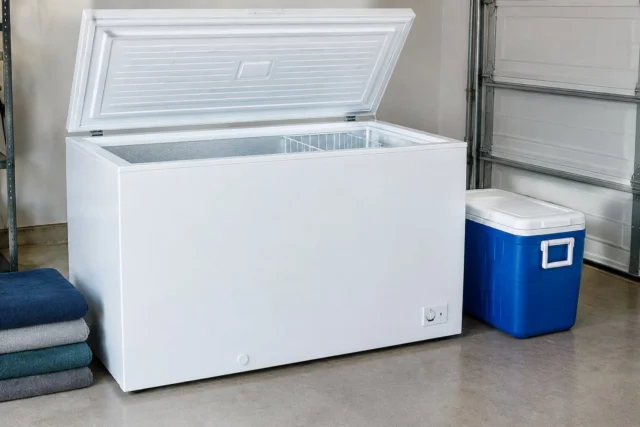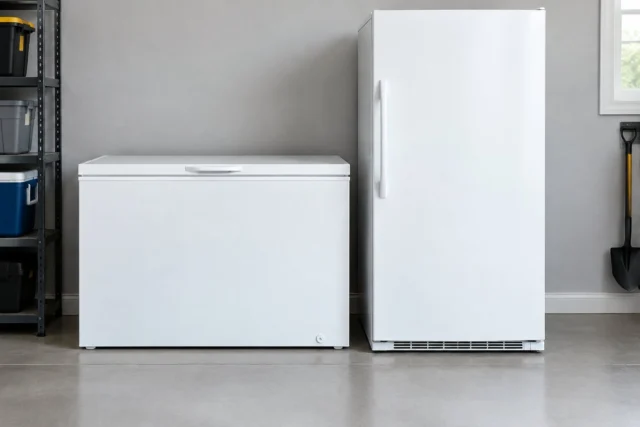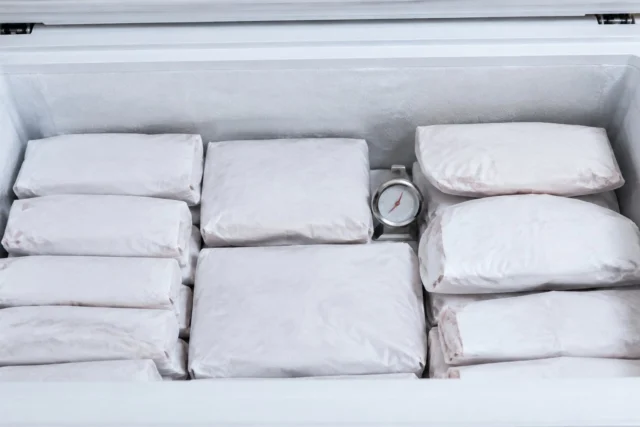

Flash freezing means freezing meat fast so it forms small ice crystals. USDA FSIS says a food 2 inches thick should ideally freeze in about 2 hours, packages should be spread in one layer, and stacked only when frozen solid. NCHFP says to add only 2 to 3 pounds of food per cubic foot at a time.
Neither FSIS nor NCHFP uses the phrase “flash freeze.” FSIS says “freeze rapidly” and mentions a “quick-freeze” shelf; this guide uses “flash freeze” as the search term for the same job: getting a fresh batch of meat frozen solid quickly for storage. It is not the short chill used to firm meat for grinding; see how long to freeze meat before grinding for that.
Why Does Freezing Speed Matter?
FSIS says to freeze food as fast as possible to maintain its quality. Rapid freezing prevents undesirable large ice crystals from forming throughout the product. Slow freezing creates large, disruptive ice crystals that damage the cells during thawing, which FSIS says causes meat to “drip” and lose juiciness.
FSIS gives one target: ideally, a food 2 inches thick should freeze completely in about 2 hours.
How Do You Set Up the Freezer for a Fresh Batch?
FSIS says that if your home freezer has a “quick-freeze” shelf, use it, and to use a free-standing freezer set at 0°F or below for long-term storage, with an appliance thermometer inside to check the temperature.
NCHFP says to freeze foods at 0°F or lower and, to facilitate more rapid freezing, to set the temperature control at -10°F or lower about 24 hours in advance. No source we opened says which home freezers allow that, so check your freezer’s manual first. The U.S. Department of Energy advises setting a freezer between -5°F and 0°F. NCHFP gives the -10°F setting as a step taken about 24 hours before loading.
For the right everyday setting, see what temperature a chest freezer should be.
How Much Meat Can You Add at Once?
NCHFP says not to overload the freezer with unfrozen food: add only the amount that will freeze within 24 hours, which is usually 2 to 3 pounds of food per cubic foot of storage space. Overloading slows down the freezing rate, and foods that freeze too slowly may lose quality.
As our own arithmetic, a 7-cubic-foot freezer would take about 14 to 21 pounds in a day by that rule. Use your freezer’s actual size. For bulk orders, our guides to how much meat from a half hog and buying half a cow give the cubic-foot figures.
How Do You Flash Freeze Meat Step by Step?
- Cool the meat before packaging; NCHFP says this speeds up freezing.
- Pack it in quantities that will be used for a single meal, leaving as little air as possible (NCHFP).
- Wrap it in drugstore wrap or butcher wrap, or use freezer bags and press out as much air as possible (NCHFP).
- Freeze it as soon as it is packed and sealed (NCHFP).
- Place packages in contact with refrigerated surfaces in the coldest part of the freezer, with a little space between them so air can circulate (NCHFP).
- Spread packages in one layer on various shelves; never stack packages to be frozen (FSIS).
- Once frozen solid, stack them and store them close together (FSIS, NCHFP).
FSIS says proper packaging helps maintain quality and prevent freezer burn. Label each package before it goes in; see how to label frozen meat. For vacuum-sealed storage times, see how long vacuum-sealed meat lasts in the freezer.
How Do You Thaw Flash-Frozen Meat Safely?
USDA FSIS (page last updated June 15, 2013) says meat is safe indefinitely while frozen, but as soon as it begins to thaw and becomes warmer than 40°F, bacteria that were present before freezing can begin to multiply. FSIS names three safe ways to thaw: in the refrigerator, in cold water and in the microwave. It also says it is safe to cook food from the frozen state.
| Method | What FSIS says | Refreeze? |
|---|---|---|
| Refrigerator | Plan ahead: even a pound of ground meat or boneless chicken breasts needs a full day. After thawing, ground meat, stew meat, poultry and seafood stay safe and good quality for a day or two before cooking; red meat cuts, 3 to 5 days. | Can be refrozen without cooking, with some possible loss of quality |
| Cold water | Use a leak-proof package, submerge it in cold tap water and change the water every 30 minutes. A pound may thaw in an hour or less; 3 to 4 pounds, 2 to 3 hours. Cook immediately once thawed. | Cook before refreezing |
| Microwave | Cook immediately after, because some areas may warm and begin to cook during thawing. | Cook before refreezing |
| Straight from frozen | Safe; cooking takes approximately 50% longer than the recommended time for fully thawed or fresh meat. | Not applicable |
FSIS says never to thaw food on the kitchen counter, in hot water, outdoors, in a garage, basement, car, dishwasher or plastic garbage bag, and that perishable food must not be left at room temperature for more than two hours. For vacuum-sealed packages, see how to thaw vacuum-sealed meat.
What Do the Sources Not Say?
| Question | What the opened sources say |
|---|---|
| How much to load | NCHFP: 2 to 3 lb per cubic foot in 24 hours (by weight) |
| How fast | FSIS: 2 inches thick in about 2 hours (by thickness and time); no combined rule |
| Freezer setting | FSIS: 0°F or below for storage; NCHFP: -10°F or lower about 24 hours before loading; DOE: -5°F to 0°F |
| Tray-freezing loose pieces of meat | No opened source gives a time or method for meat |
SAFETY: USDA FSIS: food stored constantly at 0°F will always be safe; only the quality suffers with lengthy freezer storage (FSIS). Fast freezing protects quality, not safety.
Flash Freezing Meat: Quick Answers
Is flash freezing the same as quick freezing?
The sources we opened treat them as one job. FSIS says “freeze rapidly” and mentions a “quick-freeze” shelf; neither FSIS nor NCHFP uses the phrase “flash freeze.”
Can I put warm meat straight into the freezer?
NCHFP says to cool all foods before packaging, which speeds up freezing. No source we opened gives a limit for warm meat.
Does fast freezing make meat safer?
No. FSIS says food stored constantly at 0°F will always be safe; freezing fast protects quality by keeping ice crystals small.
How long until meat is frozen solid?
FSIS says that, ideally, a food 2 inches thick should freeze completely in about 2 hours. We found no other time figure.
Your next step: check your freezer temperature with our guide to chest freezer temperature.