
To make venison jerky in a smoker safely, NDSU Extension says the meat must reach at least 160°F as it smokes, and not be smoked low then finished hot. USDA FSIS says to heat meat to 160°F before dehydrating, and that home-dried jerky can be stored 1 to 2 months.
Jerky is a nutrient-dense meat that has been made lightweight by drying, as FSIS describes it. This guide to smoked deer jerky sets out what NDSU says about smokers, how that differs from the oven-finish step other extension pages teach, and how long home jerky keeps. No source we opened gives a smoker setting or a smoking time for jerky, so this guide gives neither.
Can You Make Venison Jerky in a Smoker?
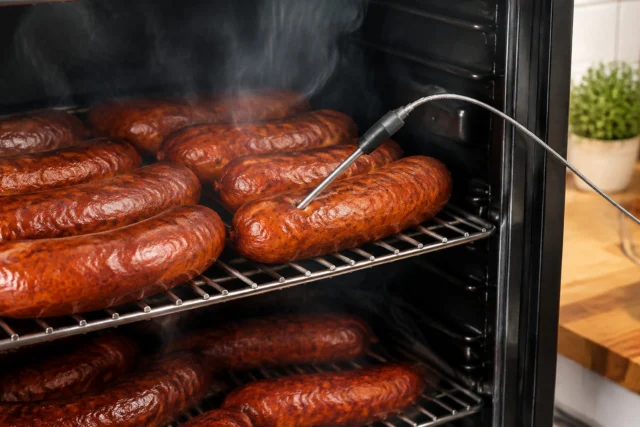
Yes, with a condition. NDSU says: “If you have a smoker or cooker that can reach high enough temperatures to fully cook the meat, you can place the jerky into a nonboiling marinade and allow it to soak at refrigerator temperatures for four to 25 hours.” It adds that if you use a cooker or smoker, “be sure the product’s temperature reaches at least 160 F to ensure any bacteria are destroyed.”
The FSIS jerky page writes its method for dehydrators and ovens. NDSU is the one source we opened that speaks to smokers directly.
What Temperature Does the Meat Need to Reach?
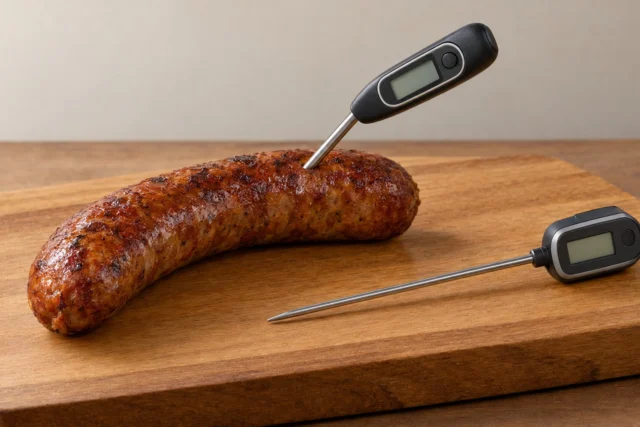
FSIS recommends heating meat to 160°F and poultry to 165°F before the dehydrating process, and NDSU gives the same 160°F target for a smoker. Ohio State University Extension says to check the temperature of several strips with a metal stem-type thermometer to confirm 160°F. NCHFP adds that disease-causing microorganisms are more difficult to eliminate in ground meat than in whole strips.
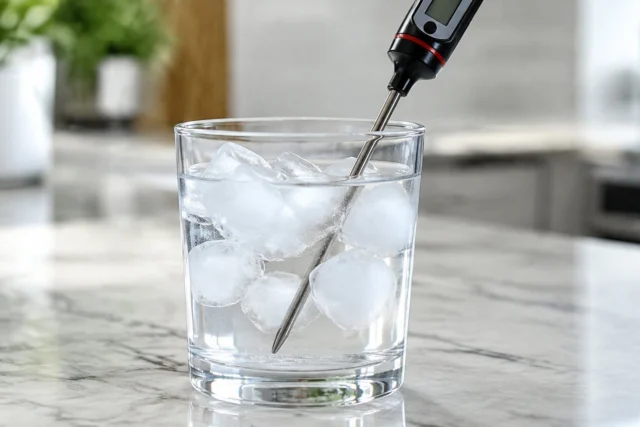
FSIS’s smoking guidance uses two thermometers, one for the smoker air and one for the meat. Check yours first with our guide on how to calibrate a meat thermometer, and see our meat thermometers for sausage and jerky.
Why Not Smoke Low and Finish Hot?
NDSU says: “If using a smoker, the meat should be brought to a fully cooked temperature as smoke is applied. Do not smoke the jerky at lower temperatures and finish at a higher temperature because some bacteria can survive the drying process and not be killed during cooking.”
Two other sources point the same way. PNW 632 (revised August 2020), from the University of Idaho, Oregon State and Washington State, says traditional methods that dry raw meat at about 140° to 155°F do not destroy pathogens if present. FSIS reports research showing pathogenic E. coli could survive drying times of up to 10 hours and temperatures of up to 145°F.
How Thick Should the Strips Be?
NDSU says to slice whole-muscle jerky into strips no more than ¼ inch thick, and that having the meat near frozen can make slicing easier. Ohio State says jerky that was more than ¼-inch thick when raw may take longer to reach the correct temperature.
What Goes in a Venison Jerky Marinade?
NCHFP gives this sample marinade for 1 1/2 to 2 pounds of lean meat (beef, pork or venison):
- 1/4 cup soy sauce
- 1 tablespoon Worcestershire sauce
- 1/4 teaspoon each of black pepper and garlic powder
- 1/2 teaspoon onion powder
- 1 teaspoon hickory smoke-flavored salt
NCHFP says to cover the strips and refrigerate 1-2 hours or overnight. FSIS says to marinate meat in the refrigerator and not to save marinade to re-use.
How Do You Make Venison Jerky in a Smoker?
These steps put the sourced points in order. They give no smoker setting or time, because no opened source does.
- Slice the venison into strips no more than ¼ inch thick; near-frozen meat slices more easily (NDSU).
- Marinate the strips in the refrigerator, and do not reuse the marinade (FSIS).
- Smoke so the meat reaches at least 160°F as smoke is applied, not low first and hot at the end (NDSU).
- Check several strips with a thermometer to confirm 160°F (Ohio State).
- Test for doneness: properly dried jerky should crack when bent in half but should not break into two pieces (NDSU).
- Store it in a sealed container (NDSU).
How Long Does Home Jerky Keep?
| Source | What it says |
|---|---|
| USDA FSIS | Home-dried jerky can be stored 1 to 2 months; commercially packaged jerky 12 months |
| NDSU Extension | For best quality, store in a sealed container and use within two weeks; refrigerate or freeze for long-term storage |
| PNW 632 (revised 2020) | Best quality for 1 to 2 months in a sealed container at room temperature, 3 to 6 months in the refrigerator and up to 1 year in the freezer |
FSIS says 1 to 2 months for home-dried jerky. NDSU frames two weeks as best quality, while PNW 632 gives 1 to 2 months at room temperature, with longer times refrigerated or frozen. The sources differ, and we show all of them rather than pick one.
What Do the Sources Disagree On?
| Point | One view | Another view |
|---|---|---|
| When to reach 160°F | NDSU: in a smoker, bring the meat to a fully cooked temperature as smoke is applied | Ohio State, NCHFP and PNW 632: after drying, heat strips ¼ inch or thinner 10 minutes in an oven preheated to 275°F |
| Air temperatures | FSIS jerky page: hold a dehydrator at 130°F to 140°F after the 160°F heating step | FSIS smoking page: smoker air of 225 to 300°F for smoking meat in general; PNW 632: drying at about 140° to 155°F does not destroy pathogens |
| Parasites in wild game | Ohio State: freeze portions no thicker than 6 inches at 0°F or below for at least 30 days | Our wild-game freezing guide covers CDC and FSIS advice not to rely on home freezing |
NDSU’s warning is about smoking low and finishing hot; the oven-finish pages are written for dehydrator and oven drying. Neither says the other is wrong. For the freezing question, see does freezing kill parasites in wild game.
SAFETY: NDSU says jerky made in a smoker must reach at least 160°F as smoke is applied (NDSU). FSIS quotes researchers who say venison can be heavily contaminated with fecal bacteria, and reports that pathogenic E. coli could survive drying for up to 10 hours at temperatures of up to 145°F (FSIS). Check the meat with a thermometer.
Venison Jerky in a Smoker: Quick Answers
Can I smoke jerky at 165°F?
No source we opened gives a smoker setting for jerky. NDSU’s target is the meat itself reaching at least 160°F as smoke is applied, checked with a thermometer.
Do I need cure for smoked venison jerky?
FSIS describes a study of jerky made with and without a curing mix containing salt and sodium nitrite, but the page gives no home dose, so we give none. Our venison summer sausage recipe and our uncured bacon explainer cover cure basics.
Can I use a dehydrator instead?
Yes. FSIS says to heat meat to 160°F before dehydrating and then hold the dehydrator at 130°F to 140°F. Our deer jerky in a dehydrator guide covers that method.
Is wild game jerky different from beef jerky?
FSIS quotes researchers who say venison can be heavily contaminated with fecal bacteria. Ohio State says carcasses should be rapidly cooled. Sources differ on freezing for parasites; see our wild-game freezing guide.
Your next step: compare methods in our deer jerky in a dehydrator guide, or pick a probe from our best meat thermometers for sausage and jerky. For smoker basics, see how to smoke sausage in an electric smoker and our venison summer sausage recipe.