
Yes, but USDA FSIS says bacon made without nitrite must be labeled “Uncured Bacon, No Nitrates or Nitrites added” and carry the statement “Not Preserved, Keep Refrigerated Below 40 degrees At All Times,” unless it is dried to USDA rules or reaches a 10% internal brine. FSIS limits sodium nitrite to 200 ppm going into dry-cured bacon.
Uncured bacon is a bacon product made without added nitrite or nitrate, which FSIS says must be labeled that way. This guide explains what FSIS requires on the label, why that label carries a refrigeration warning, and what it means if you cure bacon at home. It gives no nitrite-free recipe, because no source we opened provides one.
Can You Make Bacon Without Nitrite?
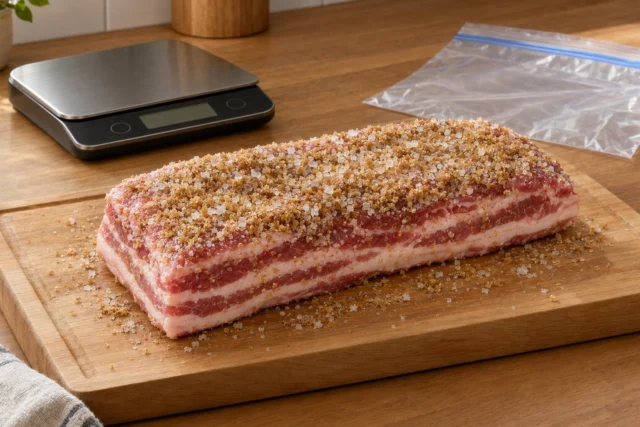
FSIS says the term “bacon” describes the cured belly of a swine (hog) carcass. In its description of how sliced bacon is made, each pork belly is skinned and any ragged edges trimmed, then cured with salt and nitrite.
FSIS says bacon can be manufactured without the use of nitrite. FSIS also says salt is the curing agent in bacon, and that nitrite, but not nitrate, is the other most frequently used additive. It says that because of the added salt and nitrite, bacon is far less perishable than other raw meat products.
FSIS’s label rules for uncured bacon include a handling statement, “Not Preserved, Keep Refrigerated Below 40 degrees At All Times”, unless the bacon is dried to USDA rules or reaches the salt level below.
What Does “Uncured” on a Bacon Label Mean?
FSIS says bacon made without nitrite must be labeled “Uncured Bacon, No Nitrates or Nitrites added.”
FSIS also says research has shown that, for products labeled as uncured, certain ingredients added during formulation can naturally produce small amounts of nitrates in bacon. Those products must carry the statement “no nitrates or nitrites added except for those naturally occurring in ingredients such as celery juice powder, parsley, cherry powder, beet powder, spinach, sea salt etc.”
So “uncured” on a label does not mean the bacon contains no nitrate at all; it means none was added beyond what those ingredients produce.
To read an uncured bacon package against the FSIS rules, check these in order:
- Find the name: FSIS says it must read “Uncured Bacon, No Nitrates or Nitrites added.”
- Look for the explanatory statement naming ingredients such as celery juice powder, which FSIS says can naturally produce small amounts of nitrates.
- Check for “Not Preserved, Keep Refrigerated Below 40 degrees At All Times,” which FSIS requires unless the bacon is dried to USDA rules or reaches a 10% internal brine.
- At home, FSIS says to refrigerate raw bacon at 40°F or below and use it within 7 days or freeze it (0°F).
Why Does Uncured Bacon Need a Refrigeration Statement?
FSIS requires uncured bacon to bear the statement “Not Preserved, Keep Refrigerated Below 40 degrees At All Times.” It gives two exceptions where the label does not have to carry that handling statement:
- The final product has been dried according to USDA regulations.
- The product contains enough salt to reach an internal brine concentration of 10% or more.
How Much Nitrite Is Allowed in Cured Bacon?
| Bacon type | FSIS sodium nitrite limit |
|---|---|
| Dry-cured bacon | Cannot exceed 200 ppm going in |
| Pumped bacon | Cannot exceed 120 ppm |
| Immersion-cured bacon | Cannot exceed 120 ppm |
The same limits appear in the federal regulation for bacon, 9 CFR 424.22: 200 ppm ingoing for dry-cured bacon and 120 ppm ingoing for immersion-cured bacon, both on skin-free green weight, and 120 ppm plus 550 ppm sodium ascorbate or erythorbate for pumped bacon.
FSIS says pumped bacon must also contain either ascorbate or sodium erythorbate, and that USDA requires adding 550 ppm of either sodium ascorbate or sodium erythorbate to pumped bacon, which it says minimizes the formation of nitrosamines (9 CFR 424.22(b)(1)).
In FSIS’s words, under certain conditions not yet fully understood, amines from the natural breakdown of proteins can combine with nitrites to form nitrosamines, most of which are known carcinogens in test animals. FSIS adds that not all cured meat products contain nitrosamines, and when present they usually are in very minute amounts.
What Does That Mean for Bacon You Cure at Home?
The FSIS page describes how bacon is made and labeled commercially. No source we opened gives a method for nitrite-free bacon at home, or says how much natural nitrate a home ingredient such as celery powder supplies, so we give no recipe or dose.
Our how to cure bacon recipe uses Cure #1, and Prague powder #1 vs #2 explains the two curing salts. Weigh cure on a scale made for curing, and follow the recipe’s amounts exactly.
SAFETY: USDA FSIS: bacon made without nitrite must be labeled “Not Preserved, Keep Refrigerated Below 40 degrees At All Times” unless it is dried to USDA rules or has a 10% internal brine. Refrigerate raw bacon at 40°F or below and use it within 7 days or freeze it at 0°F (FSIS).
How Long Does Bacon Keep?
FSIS says to take raw bacon home immediately, refrigerate it at 40°F or below, and use it within 7 days or freeze it (0°F). For freezer times, see how long vacuum-sealed meat lasts in the freezer.
Bacon Without Nitrite: Quick Answers
Is uncured bacon nitrate-free?
Not necessarily. FSIS says ingredients such as celery juice powder can naturally produce small amounts of nitrates, so uncured bacon must say “no nitrates or nitrites added except for those naturally occurring” in those ingredients.
Can I skip the cure when I make dry-cured bacon at home?
No source we opened says that is safe, and none gives a nitrite-free home method. FSIS treats uncured bacon as not preserved unless it is dried to USDA rules or reaches a 10% internal brine.
Does freezing make uncured bacon keep longer?
FSIS says to refrigerate raw bacon at 40°F or below and use it within 7 days or freeze it at 0°F. It adds that all foods stay safe while frozen, so freezer times are for quality only. For those times, see how long vacuum-sealed meat lasts in the freezer.
Your next step: if you want to cure your own, start with our how to cure bacon guide.