As an Amazon Associate I earn from qualifying purchases.
As an Amazon Associate I earn from qualifying purchases.
For turning a spare fridge or chest freezer into a curing or aging space, the Inkbird ITC-308 is the controller to start with. Its listing gives a plug-in unit with separate heating and cooling outlets, a probe and calibration; Inkbird’s comparison table lists a −58°F to 248°F range. The WiFi ITC-308 adds app control and high/low alarms. Pair either with the Inkbird IHC-200 if you also need to control humidity.
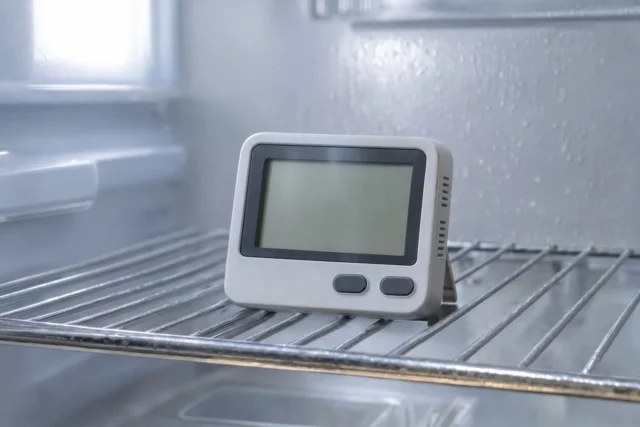
An external controller overrides the appliance’s own thermostat. You plug the fridge into the controller, put the probe inside, and the controller switches the fridge on and off to hold your set point. For ready-made cabinets instead, see best dry aging fridge.
How we ranked these
SaltRail did not hand-test these controllers. We compared what each Amazon listing states, plus Inkbird’s comparison table on its IHC-200 Amazon page: range, outputs, alarms, connectivity and load. We read every page on November 14, 2026. All three are from one maker, so this is a comparison within Inkbird’s range, not across brands. Commission rates play no part in the order.
| Pick | Controls | Range (listed) | Outputs | Alarm / app | Load (listed) |
|---|---|---|---|---|---|
| Inkbird ITC-308 (B015E2UFGM) | Temperature | −58°F to 248°F (Inkbird table) | Heating and cooling outlets | Not stated in the listing | 1200 W (title) |
| Inkbird WiFi ITC-308 (B07PVBG8K1) | Temperature | −58°F to 248°F (Inkbird table) | Dual relay, heating and cooling | High/low and sensor-fault alarm; 2.4 GHz WiFi app | 1100 W at 110 V |
| Inkbird IHC-200 (B01J1E5LWM) | Humidity | 5% to 99% RH, ±3% RH | Humidifier and dehumidifier outlets | Not stated in the listing | 10 A |
Best Inkbird Temperature Controller
Best basic controller: Inkbird ITC-308
Best with remote alarms: Inkbird WiFi ITC-308
Best for humidity: Inkbird IHC-200 Humidity Controller
Inkbird ITC-308
Inkbird ITC-308
plug-in · heating and cooling outlets · −58°F to 248°F (Inkbird table) · 2 m probe
Check today’s price on Amazon
Buy this one if you want a simple plug-in controller for one fridge or freezer. For a fridge to convert, see best fridge for curing meat.
Pros
- Separate outlets for a cooler and a heater, which it can run at the same time
- Easy calibration and a Celsius or Fahrenheit display, per the listing
- −58°F to 248°F and a 2 m NTC probe, per Inkbird’s comparison table
- Plug-and-play: set the range, place the probe, plug in
Cons
- No app or remote alarm
- The listing’s bullets don’t give accuracy
The listing names fermentation and greenhouse use, and the title gives 110 V and 1200 W.
Inkbird WiFi ITC-308
Inkbird WiFi ITC-308
2.4 GHz WiFi app · high/low and sensor-fault alarm · 1100 W at 110 V
Check today’s price on Amazon
Choose the WiFi version if the fridge sits in a garage or basement and you want an alert when it drifts.
Pros
- High and low temperature alarm, plus an alarm if the sensor fails
- Inkbird app on iOS and Android over 2.4 GHz WiFi
- Dual relay outputs switch cooling and heating
- Calibration and Celsius or Fahrenheit
Cons
- Lower listed load than the plain ITC-308: 1100 W at 110 V
- Needs 2.4 GHz WiFi where the fridge is
The listing gives model ITC-308 (WiFi ITC-308-US) and a plug-and-play design.
Inkbird IHC-200 Humidity Controller
Inkbird IHC-200 Humidity Controller
5% to 99% RH, ±3% RH · humidifier and dehumidifier outlets · 10 A
Check today’s price on Amazon
Pick this one alongside a temperature controller if your setup needs humidity held as well.
Pros
- Controls 5% to 99% RH with ±3% RH accuracy and 1% resolution, per the listing
- Switches between humidifying and dehumidifying automatically
- Separate outlets for a humidifier and a dehumidifier
- Humidity calibration
Cons
- Controls humidity only; it has no temperature probe
- Listed for mushrooms, grow tents and reptiles, not meat
Inkbird’s comparison table lists a humidity probe and 100 to 240 V input. You would run it next to an ITC-308, each on its own outlet. For humidifiers to plug into it, see best humidifier for curing chamber.
Buying Guide
- Decide what you’re controlling. Temperature only needs an ITC-308; temperature and humidity need an ITC-308 and an IHC-200.
- Check the load. Compare the fridge’s rating with the controller’s listed limit (1200 W or 1100 W).
- Decide on alarms. Only the WiFi ITC-308 lists a high/low alarm.
- Use a separate thermometer to check the probe after calibration.
For curing that uses these setups, see Prague Powder 1 vs 2 and dry-aged vs wet-aged beef.
SAFETY: UNL Extension says refrigerators should be kept at or below 40°F and checked with an appliance thermometer (UNL). USDA FSIS calls 40°F to 140°F the Danger Zone, where bacteria grow fastest (FSIS). A controller set above 40°F turns the fridge into something other than safe cold storage, so SaltRail suggests keeping raw meat that isn’t being cured by a trusted recipe in a normal fridge. Follow your cure’s label and a trusted recipe for any curing temperature.
What the Listings Don’t Say
- Temperature accuracy for either ITC-308, in the bullets we read.
- A warranty length for any of the three.
- Whether the plain ITC-308 has any alarm.
- Meat-curing settings. None of the listings mentions meat; they name fermentation, greenhouses, mushrooms and reptiles.
Frequently Asked Questions
Which Inkbird temperature controller is best for a curing fridge?
SaltRail’s pick is the Inkbird ITC-308 for a basic setup, or the WiFi ITC-308 if you want high and low alarms on your phone.
Can an Inkbird controller run a chest freezer as a fridge?
The ITC-308 listing says it controls refrigeration and heating equipment through separate outlets, and the title calls it a freezer thermostat.
What temperature range does the ITC-308 have?
Inkbird’s comparison table on Amazon lists −58°F to 248°F for the ITC-308.
Does the Inkbird ITC-308 control humidity?
No. Humidity needs a separate controller such as the Inkbird IHC-200, listed for 5% to 99% RH.
What temperature should a fridge be for food safety?
UNL Extension says refrigerators should be kept at or below 40°F.