
Prague Powder #1 is 6.25% sodium nitrite and 93.75% salt. Prague Powder #2 adds up to 4% sodium nitrate for meats not cooked before eating, such as salami or prosciutto. Use #1 for bacon and cooked sausage, and do not swap the two. Oregon State’s PNW784 lists both blends.
What Does Each Curing Blend Contain?
The two Prague powders share the same nitrite level, and only #2 carries nitrate. Complete cures sit in a third group, with often only .5% nitrite (WSU EB1661).
What Is in Cure #1?
Prague Powder #1 holds two ingredients: 6.25% sodium nitrite and 93.75% sodium chloride (plain salt). Oregon State Extension notes it is sold as Curing Salt #1 or Insta Cure #1, and it is the blend recommended for curing bacon at home.
Nitrite produces the pink cured color (Oregon State PNW784), and USDA FSIS says it greatly delays the development of the Clostridium botulinum toxin (botulism).
What Does Cure #2 Add?
Prague Powder #2 contains the same 6.25% sodium nitrite plus up to 4% sodium nitrate. It goes by Curing Salt #2 or Insta Cure #2.
Oregon State describes sodium nitrate as a slower, time-release curing agent, and says #2 is intended for cured meats that will not be cooked before eating, such as salami or prosciutto.
How Do Complete Cures Differ?
Complete cures like Morton’s Tender Quick are sold at some grocery stores or locker plants. Washington State University Extension notes they are added at much higher levels than 6.25% nitrite cures because they often contain only .5% nitrite.
That gap means you cannot trade one for the other by weight. Follow the directions on the container.
| Product | Composition | Intended use | Use for bacon? | Source |
|---|---|---|---|---|
| Prague Powder #1 | 6.25% sodium nitrite, 93.75% salt | Bacon (PNW784) and cooked sausage (WSU recipes) | Yes, recommended | Oregon State PNW784 |
| Prague Powder #2 | 6.25% sodium nitrite, up to 4% sodium nitrate | Meats not cooked before eating (salami, prosciutto) | No | Oregon State PNW784 |
| Complete cures (Morton Tender Quick) | Often only .5% nitrite | Manufacturer’s own recipes | Only per manufacturer’s directions | WSU EB1661, Oregon State PNW784 |
When Should You Use Each Cure?
Match the cure to how the meat will be eaten: cooked meats get #1, and uncooked long-cured meats get #2. Bacon gets special attention because of high-heat frying.
When Is Prague Powder #1 Appropriate?
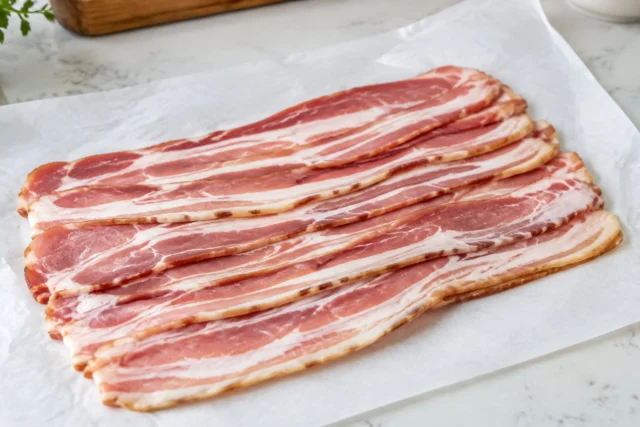
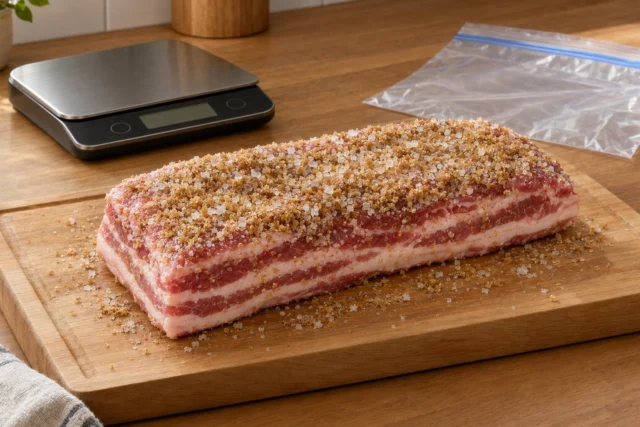
Use Prague Powder #1 for homemade bacon. Oregon State Extension recommends this blend for home bacon, and our guide on how to cure bacon uses it.
It also fits cured sausage that you cook. The WSU sausage recipes call for a commercial cure with 6.25% nitrite, the same strength as #1, which is what a venison summer sausage recipe relies on too.
Cook the finished sausage fully. USDA FSIS says uncooked sausages with ground beef, pork, lamb or veal should reach 160°F, and those with ground turkey or chicken 165°F.
When Is Prague Powder #2 Appropriate?
Prague Powder #2 is meant for cured meats that will not be cooked before eating. Oregon State names salami and prosciutto as examples.
Follow a researched recipe for the full method; this guide covers which product you need, not how to make dry-cured meats.
Why Is Cure #2 Not Recommended for Bacon?
Cure #2 and other nitrate blends are likely to make more nitrosamines when the meat is cooked at high heat, such as frying bacon. Oregon State Extension advises against them for bacon for this reason.
Bacon goes into a hot pan, so stick with #1. USDA FSIS also lists nitrite, not nitrate, as the curing additive most used in bacon.
What Is Pink Curing Salt, and Why Does Safety Matter?
Pink curing salt is dyed so you never confuse it with table salt, and its nitrite is what guards against botulism. Both facts tie straight to safe handling.
Why Is Curing Salt Dyed Pink?
Most curing salts are dyed pink so they stand apart from table salt in your pantry. Check the label to know which blend you hold.
These pink salts are a different product from Himalayan pink salt. Himalayan pink salt is pink due to trace mineral content (Oregon State PNW784).
How Does Nitrite Help Control Botulism?
Nitrite greatly delays the development of the Clostridium botulinum toxin, which causes botulism. USDA FSIS explains this in its bacon and food safety guidance.
What Must the Safety Callout Explain?
SAFETY: Nitrite and nitrate salts have relatively high toxicity. Use them only in the amounts set by researched recipes (Oregon State Extension PNW784). Federal law limits nitrite in commercially cured meats, and USDA FSIS caps added sodium nitrite in dry-cured bacon at 200 ppm. Most curing salts are dyed pink so they are distinguishable from table salt.
How Do You Determine the Correct Amount of Cure?
You get the right amount from a researched recipe written for your specific blend. Do not pick a ppm target yourself: limits differ by product, and this guide gives no dose.
What Calculation Method Does Wisconsin Extension Describe?
University of Wisconsin-Madison Extension gives a restricted ingredients formula for 6.25% curing salt. The green weight is the meat’s weight before curing.
- To find nitrite in the product: multiply pounds of curing salt by 0.0625, then by 1,000,000.
- Divide that result by the green weight of the meat block. The answer is parts per million.
Use this only to check a recipe’s amount. The 0.0625 only works for 6.25% blends. A complete cure needs different math. For weighing, see our best scale for curing meat guide.
What Does the Dry-Cured Bacon Limit Mean?
USDA FSIS says added sodium nitrite in dry-cured bacon cannot exceed 200 ppm.
Oregon State says the recipes in PNW784 produce bacon under 200 parts per million nitrite. FSIS confirms bacon can be home cured and points you to your local extension office for instructions.
Why Must You Follow the Recipe for Your Specific Blend?
Each blend has its own strength, so a recipe written for one cure gives the wrong amount with another. Oregon State notes that proprietary blends like Morton Tender Quick should follow the maker’s recipes and may not suit recipes written for Prague Powder.
| Blend | Nitrite strength | Recipe to follow |
|---|---|---|
| Prague Powder #1 | 6.25% | Extension recipe written for 6.25% cure |
| Prague Powder #2 | 6.25% plus nitrate | Researched recipe for uncooked cured meat |
| Tender Quick | Often .5% | Manufacturer’s instructions |
Frequently Asked Questions
These answers cover swapping cures, bacon, Tender Quick, and overuse.
Can I use Prague Powder #2 instead of #1?
No. Oregon State Extension describes the two blends for different uses. Prague Powder #2 contains up to 4% sodium nitrate and is meant for meats not cooked before eating, such as salami or prosciutto. For bacon and cooked sausage, use #1 with a researched recipe written for a 6.25% nitrite cure.
Can I use Prague Powder #2 for homemade bacon?
No. Oregon State Extension does not recommend #2 or any nitrate blend for bacon. Nitrate blends are likely to make more nitrosamines when bacon is fried or cooked at other high heat. Prague Powder #1 is the blend recommended for home bacon, and USDA FSIS says your local extension office can give home curing instructions.
Is Morton Tender Quick the same as Prague Powder #1?
No. Tender Quick is a complete cure that often contains only .5% nitrite, according to WSU Extension, so it is used at much higher levels than a 6.25% cure. Oregon State adds that it should follow the manufacturer’s recipes and may not suit recipes written for Prague Powder. Use the directions on the container.
What happens if I use too much Prague Powder #1?
Too much nitrite is a health risk. Oregon State Extension notes that nitrite and nitrate salts have relatively high toxicity, so you must use the amounts set in researched recipes. Federal law limits nitrite in commercial cured meats for this reason. Use the amounts in a researched recipe.
Your next step is our guide to curing bacon at home with Prague Powder #1.
This is general guidance based on Oregon State, Washington State and Wisconsin Extension and USDA FSIS. When in doubt, follow a researched recipe for your blend.