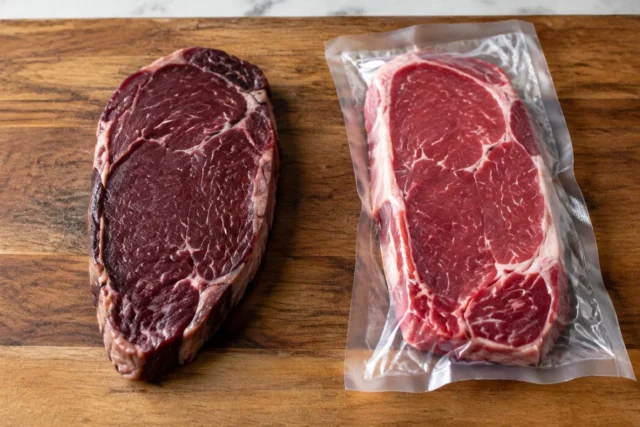
Wet-aged beef ages in a sealed vacuum bag. Dry-aged beef ages unwrapped in a controlled cooler, so it loses water and weight. One university study measured up to 9.66% loss at 42 days for dry aging, against under 1% for wet, before any trimming. Dry-aged tastes “beefy or nutty” (SDSU Extension); whether it is more tender is disputed between the sources.
After reading, you will know what each label means and what the weight loss does to your cost per pound. You will also know what to ask before you buy. Three university extension sources are laid side by side here, including where they disagree on tenderness, with the yield math worked out on a 10 lb piece of beef.
How Do Packaging, Flavor, and Tenderness Compare?
Packaging is the one real difference, and it drives everything else. The subsections cover what happens during aging, how each method tastes, the tenderness dispute, and the times and temperatures each source publishes.
What Changes During the Aging Process?
Beef aging refers to holding beef cold after slaughter so it tenderizes. The LSU AgCenter defines it as storing meat under refrigerated conditions after slaughter. The animal’s age is a separate matter.
Wet-aged beef is beef held under refrigeration in a vacuum-sealed bag, so it tenderizes while keeping almost all its moisture. It is the same idea as vacuum sealing at home, done at plant scale. If you are curious how commercial bags differ from home ones, see the chamber vacuum sealer vs vacuum sealer comparison.
Dry-aged beef sits with no packaging. Air pulls water from the surface, which dries into a hard outer layer. That layer gets trimmed off before the steak is cut. The dry aging category covers the gear side of that process.
Which Cuts Are Dry Aged Most Often?
UNR describes the usual restaurant routine: buy vacuum-packaged bone-in cuts aged around five days, take them out of the bags, and dry age them on racks for 21 to 42 days. “Ribeyes and short loins are the most common cuts,” UNR says. None of the three sources ranks the best cuts for dry aging beyond that. If you are comparing a dry-aged and a wet-aged steak side by side, the yield table below shows what each costs you in weight. For dry aging bags sized by cut, see UMAi dry aging bags.
What Does Each Method Taste Like?
Dry-aged steak tastes deeper and more roasted. SDSU Extension describes dry-aged beef as “beefy or nutty” and wet-aged beef as “slightly metallic or sour.”
LSU’s word list for dry-aged beef is longer: brown-roasted, nutty, buttery and brothy. For wet aging, LSU notes that “metallic, sour or ‘serumy’ notes” develop.
SDSU’s own view is that “there is no best decision.” Pick by taste.
Is Dry-Aged Beef More Tender?
The sources split on this, and both sides are worth seeing.
- University of Nevada, Reno Extension: “Dry aging beef does not improve tenderness when compared to wet aging.” UNR adds that tenderness claims for dry-aged beef “are not supported by scientific data.”
- LSU AgCenter: dry aging “delivers superior flavor and tenderness.”
Keep the scope in mind. UNR’s finding comes from one study of 48 short loins (24 Choice, 24 Prime) aged 21 or 42 days. It does not cover every cut or every aging length. No verdict is offered here; both methods tenderize beef.
How Do Published Aging Times and Temperatures Differ?
Each source gives different numbers, and they describe commercial or research coolers. None of them is a home method.
| Point | UNR (2019) | LSU AgCenter | SDSU (2024) |
|---|---|---|---|
| Packaging, wet | Vacuum, moisture retained | Vacuum-packed bags | Vacuum packaged |
| Packaging, dry | Not packaged | Uncovered | No packaging |
| Temperature | 36°F (study cooler) | 32 to 34°F, both methods | Not stated |
| Wet aging length | 21 or 42 days (study) | Up to 3 weeks | Not stated |
| Dry aging length | 21 to 42 days, common restaurant range | Up to 4 weeks | 3 days to over 100 days |
| Dry yield loss before trim | 4.68% (21 d), 9.66% (42 d) | Names moisture loss as a cost, no figure | Not stated |
| Wet yield loss | 0.64% (21 d), 0.95% (42 d) | Not stated | Less trim loss |
| Tenderness claim | No improvement over wet | Superior | Not addressed |
LSU also notes that beef held around 35°F keeps tenderizing for about seven to 10 days.
How Much Weight Is Lost, and Why Does It Affect Cost?
Dry aging lost about seven to ten times more weight than wet aging in the UNR study (4.68% vs 0.64% at 21 days, 9.66% vs 0.95% at 42 days), and you pay for that lost weight. The subsections cover UNR’s numbers, what they mean on a 10 lb subprimal, and why trimming adds more.
What Did UNR Measure Before Trimming?
UNR aged short loins at 36°F and weighed them before the surface was trimmed. Wet-aged loins lost 0.64% at 21 days and 0.95% at 42 days. Dry-aged loins lost 4.68% at 21 days and 9.66% at 42 days.
The gap grows with time. Doubling the dry aging time roughly doubled the loss.
What Does the Loss Mean for a 10 lb Subprimal?
This is plain arithmetic from UNR’s table, applied to a 10 lb piece.
| Method and time | Loss (%) | Weight lost | Weight left | Cost per finished lb vs start |
|---|---|---|---|---|
| Wet, 21 days | 0.64% | 0.06 lb | 9.94 lb | About 0.6% higher |
| Wet, 42 days | 0.95% | 0.10 lb | 9.90 lb | About 1.0% higher |
| Dry, 21 days | 4.68% | 0.47 lb | 9.53 lb | About 4.9% higher |
| Dry, 42 days | 9.66% | 0.97 lb | 9.03 lb | About 10.7% higher |
The last column is 1 divided by the share left. For 42-day dry aging: 10 ÷ 9.03 = 1.107, so each finished pound carries about 10.7% more of the starting cost. That is before trimming, labor or cooler time.
Why Does Trimming Add to the Cost?
UNR notes that “additional trimming is required to remove dry surfaces” on dry-aged beef. That dried layer comes off before steaks are cut, and every ounce trimmed raises your cost per pound again. UNR adds that the extra trimming “also leads to lighter weights and lower yields.”
LSU lists the full cost picture for dry aging: moisture loss, trimming and longer storage time. That is why LSU says wet aging stays dominant for its practicality and affordability.
How Do You Choose Beef at the Butcher Counter?
Start with flavor, then confirm the cut and the method, then ask how the price handles trim. Those three steps follow a short prep list.
What You Need Before You Buy
- Your flavor goal: traditional beef taste, or beefy and nutty.
- The cut you want: ribeye, strip loin, porterhouse, T-bone, sirloin or filet mignon.
- A rough weight for the meal or the freezer.
- If buying in bulk, your total hanging or package weight from the farmer. The bulk buying section covers storage planning.
1. Choose the Flavor You Want: Neither Method Suits Everyone
Pick dry-aged if you want the brown-roasted, nutty notes LSU describes. Pick wet-aged if you want the traditional beef taste LSU describes.
2. Confirm the Cut and Aging Method: Labels Alone Leave Questions
Ask which method was used and for how many days. “Aged” on a sign gives you neither. UNR notes that ribeyes and short loins are the most common cuts restaurants dry age.
3. Ask About Trimming: Starting Weight Is Not Finished Yield
Ask whether the price per pound is figured before or after trim. On a half or whole cow, ask how aging affects your take-home weight. Families weighing whether buying half a cow is worth it should build that answer into the math.
Three questions cover it at the counter or on the phone with a beef farmer:
- Was this beef wet aged or dry aged?
- For how many days, and at what temperature?
- Is the price per pound figured before or after the dry surface is trimmed?
What Should You Do When Buying Details Are Missing?
SDSU states that the vast majority of US beef is wet aged. SaltRail’s inference, not a source’s claim: unlabeled beef is most likely wet-aged. If a farmer or processor cannot tell you the method or days, ask how the beef was handled and packaged. For bulk beef, also ask whether it was processed custom exempt or USDA inspected.
What Do These Sources Establish About Safety and Home Aging?
All three sources describe commercial or research aging, and none gives a home method. The subsections cover what that means for you, what SDSU says about mold, and how to read UNR’s bacteria counts.
SAFETY: Commercial Aging Conditions Are Not Home Instructions
SAFETY: The 32 to 34°F range (LSU AgCenter) and the 36°F cooler (University of Nevada, Reno Extension) describe controlled commercial and research settings. Neither source offers steps, humidity settings or day counts for a home refrigerator. Do not treat these numbers as a home recipe.
Commercial aging rooms control temperature, humidity and airflow together.
What Does SDSU Say About Surface Mold?
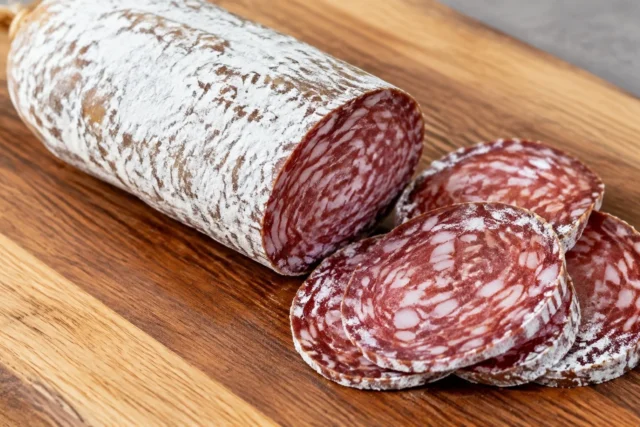
SDSU states that dry-aged beef can develop “a harmless type of mold” on the surface. SDSU adds that the mold and dried portion are cut off well before the meat reaches your plate. That is the full claim; it says nothing about mold on other products. White mold on cured sausage is a separate topic, covered in whether white mold on salami is safe to eat.
Why Do Lower Surface Counts Not Prove Safer Beef?
UNR found lower surface bacteria counts on dry-aged loins: 2.04 log CFU/cm² against 4.68 for wet-aged. That number is an aerobic plate count of surface bacteria, swabbed on the day of fabrication, in one study. It does not test specific pathogens.
So it does not show dry-aged beef is safer to eat. It shows a dry surface held fewer bacteria in that study.
Frequently Asked Questions
How long can you wet age beef?
LSU AgCenter lists wet aging in vacuum-packed bags at 32 to 34°F for up to three weeks. The UNR study wet aged loins for 21 and 42 days at 36°F. Those are commercial and research settings. LSU notes that some wet-aged cuts may develop metallic, sour or “serumy” notes.
Is grocery-store beef usually wet aged?
Yes. SDSU states the vast majority of US beef is wet aged, and LSU calls wet aging the industry standard since it arrived in the 1970s. Vacuum-packed subprimals keep aging in the bag as they move from the plant to the store. SaltRail’s inference: if a label says nothing about aging, it is most likely wet-aged.
Is mold on dry-aged beef safe?
SDSU describes the surface mold on dry-aged beef as a harmless type of mold. It is trimmed off with the dried crust before the beef is sold. That covers commercial dry-aged beef handled by a butcher. It does not cover mold on beef in your home fridge or on other meats.
Can I dry age beef in my home refrigerator?
The extension sources here give no home dry-aging method, so no settings or day counts are offered. Their temperatures describe commercial and research coolers. If you are looking at dedicated equipment, the best dry aging fridge roundup compares units by specs and owner reports, as gear information only.
Is aging beef the same as hanging a deer?
They share an idea: holding meat cold after harvest so it tenderizes. These beef sources do not cover venison, so their times and temperatures do not carry over. For deer, see how long to hang a deer, which treats that question on its own terms.
If you are planning freezer space for a half cow of wet-aged cuts, the vacuum sealing guides on SaltRail are the next useful step.