
To make deer jerky in a dehydrator safely, heat the venison strips to 160°F internally before drying, then dry them with the dehydrator holding 140°F or higher. NCHFP and Ohio State say to begin checking after about 3 hours. The clock is only an estimate. A thermometer and a bend test tell you when the batch is done.
Making venison jerky in a dehydrator is simple once you master the basics. If you want classic deer jerky with excellent chew, this deer jerky recipe shows you how to produce flavorful homemade deer jerky. It is an easy way to turn wild game into a satisfying, high-protein snack.
If you have made beef jerky before, working with lean deer meat follows a similar approach. However, dehydrating deer jerky requires careful attention to internal heat to guarantee food safety.
You will learn how to confirm the heat step for food safety, judge dryness, and store the batch conservatively. You will also see why the dehydrator dial setting differs from the meat’s own temperature. Three common texture problems get a fix as well.
What You Need for a Batch of Deer Jerky
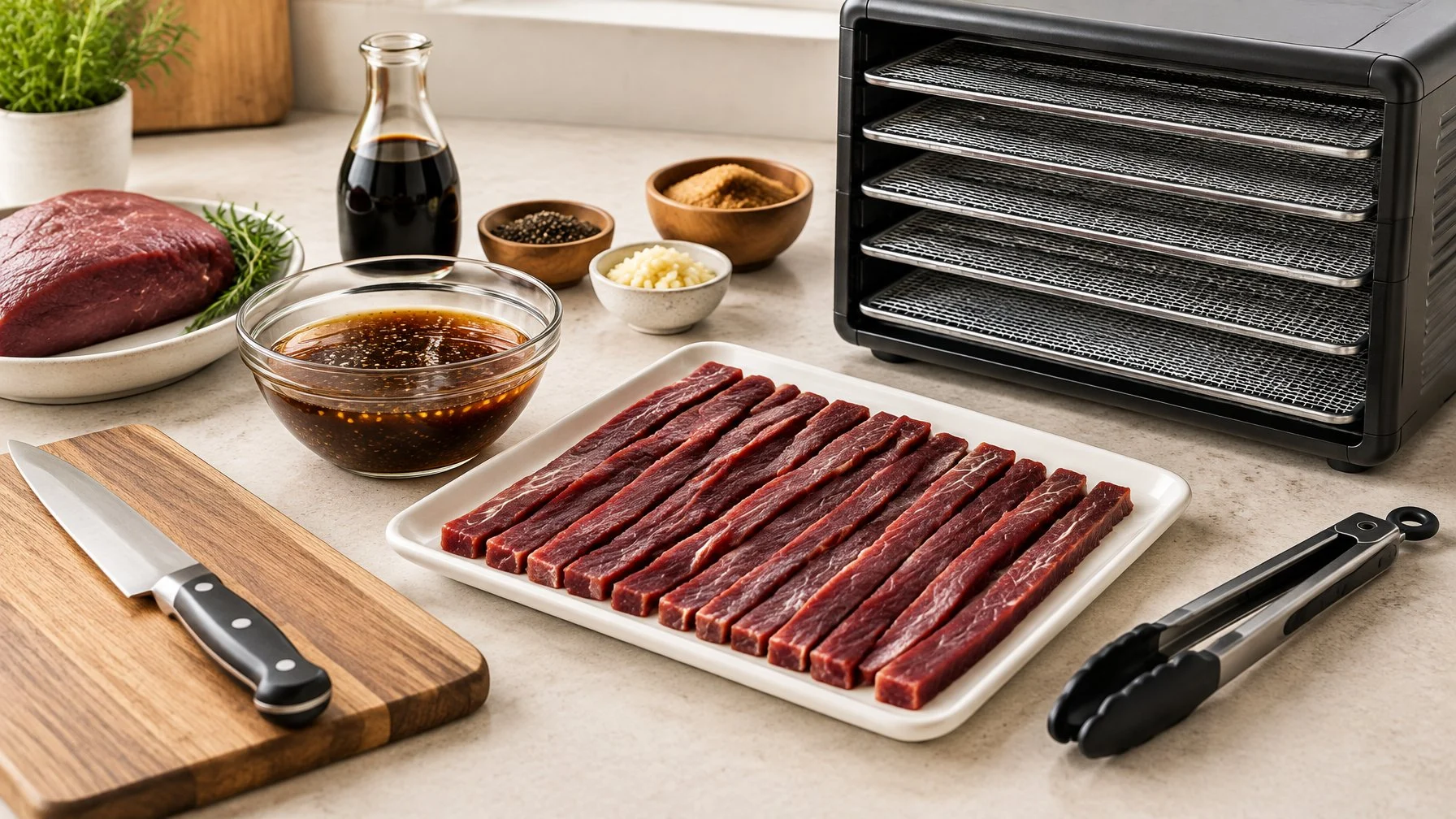
You need four pieces of gear and a short list of pantry seasonings. The gear decides whether the batch is safe. The marinade decides how it tastes.
Equipment: Dehydrator, Thermometer, Knife, and Trays
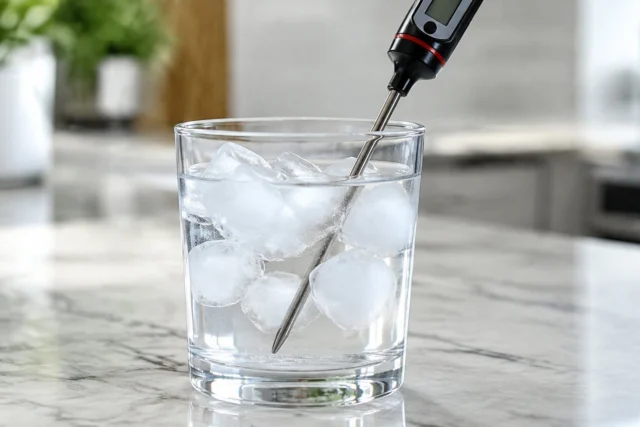
Pick a food dehydrator with an adjustable temperature dial. USDA FSIS says your unit should hold at least 130°F to 140°F through the whole drying process, and NDSU says not to rely on the dial: check the unit with a calibrated thermometer. A dial that tops out lower than that is the wrong tool for meat.
A reliable food dehydrator provides consistent airflow across every tray. This keeps drying times predictable and prevents cool spots.
| Item | What to look for | Why it counts |
|---|---|---|
| Food dehydrator | Adjustable dial that holds 140°F or higher, fan | Steady heat and airflow dry strips evenly |
| Instant-read or stem thermometer | Thin probe, reads to 160°F+ | Confirms the meat’s internal temperature |
| Sharp slicing knife | Long, thin blade | Even ¼-inch strips dry at the same rate |
| Cutting board, saucepan, tongs | Large board, 3-quart pot | Slicing and the pre-drying boil |
| Paper towels | Plain, unscented | Blotting marinade and fat |
A dull knife tears venison and gives you ragged strips of mixed thickness. If your blade is worn, a good knife for processing deer pays for itself in more even jerky.
In a commercial kitchen, the thermometer is the tool nobody skips. The dehydrator’s dial only reports the air temperature it aims for.
Ingredients: Venison and a Simple Marinade
Start with 2 lb of lean deer meat. Selecting lean cuts of meat is essential because fat spoils quickly. Hindquarter cuts such as top round work best, though flank steak is another popular choice for jerky meat.
This deer jerky marinade follows the NCHFP base recipe, pairing Worcestershire sauce and soy sauce to build a rich, savory foundation. Garlic powder, onion powder, and crushed black pepper complement the earthy profile of deer meat without overpowering it.
Brown sugar and smoked paprika round out the blend, delivering the classic balance expected from traditional homemade deer jerky.
Adjusting the dry seasonings lets you tweak the flavor to your liking. Adding extra black pepper gives the jerky a bolder kick, while slightly increasing the garlic powder and onion powder enhances the savory depth.
A little more brown sugar softens the intense salty notes from the soy sauce. You can also adapt the marinade for different deer jerky recipes. For example, teriyaki deer jerky uses a similar salty-sweet profile with garlic and minced ginger added to the mix.
Yield: 2 lb raw venison (it loses most of its weight as it dries)
Prep time: 30 minutes, plus 1 to 2 hours to firm the meat in the freezer
Marinating time: 1 to 2 hours, or overnight
Drying time: start checking at 3 hours
- 2 lb lean venison, trimmed of all fat and silver skin
- ¼ cup soy sauce
- 1 tablespoon Worcestershire sauce
- 1 tablespoon brown sugar
- ¼ teaspoon black pepper
- ¼ teaspoon garlic powder
- ½ teaspoon onion powder
- ½ teaspoon smoked paprika
The soy sauce and Worcestershire sauce bring plenty of salt, so leave out extra table salt. Long soaks make jerky saltier. Some cooks find an overnight soak too intense for tender deer meat.
How to Prepare, Heat, and Dry the Strips
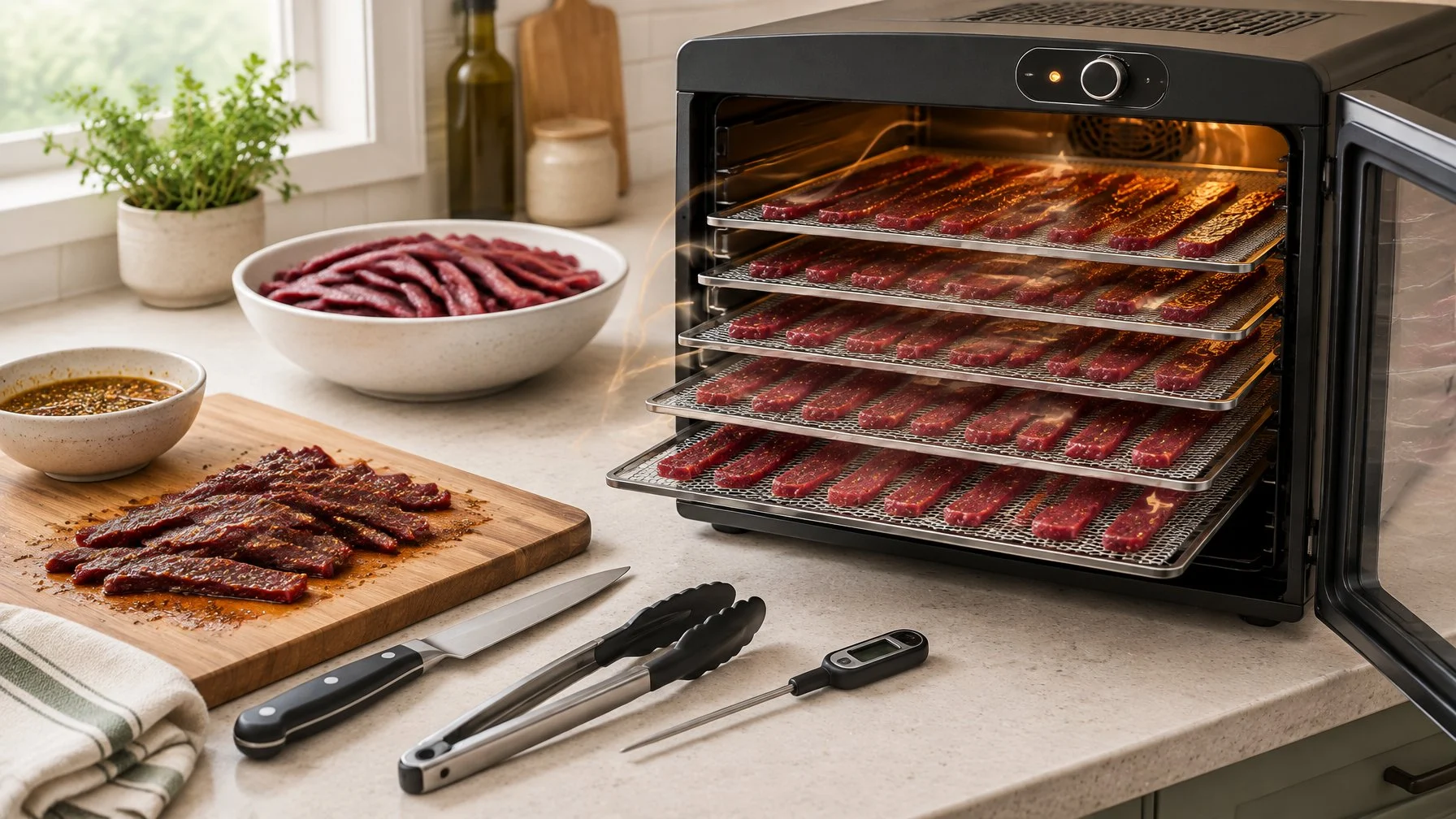
The method runs in four steps: slice and marinate cold, heat the strips to 160°F, dry them in single layers, then check the thickest pieces. Each step has a job, and none of them replaces another.
1. Trim, Slice, and Refrigerate the Meat in Marinade
Thin, even, fat-free strips are the foundation of quality homemade deer jerky. Unlike fattier beef jerky, deer meat has minimal intramuscular fat, but exterior fat turns rancid quickly. Clean slicing ensures your homemade jerky dries evenly on every rack.
- Trim all visible fat and connective tissue. Fat turns rancid and gives off flavors.
- Freeze the meat until firm but not solid. Firm meat slices cleanly and evenly.
- Slice strips no thicker than ¼ inch. Thickness sets both drying time and how well the heat step works.
- Slice with the grain for chewy jerky, or across the grain for a more tender, brittle bite.
- Whisk the marinade in a shallow dish, add strips, cover, and refrigerate 1 to 2 hours or overnight. Cold marinating keeps bacteria from growing.
If you broke down the deer yourself, the top round from your deer butchering is the cut to set aside for this.
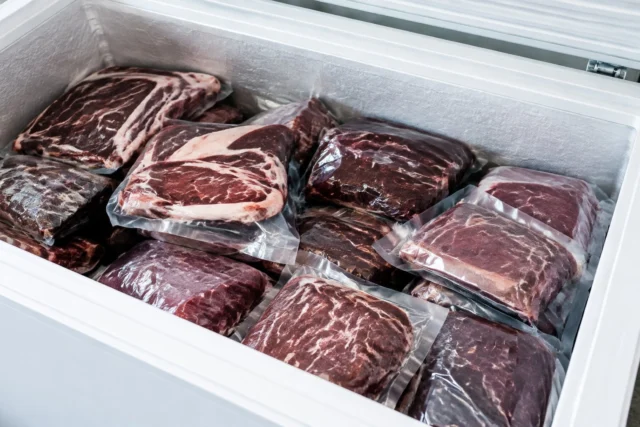
NCHFP advises freezing wild game for jerky at 0°F or below for at least 30 days, in pieces 6 inches thick or less, to kill trichinella. Freezing does not kill bacteria. CDC warns that some trichinella found in wild game resist freezing, so never skip the 160°F heating step below.
2. Heat the Strips to 160°F Before Drying
The pre-drying heat step is what makes home venison jerky safe; marinade, drying time, and a bend test do not replace it.
- Pour the strips and marinade into a saucepan. The marinade becomes your heating liquid.
- Bring to a boil and boil 5 minutes. This brings ¼-inch strips up to temperature.
- Probe several of the thickest strips with your thermometer. Each should read 160°F.
- Boil longer if any strip reads under 160°F or was cut thicker than ¼ inch.
- Drain the strips on clean paper towels and discard the marinade. Reused marinade carries raw-meat bacteria.
Heated strips look grayer and dry faster than traditional jerky. That is expected.
3. Arrange the Strips and Dehydrate Until Dry
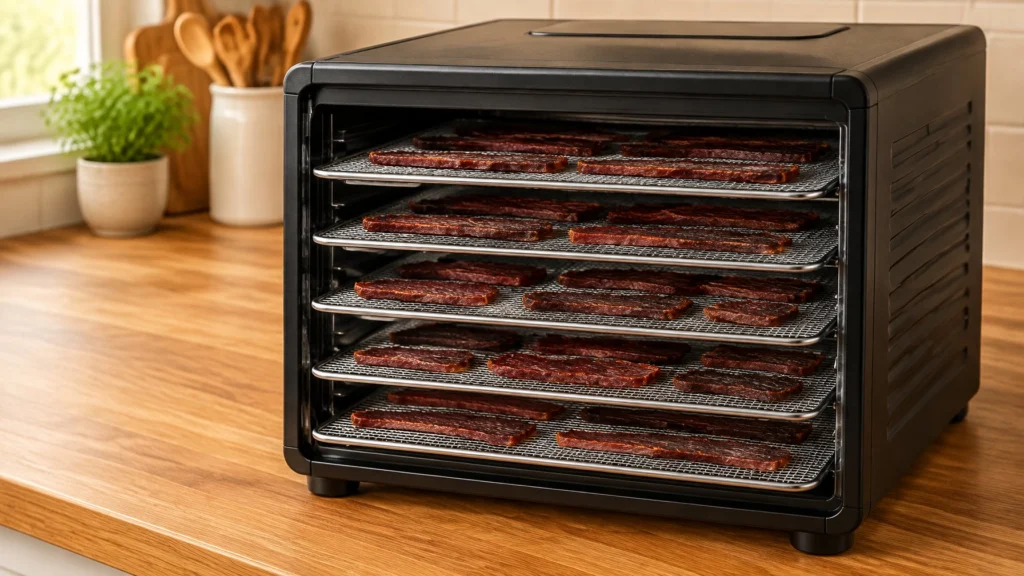
When dehydrating deer jerky, air needs to reach every side of every strip. Lay strips close together on the trays, but never touching or overlapping.
It takes steady heat inside the food dehydrator to dehydrate deer jerky properly. When you dehydrate deer jerky at home, keep space between pieces so warm air circulates freely around the deer meat.
- Preheat the dehydrator to 140°F or higher, the temperature NCHFP preheats to. Hot air from the start keeps the meat out of the danger zone.
- Load trays in a single layer. Overlaps trap moisture and leave soft spots.
- Pat off beads of oil during drying. Surface fat goes rancid.
- Rotate trays top to bottom if your unit heats unevenly. Strips near the fan dry first.
The sources differ on drying air temperature. USDA FSIS and NDSU say at least 130°F to 140°F throughout, NCHFP preheats to 140°F, NDSU’s own recipe dries at 140°F to 150°F, and Ohio State says at least 145°F. We do not pick one; do not let the unit fall below the FSIS range.
4. Check the Thickest Pieces Before Cooling
Done jerky cracks when you bend it but does not snap. Pull one of the thickest strips, let it cool for a minute, and bend it.
Properly dried jerky is pliable, and you cannot squeeze any water out of it. Thin strips finish first. Pull them as they pass and leave the rest on the trays.
Once the batch is dry, blot any oil, move the strips to a clean surface, and let them cool completely before you pack them.
How Do You Handle Safety and Storage?
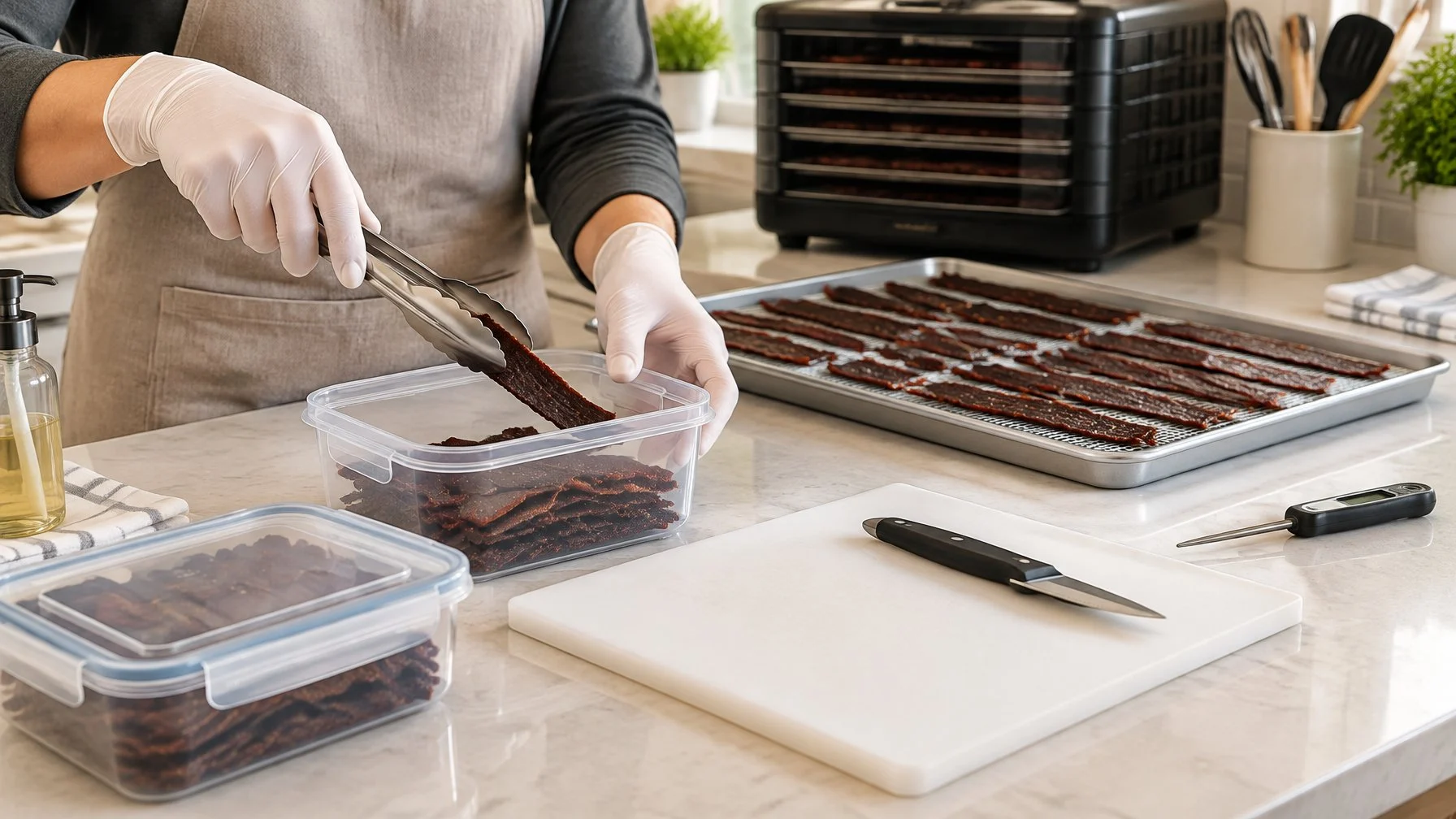
Safety comes down to three points: the dial is not the meat, the finished batch needs cold storage for anything past a short window, and ground venison follows stricter rules.
Why a 160°F Dehydrator Setting Is Not the Safety Check
A dehydrator setting is the air temperature the unit aims for. Meat inside it stays much cooler while water evaporates, and it only heats up once most of the moisture is gone. By then, surviving bacteria have become more heat resistant.
In lab work on inoculated venison, pathogenic E. coli survived drying for up to 10 hours at up to 145°F. That is why you heat the strips to 160°F first and confirm it with a thermometer.
SAFETY: USDA FSIS recommends heating meat to 160°F, measured with a food thermometer, before dehydrating, and using a dehydrator that holds at least 130°F to 140°F throughout drying. Venison carries extra risk because deer carcasses are often held at outdoor temperatures. If you skipped the pre-drying heat, NCHFP describes a fallback: heat dried strips cut ¼ inch or thinner for 10 minutes in a 275°F oven.
How to Cool, Pack, and Store Finished Jerky
Cool the jerky fully, then pack it with as little air as you can. Trapped air causes rancid flavors. Dehydrating deer jerky removes water to stop microbial growth, but proper storage prevents moisture from returning.
When storing deer jerky, using airtight packaging helps your homemade jerky stay fresh longer. Label and date every package with the drying date.
| Storage | Time and source |
|---|---|
| Room temperature, sealed container | 2 weeks (Ohio State, NCHFP, NDSU); 1 to 2 months (PNW 632, 2020 revision) |
| Refrigerator | 3 to 6 months (Ohio State, PNW 632) |
| Freezer | Up to 1 year (PNW 632) |
| USDA FSIS limit for home-dried jerky | 1 to 2 months (USDA FSIS) |
The storage times differ: FSIS says 1 to 2 months for home-dried jerky, Ohio State says 3 to 6 months in the refrigerator, and PNW 632 (revised 2020) gives best quality of up to 1 year in the freezer. We do not pick one. NDSU says to use jerky within two weeks for best quality and to refrigerate or freeze it for long-term storage. For a conservative plan, keep a two-week supply out and refrigerate or freeze the rest. Vacuum-sealed bags in one of your chest or upright freezers hold quality longest. Check stored jerky now and then for mold.
What Changes for Ground Venison Jerky?
Ground venison jerky carries more risk than whole strips. Grinding spreads surface bacteria through the whole batch, so pathogens are harder to kill.
- Grind cold, lean venison. A meat grinder for deer with a 3/8-inch plate works for a coarse grind.
- Mix the seasonings in evenly. Blend in your garlic powder, onion powder, black pepper, and brown sugar so every bite is seasoned consistently.
- Press strips with a jerky gun, 1/8 to 1/4 inch thick. Even strips heat evenly.
- Bring the meat to 160°F internally, checked with a thermometer. Research on ground beef jerky found this step cuts E. coli O157 risk.
- Dry at 140°F or higher and use the same bend test.
Troubleshooting Uneven, Brittle, or Sticky Jerky
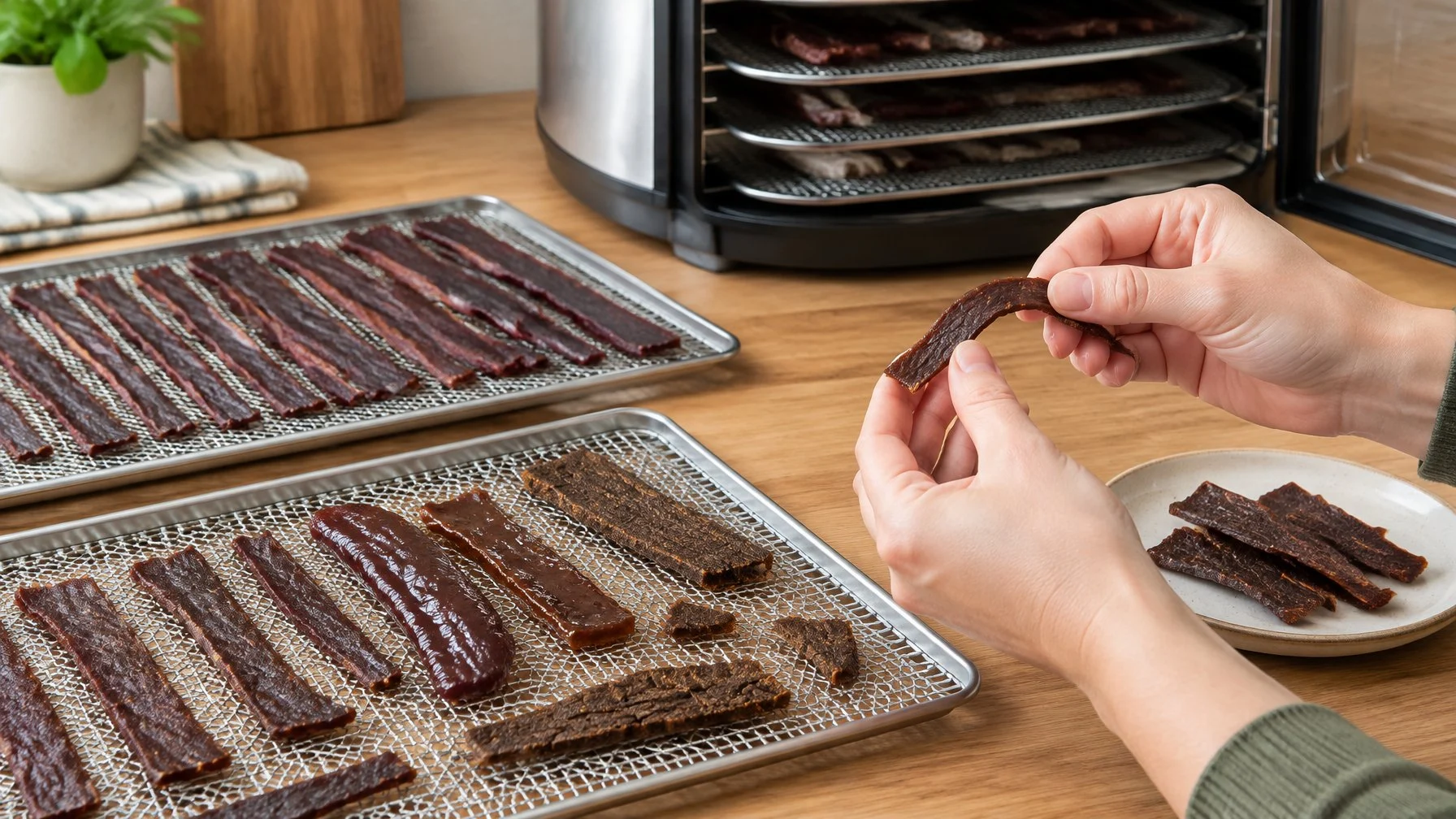
Most texture problems trace back to slicing or loading. Damp strips, brittle strips, and sticky surfaces each have a quick fix.
Some Strips Are Still Damp: Sort by Thickness and Keep Drying
Mixed thickness is the usual cause. A ⅜-inch strip on the same tray as a ⅛-inch strip will lag far behind.
- Pull the strips that pass the bend test and leave the rest drying at the same temperature.
- Group thick strips on one tray so you can check them together.
- Move the slow tray closer to the heat source.
Next time, flatten strips with a rolling pin before marinating. NCHFP says drying can take 10 to 24 hours for strips not heated first, and even thickness keeps that range tight.
The Jerky Is Brittle: Slice Evenly and Check Earlier Next Time
Brittle jerky is overdried, or it was cut across the grain. Both produce strips that snap when bent.
- Start checking after about 3 hours for pre-heated strips (NCHFP and Ohio State), then check often.
- Slice with the grain if you want chew.
- Pull strips as they pass the bend test; the sources we opened do not say to lower the temperature partway through.
Brittle jerky is still safe to eat. Crumble it over rice or into soups.
The Surface Is Sticky: Blot Marinade and Leave Space Between Strips
Sticky jerky comes from leftover marinade sugar or crowded trays. Sugar stays tacky, and crowding slows surface drying. Lowering the amount of brown sugar helps if you prefer a drier, less tacky exterior.
- Drain strips well on paper towels before loading.
- Leave a small gap between every strip.
- Pat off beads of oil and syrup during drying.
- Cut the brown sugar to 2 teaspoons if the problem repeats.
Deer Jerky in a Dehydrator: Quick Answers
How long does deer jerky take in a dehydrator?
Strips heated to 160°F before drying finish faster than raw strips, so NCHFP says to begin checking after about 3 hours. NCHFP gives 10 to 24 hours for strips not heated first. Treat any time as an estimate. Thickness, tray load, and room humidity all change it, so judge doneness by the bend test on your thickest strip.
Do you need to flip jerky in a dehydrator?
Flipping is optional in a dehydrator with a fan and open mesh trays, since air reaches both sides. Rotating trays top to bottom helps more, because strips nearest the heat dry first. If the underside of your strips stays damp or sticks to the tray, flip them once around the halfway point.
What temperature should I set the dehydrator to for deer jerky?
Hold it at 140°F or higher. USDA FSIS and NDSU say the unit should hold at least 130°F to 140°F throughout drying, NCHFP preheats to 140°F, and Ohio State says at least 145°F. That setting controls air temperature only. It does not make the meat safe on its own, so heat the strips to 160°F internally before drying and confirm the reading with a thermometer. NDSU says not to trust the dial, so check the dehydrator with a calibrated thermometer.
Can I make teriyaki deer jerky or spicy deer jerky with the same method?
Yes. Swap the flavorings and keep every safety step the same. To prepare teriyaki deer jerky, use soy sauce, ginger, and extra brown sugar for sweetness. For spicy deer jerky, add cayenne, cracked black pepper, and extra garlic powder or onion powder to the base marinade. Sugary marinades get sticky, so drain and blot well before drying.
Can I make deer jerky without a dehydrator?
Yes, in an oven that holds a low temperature. While a dedicated food dehydrator yields more consistent airflow, an oven can still produce solid homemade deer jerky. Place strips on wire racks over baking sheets and dry in an oven preheated to 140°F, as NCHFP says. Ohio State says to hold the oven between 145°F and 170°F and prop the door open a few inches. Heat the strips to 160°F internally before drying, the same as with a dehydrator, and use the bend test to judge doneness.
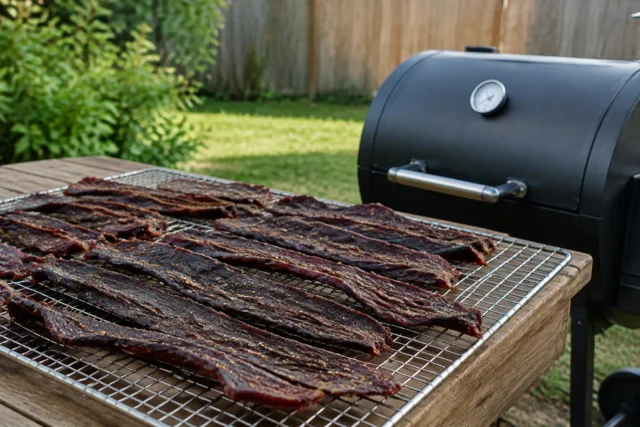
Once the batch is dry, the next step is packing it well, and SaltRail’s storage guides cover vacuum sealing and freezer setup. If you use a smoker instead, see venison jerky in a smoker for what NDSU and USDA FSIS say.
This is general guidance based on USDA recommendations. When in doubt, follow the USDA FSIS source linked above.