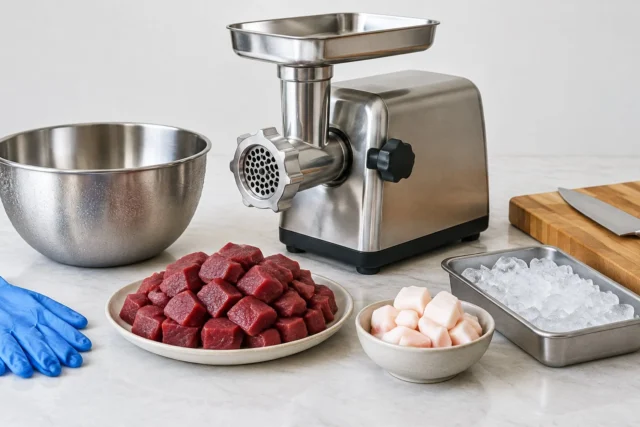
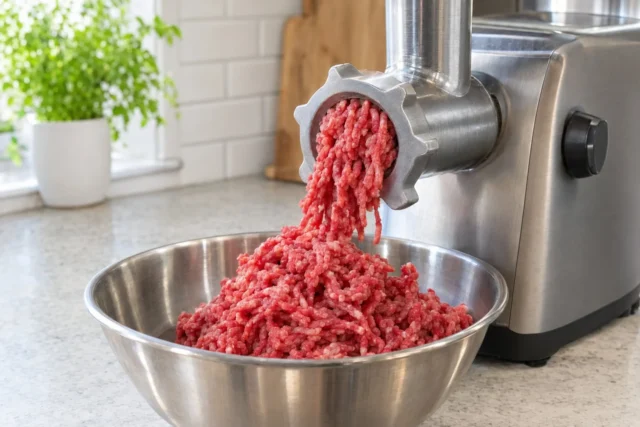
Keep the pork at 40°F or colder, cut it into pieces that fit the grinder, grind it through a coarse plate, then grind again through a fine 1/8 or 3/16 inch plate. UGA Extension says a single grind is usually not adequate for sausage. Cook ground pork to 160°F (USDA), and use raw ground meat within 1 to 2 days or freeze it.
This guide compares UGA Extension’s Bulletin 1437, Basics of Sausage Making, NDSU Extension’s FN176, The Art and Practice of Sausage Making (revised October 2022) and FN572, Food Safety Basics, Mississippi State Extension’s P2692, Making Sausage at Home, and USDA FSIS’s Fresh Pork From Farm to Table (December 10, 2024) and Refrigeration and Food Safety. The extension sources are written for sausage making; this page says so where their figures apply only to sausage.
What Cut and How Much Fat?
| Product | Fat | Source |
|---|---|---|
| Fresh pork sausage (USDA definition) | No more than 50% fat by weight | UGA, citing USDA |
| Fresh pork sausage, typical | 30 to 45% fat | UGA |
| Pork sausage recipe | 2/3 lean, 1/3 fat (adjust to taste) | Mississippi State |
| Game sausage with pork added for fat | 15 to 20% fat; a pork shoulder butt is a common fat source | UGA |
Mississippi State says pork shoulders, hams and loins are often boned for sausage, and that pork trimmings should be no more than 5 days old and kept at 40°F or lower. No source gives a fat ratio for plain ground pork that isn’t made into sausage.
How Cold Should the Pork Be?
NDSU says to keep meat as cold as possible, 40°F or lower, during processing; UGA says raw meat must be kept below 40°F at all times. Mississippi State goes further: it chills the meat to approximately 32°F to minimize fat smearing. UGA adds that dull knife blades make excessive heat and a smeared product.
How Do You Grind Pork, Step by Step?
- Chill the pork to 40°F or below (UGA; NDSU), or near 32°F (Mississippi State).
- Trim out gristle and bone fragments so the plate and blade fit together, and cut the lean and fat into small pieces for the grinder (UGA; Mississippi State).
- Check that the knife blade is sharp and matches the plate (UGA).
- Grind through a coarse plate: UGA uses 3/8 inch; Mississippi State uses ½ to ¾ inch.
- For sausage, mix in the seasonings now (UGA; NDSU).
- Grind again through a fine 1/8 or 3/16 inch plate (UGA; Mississippi State).
- Work in batches; NDSU suggests up to 25 pounds at a time for even mixing.
- Package, refrigerate or freeze right away, and clean the grinder.
UGA says that if you only have one plate, you can add the spices to the meat pieces and grind twice through the small plate. For when a second pass helps, see should you grind meat twice; for grinding other meats, how to grind venison and how to grind chicken. For lamb, see the lamb sections below.
Which Plate Size?
| Grind | Plate holes | Source |
|---|---|---|
| Coarse | 1/4, 3/8 or 1/2 inch | UGA |
| Fine | 1/8 or 3/16 inch | UGA |
| First pass | 3/8 inch (UGA) or ½ to ¾ inch (Mississippi State) | UGA; Mississippi State |
How Do You Clean the Grinder?
UGA and NDSU both sanitize with 1 tablespoon of chlorine bleach per gallon of water and let surfaces air dry. For bones, see can you grind bones in a meat grinder. For boards, see how to sanitize a cutting board after raw meat.
How Long Does Ground Pork Keep?
| Source | Product | Refrigerator | Freezer (quality) |
|---|---|---|---|
| USDA FSIS (Refrigeration) | Raw ground meats | 1 to 2 days | Not given |
| NDSU FN572 | Raw ground meat, at 41°F or lower; ground pork frozen | 1 to 2 days | 1 to 2 months |
| NDSU FN176 | Fresh pork sausage | Within 3 days, or freeze | Not given |
| Mississippi State | Fresh pork sausage | No more than 3 days | 2 to 4 months |
| UGA | Fresh sausage, at 35 to 40°F | 7 to 10 days | 4 to 6 months |
UGA’s 7 to 10 days is the outlier. SaltRail’s suggestion: for plain ground pork, use the FSIS and NDSU figure of 1 to 2 days, the shorter one. NDSU gives ground pork a shorter freezer time (1 to 2 months) than ground beef (3 to 4 months).
SAFETY: USDA recommends cooking ground pork patties and ground pork mixtures such as meat loaf to 160°F (FSIS); UGA uses 160°F for pork sausage too. Whole pork chops and roasts are 145°F, but ground pork is 160°F. Check with a calibrated thermometer; see how to calibrate a meat thermometer and is it safe to grind your own meat at home.
Which Cuts Make Ground Lamb?
K-State says the shoulder can be used for ground lamb, depending on the customer’s preference, and that the foreshanks can go into ground lamb if you don’t want them whole. It also says lamb carcasses produce less trim for ground lamb than pork or beef carcasses. Virginia Tech adds that turning a primal into ground product gives yields similar to boneless cuts, because the bones must be removed before grinding.
How Much Cooked Meat Does Ground Lamb Give?
FSIS says a pound of ground lamb or boneless lamb yields about 10.5 ounces of cooked meat.
What Do the Sources Not Say?
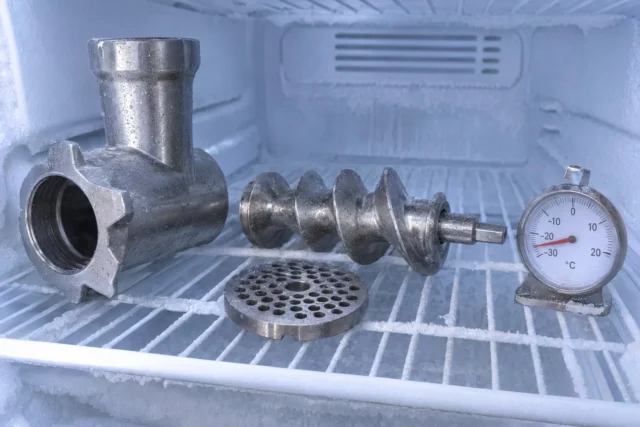
- Whether to chill the grinder parts in the freezer first.
- A fat ratio for plain ground pork, as opposed to sausage.
- How much ground pork a pork butt yields.
- Recipes for turning it into sausage. For those, see homemade Italian sausage and how to make bratwurst.
Frequently Asked Questions
What cut of pork is best for grinding?
Mississippi State says pork shoulders, hams and loins are often used for sausage, and UGA names the pork shoulder butt as a common fat source.
What plate size should you use to grind pork?
UGA grinds through a 3/8 inch coarse plate, then a 1/8 or 3/16 inch fine plate. Mississippi State starts with ½ to ¾ inch.
Should you grind pork once or twice?
For sausage, UGA says a single grind is usually not adequate: grind coarse, mix, then grind fine.
How long does fresh ground pork last in the fridge?
FSIS and NDSU give raw ground meat 1 to 2 days. Fresh sausage figures run from 3 days (NDSU, Mississippi State) to 7 to 10 days (UGA).
What temperature should ground pork be cooked to?
160°F. USDA FSIS recommends it for ground pork patties and mixtures, and UGA uses it for pork sausage.