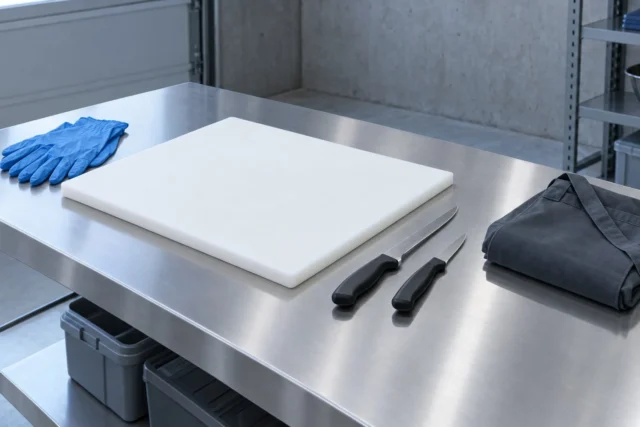
Wash the board with hot, soapy water right after cutting raw meat, rinse it with clear water and let it air dry. To sanitize, USDA FSIS says to flood the board with 1 tablespoon of unscented liquid chlorine bleach per gallon of water, let it stand for several minutes, then rinse and dry. Keep a separate board for raw meat.
The steps come from the USDA Food Safety and Inspection Service (FSIS) page Cutting Boards (updated August 27, 2024) and the CDC’s Preventing Food Poisoning page (November 24, 2025). For butchering day, this guide adds the Wisconsin DATCP Safe Venison Handling fact sheet (February 2019), Clemson Extension’s Safe Handling of Wild Game Meats (revised March 8, 2007) and the CDC brochure for feral swine hunters. The sources give different bleach strengths for different jobs, and you see all of them.
How Do You Sanitize a Cutting Board After Raw Meat?
FSIS’s method, step by step:
- Wash it right away. Use hot, soapy water after each use. The CDC says to wash cutting boards with hot, soapy water after preparing each food item.
- Rinse with clear water.
- Sanitize if you choose. FSIS says both wooden and plastic boards can be sanitized with 1 tablespoon of unscented liquid chlorine bleach per gallon of water. Flood the surface with the solution.
- Let it stand for several minutes.
- Rinse again with clear water.
- Dry it. Air dry, or pat dry with clean paper towels.
SAFETY: Wash the board with hot, soapy water after every use, and wash your hands for at least 20 seconds after handling raw meat (CDC). If you sanitize with bleach, use unscented liquid chlorine bleach, as FSIS says, and follow the product label, as the CDC hunter brochure says.
How Strong Should the Bleach Solution Be?
The sources give three very different strengths, each for a different job. SaltRail does not pick one:
| Source | Strength | What it is for | Contact time |
|---|---|---|---|
| USDA FSIS | 1 tablespoon of unscented liquid chlorine bleach per gallon of water | Sanitizing wooden and plastic cutting boards | Let stand several minutes, then rinse |
| CDC feral swine hunter brochure | 10%: 1 cup of bleach to 9 cups of water | Gloves and boots after handling feral swine | Not stated |
| Wisconsin DATCP | 50/50 household chlorine bleach and water | Knives and equipment, counters and surfaces after deer processing | Soak knives and equipment for an hour; wipe surfaces down |
The DATCP strength comes from a fact sheet on chronic wasting disease and lead in deer processing, and the CDC strength from a brochure on brucellosis in feral swine. FSIS’s 1 tablespoon per gallon is the only figure of the three written for cutting boards.
Wood or Plastic: Which Is Better for Raw Meat?
FSIS says you can choose either wood or a nonporous surface such as plastic, marble, glass or pyroceramic, and that nonporous surfaces are easier to clean than wood. Both can be sanitized with the same bleach solution.
| Board | Dishwasher? | FSIS notes |
|---|---|---|
| Plastic or acrylic | Yes | Nonporous, easier to clean than wood |
| Glass | Yes | Nonporous |
| Solid wood | Yes | Can be sanitized with the bleach solution |
| Laminated wood | No | May crack and split in a dishwasher |
| Bamboo | Not stated | Harder and less porous than hardwoods; clean with hot soapy water, sanitize if desired and rub with mineral oil |
Can You Put a Cutting Board in the Dishwasher?
FSIS says nonporous acrylic, plastic or glass boards and solid wood boards can be washed in a dishwasher. Laminated boards may crack and split.
Why Use a Separate Board for Raw Meat?
The CDC says to use one cutting board or plate for raw meat, poultry and seafood, and a separate one for produce, bread and other foods that won’t be cooked. FSIS suggests the same: one board for fresh produce and bread, and another for raw meat, poultry and seafood.
What About Knives and Counters on Butchering Day?
Wisconsin DATCP says to clean knives and equipment of residue with soapy water and then disinfect them by soaking for an hour in a 50/50 solution of household chlorine bleach and water. After cleaning counters with soapy water, it says to wipe them down with the same 50/50 solution. It also says to use knives dedicated to hunting, and if you must use household knives, to clean and sanitize them with that solution.
Clemson Extension says to keep raw and cooked meat separate and to wash your knife, hands and cutting board often with warm, soapy water. The CDC hunter brochure says to clean surfaces with hot, soapy water before and after butchering. For the grinder, see how to clean a meat grinder, and for the full job, how to butcher a deer and is it safe to grind your own meat at home.
When Should You Replace a Cutting Board?
FSIS says that once cutting boards become excessively worn or develop hard-to-clean grooves, they should be discarded. For blades, see the best knife for processing deer.
What Do the Sources Not Say?
None of the pages opened for this post covers vinegar, hydrogen peroxide or other sanitizers, or gives oiling advice for wood boards beyond FSIS’s mineral oil line for bamboo. FSIS gives no exact standing time beyond several minutes, and the CDC brochure gives no contact time for its 10% solution.
Frequently Asked Questions
How much bleach do you mix to sanitize a cutting board?
USDA FSIS says 1 tablespoon of unscented liquid chlorine bleach per gallon of water. Flood the board, let it stand several minutes, then rinse with clear water and dry.
Do you have to sanitize a cutting board after raw chicken?
FSIS and the CDC say to wash cutting boards with hot, soapy water after each use. FSIS says boards can also be sanitized with its bleach solution.
Can a wooden cutting board go in the dishwasher?
USDA FSIS says solid wood boards can be washed in a dishwasher, but laminated boards may crack and split.
Is a plastic or wood cutting board better for meat?
USDA FSIS says either is fine, but nonporous surfaces such as plastic are easier to clean than wood. Use a separate board for raw meat.
When should you throw out a cutting board?
USDA FSIS says to discard cutting boards that are excessively worn or have hard-to-clean grooves.
Processing birds too? See how to butcher a chicken, and for deer, how to field dress a deer.
This is general guidance based on USDA FSIS, CDC, state and university extension recommendations. When in doubt, follow the sources linked above.