To butcher a chicken at home, pull feed 6 to 12 hours ahead but leave water, kill in a cone with the esophagus intact, scald near 140°F until wing feathers pull easily, then pick, open, and clean the bird and chill it to 40°F within 4 hours. Every other step supports those numbers.
After reading, you can set up clean and dirty stations, run each step in order, and spot birds and organs you should not keep. The steps come from three university extension guides and USDA FSIS storage rules. Where those sources disagree on fasting, scald heat, or fridge time, you see both figures side by side. For wild birds, see how to clean a wild turkey. For ducks, see how to clean a duck.
What You Need Before Processing
A good processing day depends on three things you settle before you catch a bird: gear placed at the right station, birds taken off feed on time, and a layout that keeps dirty work away from finished meat.
Which Equipment Belongs at Each Station?
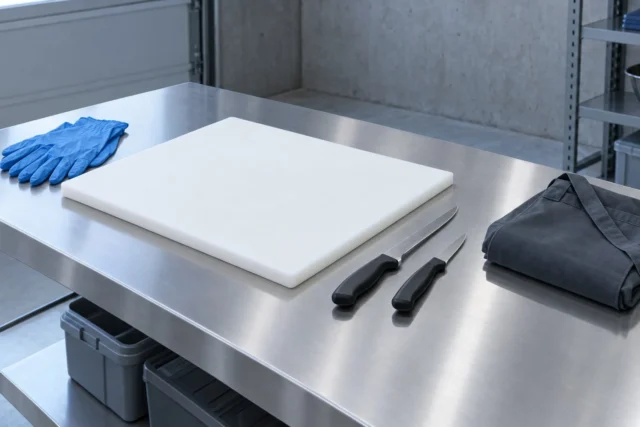
Group your gear by job, then set the stations in a line. The University of Minnesota Extension lists a thermometer that reads between 120 and 212°F, sharp boning knives, clean cans for scald and chill water, and a plastic-covered table. For thermometer types, see our roundup of the best meat thermometers for sausage and jerky.
| Station | Equipment | Why it matters |
|---|---|---|
| Kill | Killing cone, bucket below, sharp knife | The cone holds the bird still and upside down |
| Scald | Large pot or can, heat source, thermometer | Water heat has to stay in a narrow range |
| Pick | Chicken plucker or a clean tub for hand-picking | A plucking machine saves time on bigger batches |
| Eviscerate | Plastic-covered table, boning knife | A smooth surface cleans fast |
| Chill | Can or cooler of ice water | Brings meat down to 40°F |
| Package | Freezer bags, labels, marker | Stops freezer burn and mix-ups |
For the knife itself, the traits that make a knife good for processing deer (a firm grip and an edge that holds) apply to poultry too.
How Long Should Chickens Go Without Feed?
Take feed away 6 to 12 hours before processing, and keep water available the whole time. The three extension guides give different windows.
| Source | Time off feed |
|---|---|
| University of Minnesota Extension | 6 to 8 hours |
| K-State Research and Extension | 8 to 10 hours |
| University of Kentucky Extension | Ideal 8 to 12 hours, minimum 6 |
Kentucky explains both edges of the range. Too short, and feed stays in the crop and gut. Too long, and the gut contents turn watery and the intestines get fragile, which makes them easier to break.
How Do You Keep Dirty and Clean Work Separate?
Run the steps in one direction, from live bird to cold bag, and never carry a finished bird back past the kill or pick area. Feathers, blood, and gut contents belong at the start of the line. Chilled carcasses belong at the end.
- Wash your hands each time you move from the dirty end to the clean end.
UMN puts it plainly: always wash your hands, equipment, and work space after contact with raw poultry. The same habits from home butchery of larger animals carry over here.
Follow the Processing Steps in Order
The work runs as one sequence: bleed in the cone, scald, pick, trim, open, and remove the organs. Each step sets up the next, so doing them out of order costs you time or meat.
Use the Cone and Follow Extension Slaughter Guidance
A killing cone is a funnel that holds the bird head-down while it bleeds. UMN and Kentucky both describe using one.
- Place the bird head-first into the cone.
- Make the cut as your extension guide describes. UMN cuts from the outside just behind the lower jaw; Kentucky describes cutting the jugular veins.
- Keep the esophagus and windpipe intact. Both UMN and Kentucky say this.
- Avoid cutting the spinal cord. Kentucky notes a cut spinal cord is said to “set” the feathers and make picking harder.
- Let the bird bleed out fully in the cone before moving on.
Kentucky also says any bird that dies before it reaches the cone should be thrown out.
Scald the Bird and Check Feather Release
Scalding means dipping the bird in hot water to loosen feathers. The sources disagree on heat and time:
| Source | Bird | Water temp | Time |
|---|---|---|---|
| UMN | Young birds | 125 to 130°F | 30 to 75 seconds |
| UMN | Older birds | Near 140°F | 30 to 75 seconds |
| K-State | All | 140°F | 30 to 40 seconds |
| Kentucky | All | About 140°F | Not stated |
All three agree on the test: when the wing and tail feathers pull out easily, the scald is done. Water that runs too hot partly cooks the skin and makes it tear (Kentucky, K-State).
Pluck Promptly, Then Remove the Head, Shanks, and Oil Gland
UMN is direct: do not delay picking after the scald.
- Pick by hand or run the bird through a chicken plucker. A plucking machine strips a bird quickly; hand-picking works for a few birds.
- Pull pinfeathers at the table.
- Cut the head off between the head and the first neck vertebra (UMN).
- Cut the shanks off at the hock joint (UMN).
- Remove the oil gland. UMN says to start the cut 1 inch forward of the gland’s nipple and scoop it out.
The oil gland sits on top of the tail. Kentucky says removing it is not required for food safety reasons; UMN’s steps still include it.
Open the Abdomen Without Cutting the Intestines
UMN uses a “J” cut to open the belly. Make a shallow cut through the skin below the keel (breastbone), then curve it around the vent.
Keep the blade shallow and pull the skin up as you cut. UMN warns: don’t cut into the intestine. Kentucky adds that a nicked or broken intestine leads to fecal contamination of the carcass.
Remove the Organs and Separate the Giblets
SaltRail’s suggestion: reach in along the top of the body cavity and work slowly so nothing tears.
- Pull the crop free from the neck end.
- Cut around the vent so the intestines come out attached.
- Scrape out the lungs, which sit against the backbone.
- Set the heart, liver, and gizzard aside as giblets.
Kentucky says to handle the gall bladder with care so bile does not stain the liver.
Inspect, Chill, and Package the Chicken
After the organs are out, you have three jobs: check that the bird is fit to eat, get it cold fast, and pack it for the fridge or freezer.
Which Birds and Organs Should You Not Use?
UMN and K-State share the same reject list. Do not use a bird if you see any of these:
- Lumps or spots of any size on the liver surface
- Any measurable fluid in the body cavity
- Orange fat in a poorly fleshed bird
- An organ two or more times its normal size
- Breast meat the color of thigh meat
- White streaks in the meat
Kentucky describes normal organs. A healthy liver is mahogany to light tan. Healthy lungs are bright pink with no lumps.
Prepare Giblets and Rinse at the Processing Station
Kentucky says to cut the gizzard open and peel off the inner membrane. SaltRail’s suggestion: keep the gizzard, heart and liver together in a clean container on ice.
Rinse the carcass inside and out at the processing table. All three extension guides include this rinse. USDA FSIS says washing raw poultry before cooking is not recommended. These are two separate steps: rinse during processing, and skip washing in your home kitchen later.
How Quickly Must the Carcass Be Chilled?
Kentucky’s target is 40°F or lower in less than 4 hours, using a tank of water and ice. K-State says to keep carcasses in an icy slush until all birds are processed, and to chill below 40°F or freeze them.
SAFETY: Get every bird to 40°F or below in less than 4 hours (University of Kentucky Extension). K-State says to keep carcasses in an icy slush until all birds are processed. SaltRail’s suggestion: check the thickest part of the breast with a probe thermometer and add ice as it melts.
Should You Package the Bird Whole or Cut It Into Pieces?
UMN’s cut-up order runs: legs, thighs, wings, back, then breast. SaltRail’s suggestion: package whole if you plan to roast, and cut into pieces if you cook in parts. For stock from the carcass bones, see how to can bone broth.
Whole birds keep longer in the freezer than parts (see the FSIS chart below). You can flash freeze meat pieces on a tray first so they stay loose in the bag. To grind the meat, see how to grind chicken. To cut the chilled bird into parts, see how to cut up a whole chicken.
How Long Can You Refrigerate or Freeze the Meat?
USDA FSIS gives these limits:
| Product | Refrigerator | Freezer (quality) |
|---|---|---|
| Fresh whole chicken | 1 to 2 days | 1 year |
| Fresh chicken parts | 1 to 2 days | 9 months |
| Giblets | 1 to 2 days | 3 to 4 months |
FSIS notes freezer times are for quality only; frozen food stays safe indefinitely. K-State’s older guide allows less than 4 days in the fridge. Use the shorter FSIS number. Mark the date and cut on each bag; good habits for labeling frozen meat keep you within those windows. To preserve the meat in jars instead, see how to can chicken.
Troubleshooting Common Processing Problems
Most problems trace back to scald heat, timing, or the fast. Each one below has a cause and a fix.
Feathers Will Not Pull Free
The scald was too cool or too short, or the bird sat too long before picking. UMN says a scald that is long enough lets the tail and wing feathers come out easily, so re-dip for a short time and try the wing feathers again. Check your thermometer between birds. Kentucky’s note about the spinal cord applies too: a cut cord can set the feathers.
Skin Tears During Plucking
The water was too hot or the bird stayed in too long. K-State warns the skin will be slightly cooked and tear easily if the water is too hot. Lower the heat toward UMN’s 125 to 130°F for young birds, and shorten the dip.
The Crop Is Still Full
The birds did not fast long enough. Kentucky ties short fasting to feed left in the crop. Next time, start the fast at least 6 hours ahead, with 8 to 12 hours as Kentucky’s ideal.
The Intestines Break During Removal
Kentucky names two causes: a knife that went too deep, and birds that fasted too long so the intestines turned fragile. Kentucky warns that a nicked or broken intestine leads to fecal contamination. SaltRail’s suggestion: if contents touch the meat, trim that area. Keep the J cut shallow and stay inside the 8 to 12 hour window next time.
Frequently Asked Questions
Can you butcher a chicken without a plucker?
Yes. Hand-picking works well after a good scald, when wing and tail feathers slide out easily. It is slower, so it suits a few birds at a time. A chicken plucker earns its space once you process larger batches, and the scald rules stay the same either way.
Do you have to remove the oil gland?
Kentucky Extension says preen gland removal is not required for food safety reasons. UMN’s method still removes it: start the cut 1 inch forward of the gland’s nipple and scoop it out.
How long can freshly butchered chicken stay in the fridge?
USDA FSIS says fresh chicken keeps 1 to 2 days in the refrigerator, whole or in parts. K-State’s older guide allows less than 4 days, but the federal FSIS figure is shorter and safer. If you will not cook the bird within 2 days, freeze it right after chilling.
Can you sell chickens you butcher at home?
Sometimes, within limits. UMN and K-State describe an exemption of up to 1,000 chickens, turkeys, or geese a year sold within the state, and UMN notes uninspected poultry cannot be sold across state lines. Rules differ by state, so check with your state agriculture agency. The difference between custom exempt and USDA inspected meat explains the basics.
What temperature should home-processed chicken reach when cooked?
USDA FSIS says to cook all poultry to 165°F. Home-processed birds follow the same rule as store-bought chicken.
When your birds are bagged and cold, the next step is keeping them organized; see our guide to organize a chest freezer. If you raise meat rabbits too, see how to butcher a rabbit.
This is general guidance based on university extension and USDA FSIS recommendations. When in doubt, follow the sources linked above.