Natural casings are cleaned animal intestine from sheep, hogs or cattle. They need soaking and flushing before use, and they give a traditional snap and curve. Collagen casings are formed from beef hide, come out the same size every time, and most small ones go on the tube dry. Choose by sausage size, how you will link it, and how much prep you want.
After reading, you will be able to pick a casing by sausage style and diameter, prep it the right way for its type, and stuff and link it without splits. You also get the sourced size ranges in millimeters, the two soak times the sources disagree on, which casings you must peel, and fixes for common casing problems from SaltRail’s stuffer guide.
How Do the Casing Types Compare?
Natural and collagen casings differ in what they are made from, whether you can eat them, and how they bite, hold up and stay uniform. Fibrous, cellulose and plastic casings enter the picture once you move to large or skinless sausage. For where to buy each type, see where to buy sausage casings.
What Are Natural and Collagen Casings Made From?
Natural sausage casings come from three animals: pork, sheep and beef. Sheep casings are the smallest natural casings at 16 to 28 mm, and hog casings run 28 to 40 mm for fresh or fully cooked smoked sausage. Beef casings (rounds, middles and bungs) are used for bologna, salami, ring bologna and Polish sausage.
A collagen casing is a sausage tube made from collagen taken from the inner layer of beef hide, then extruded, dried and pleated. The same AMSA presentation describes collagen as “ready to stuff” and made in different grades for different sausage jobs.
The other common types:
- Fibrous casings: paper with a viscose coating, 34 to 200 mm.
- Cellulose casings: used for skinless links and some large sausages.
- Plastic casings: mostly for cooked sausages, with high moisture barriers.
Which Casings Are Edible, and Which Must You Peel?
Small natural and small collagen casings are eaten with the sausage. Fibrous casings are inedible. Collagen also comes in a large-diameter inedible form, and the FAO states that inedible collagen casings must be removed before eating.
| Casing | Made from | Edible? | Prep | Common size |
|---|---|---|---|---|
| Sheep (natural) | Sheep small intestine | Yes | Soak and flush | 16–28 mm |
| Hog (natural) | Hog intestine | Yes | Soak and flush | 28–40 mm |
| Small collagen | Beef hide collagen | Yes | Stuff dry | 13–43 mm by grade |
| Large collagen | Beef hide collagen | No, peel | Soak per package | Large diameter |
| Fibrous | Paper with viscose | No, peel | Soak per package | 34–200 mm |
Skinless cellulose casings are also inedible. They are peeled off before the sausage is eaten.
How Do Bite, Strength and Uniformity Differ?
Collagen wins on uniformity and overall strength. The FAO notes that edible collagen casings are stronger than natural casings, and artificial casings offer a uniform cylindrical shape.
Natural casings win on look and twist. AMSA lists “knack/snap,” curve and an old-world appearance as sheep casing advantages. It lists machinability, product uniformity, ease of use, soaking and pricing or availability as drawbacks.
Strength and twisting are separate traits. The FAO says edible collagen is stronger than natural casing overall, yet SaltRail’s stuffer guide notes collagen tears when twisted hard, while natural casings are twisted into links.
What Do the Sources Leave Unsettled?
The snap debate is open. AMSA credits sheep casings with the most tender, desirable “knack,” and says early collagen was “relatively thick, chewy” while newer collagen is “strong and easy to use but tender to bite.” A single industry consumer-panel slide in the same deck carries the line “You recognize as being different but consumers don’t!” One slide is thin evidence either way.
Soak time is also open. Mississippi State University Extension says to soak salted natural casings in lukewarm water for 30 minutes, then run cold water through them. SaltRail’s stuffer guide gives 85 to 90°F water for at least 10 minutes. Neither is wrong for every casing, so follow your package.
Which Casing Fits the Sausage You Are Making?
Match the casing to the sausage’s diameter first, then to how you will link and cook it. Breakfast links and sticks, brats and smoked links, and large dry sausage each point to a different casing.
| Sausage | Casing | Size (AMSA) | Edible? | Stuffing tube |
|---|---|---|---|---|
| Snack sticks | Beef-stick collagen | 13–23 mm | Yes | 16 mm (about 1/2″) |
| Breakfast links | Sheep | 16–28 mm | Yes | 16–19 mm |
| Brats, Italian | Hog | 28–40 mm | Yes | 22–25 mm |
| Smoked links | Hog or processed-meat collagen | 28–40 mm / 13–43 mm | Yes | 22–25 mm |
| Summer sausage | Fibrous or large collagen | 34 mm and up | No | 38 mm (1 1/2″) |
Tube sizes come from SaltRail’s stuffer guide, which pairs the 16 mm tube with 16-19 mm collagen and the 38 mm tube with casings of 40 mm and up; the smoked-links figure is the hog row’s. AMSA says to leave at least 1 mm between the casing’s inner bore and the tube, so choose the tube from your casing’s actual diameter.
What Should You Choose for Breakfast Links and Snack Sticks?
Use sheep casings for breakfast links. They are the smallest and most tender natural casing, and SaltRail’s stuffer guide says natural casings are twisted into links. Sheep casings come in grades; A, AA or FQ are the highest quality, while lower grades have pinholes.
Use collagen for snack sticks. AMSA’s beef-stick collagen runs 13 to 23 mm, built for strong cross-linking and good performance at cold temperatures.
What Works for Bratwurst, Italian Sausage and Smoked Links?
AMSA lists hog casings (28 to 40 mm) for fresh or fully cooked smoked sausage, which covers bratwurst and Italian links, and natural casings twist into links. For a bratwurst recipe, see how to make bratwurst. For hot dogs, see how to make hot dogs.
Collagen works here too. Fresh-sausage collagen covers 16 to 32 mm for grilling and frying. Processed-meat collagen covers 13 to 43 mm and is made for smoked sausage and franks. Match the collagen grade on the package to how you will cook the sausage.
If you are planning a full batch of homemade sausage, start with fat ratio and grind size in our sausage making coverage, then pick the casing.
How Do Summer Sausage and Salami Change the Choice?
Large sausages move you into casings you peel. Fibrous casings are inedible and peeled. Mississippi State University Extension notes fibrous casings are permeable to smoke and moisture.
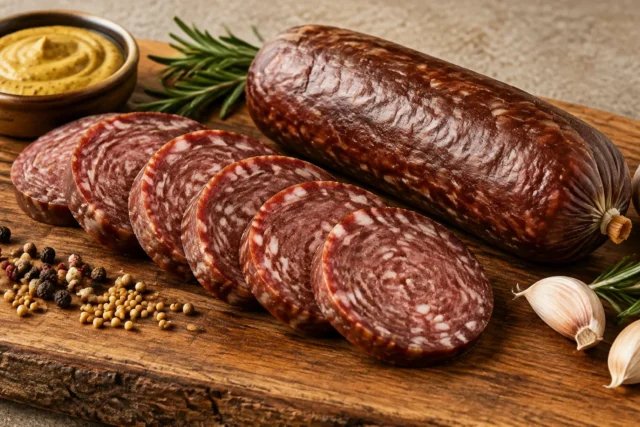
Large-diameter inedible collagen is ideal for dry and semi-dry sausage, per AMSA. Traditional salami also uses natural hog bungs (50 to 90 mm) and beef middles. For cure and smoke numbers, follow a published recipe such as our venison summer sausage recipe. For a smaller smoked stick, see how to make snack sticks.
How Do You Prepare, Stuff and Link Your Casings?
Prep depends on casing type, and the fill and link steps follow from that. Check the package, prep for the type, fill without forcing, then link the way the casing allows.
What You Need
Equipment by type:
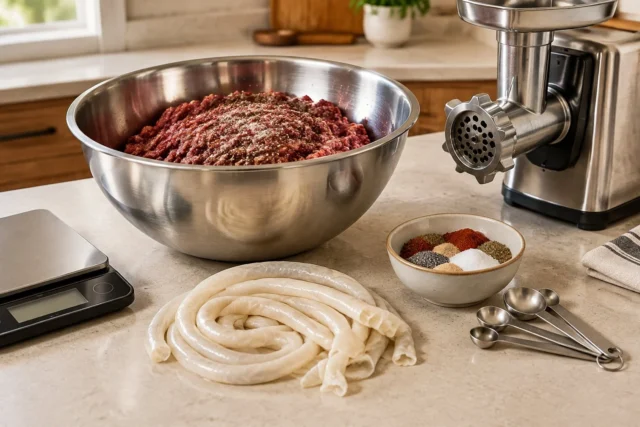
- Stuffer: a vertical manual sausage stuffer with an air-release valve.
- Grinder: sized for your batch; our meat grinder size guide covers plate and head sizes.
- Scale: one that reads grams.
- Stuffing tubes: sized to your casing (table above).
- Bowl of lukewarm water: for natural casings.
- Cotton twine, hog rings and a sausage pricker.
- Food thermometer: see our meat thermometers for sausage and jerky.
Casings: the type and diameter from the table above. Salt and cure amounts come from your recipe, not from this guide.
SAFETY: Fresh sausage is raw until cooked. USDA FSIS’s Safe Minimum Internal Temperature Chart lists 160°F for ground meats and 165°F for ground poultry, measured with a food thermometer.
Step 1: Check the Package and Match the Stuffing Tube
- Read the label for edible or inedible, and for soak instructions. Large collagen and fibrous need peeling, and prep varies by maker.
- Pick the largest tube the casing slides onto easily. AMSA calls for at least 1 mm between the casing’s inner bore and the tube.
- Run a fingertip around the tube tip. A burr nicks casings and starts splits.
Step 2: Prepare the Casing for Its Type
- Natural casings: rinse off salt, soak, then flush cold water through each strand. Mississippi State Extension says 30 minutes in lukewarm water; SaltRail’s stuffer guide says at least 10 minutes at 85 to 90°F.
- Small edible collagen: keep it dry and put it straight on the tube. AMSA’s first rule is “stuff dry”.
- Large collagen and fibrous: soak as the package directs. AMSA lists a 10 to 15% brine soak for large collagen, and fibrous is soaked before use except ready-to-use types.
- Resalt any leftover natural casing the same day, as the FAO directs.
Step 3: Load and Fill Without Forcing the Casing
- Push meat to the tube tip before loading the casing. This purges air from the tube.
- Slide the whole casing on and tie the end. A sealed end lets pressure build evenly.
- Crank at a steady pace and hold the casing near the tip with light pressure. Starts and stops cause air gaps.
- Fill firm with some give. Collagen should be stuffed to its recommended size; AMSA warns against understuffing, while overstuffing splits natural casings when you twist.
- Prick air pockets with a clean pin.
Step 4: Link or Tie as the Casing Allows
- Natural casings: pinch at link length and twist, alternating direction each link. Alternating keeps links from unwinding.
- Collagen: tie each link with cotton twine. Collagen tears when twisted hard.
- Fibrous and large collagen: leave roughly 2 inches empty at the open end (SaltRail’s stuffer guide), twist the end, and close with twine or hog rings.
- Lay links on a sheet pan and refrigerate right away.
What Should You Do When Casings Cause Problems?
Most casing problems trace back to prep, tube size or fill pressure, and each has a direct fix.
Casings Split During Stuffing: Check the Tube and Filling Technique
SaltRail’s stuffer guide traces splits to a burr on the tube tip, old or brittle casings, the wrong soak, or overfilling. Smooth or replace a nicked tube, replace brittle casings, and back off the crank a little. Keep collagen dry and give natural casings a full soak.
Collagen Links Tear When Twisted: Use the Linking Method Specified
SaltRail’s stuffer guide says collagen tears when twisted hard. SaltRail’s stuffer guide says about 3/4 full for collagen you will tie, while AMSA says to stuff to the casing’s recommended size, so follow the package. Tie links with twine. If the package says the casing can be twisted, keep it to gentle twists and alternate directions.
Casings Feel Tough After Smoking: Review Drying and Smoking
AMSA states that collagen bite is “strongly influenced by” drying and smoking, and too much of either makes the casing tough. Humidity during the cook is what keeps the bite tender. For smoked sausage, check your heat and timing against our guide on how to smoke sausage in an electric smoker, and see our smoking coverage for other setups.
Frequently Asked Questions
Can you eat collagen sausage casings?
Yes, small collagen casings sold for links and sticks are edible. Large-diameter collagen for summer sausage and salami is inedible, and the FAO says it must be removed before eating. Check the package label before cooking.
Is collagen casing made from pork or beef?
Most collagen casings come from beef. AMSA traces collagen casings to the inner layer of beef hide. Some co-extruded collagen uses beef or pork collagen, so read the species on the label.
Do natural casings taste different from collagen casings?
The sources describe the difference as bite and look, not flavor. Natural casings are credited with snap and a curve, while newer collagen is described as tender to bite. One industry panel slide suggests many consumers cannot tell them apart.
Can you twist collagen casings into links?
Twisting collagen is risky because it tears when twisted hard. Tie links with cotton twine instead. Natural sheep and hog casings are the better pick when you want twisted links.
Are fibrous casings the same as collagen casings?
No, fibrous casings are made from paper with a viscose coating, and they are inedible. They run 34 to 200 mm and suit summer sausage. Collagen comes from beef hide and is edible in small sizes.
Ready to fill your first batch? Set up with our manual sausage stuffer guide and match the tube to the casing you chose.