
As an Amazon Associate I earn from qualifying purchases.
A meat grinder’s number, like #8, #12, #22 or #32, describes the size of the grinder head and the plate that fits it, while the plate’s hole diameter, from 3 mm to 12 mm, controls how fine or coarse your grind comes out. For most home processors handling a deer or two a year, a #12 grinder with a 10 mm and a 4.5 mm plate covers nearly everything.
After reading, you will be able to pick a grinder number that matches your yearly volume, order a replacement plate that fits the first time, and choose hole sizes for burgers, snack sticks or bologna. You will also get the cold-meat numbers that keep a grind clean and safe, which most size charts leave out.
What Do Meat Grinder Numbers Mean?
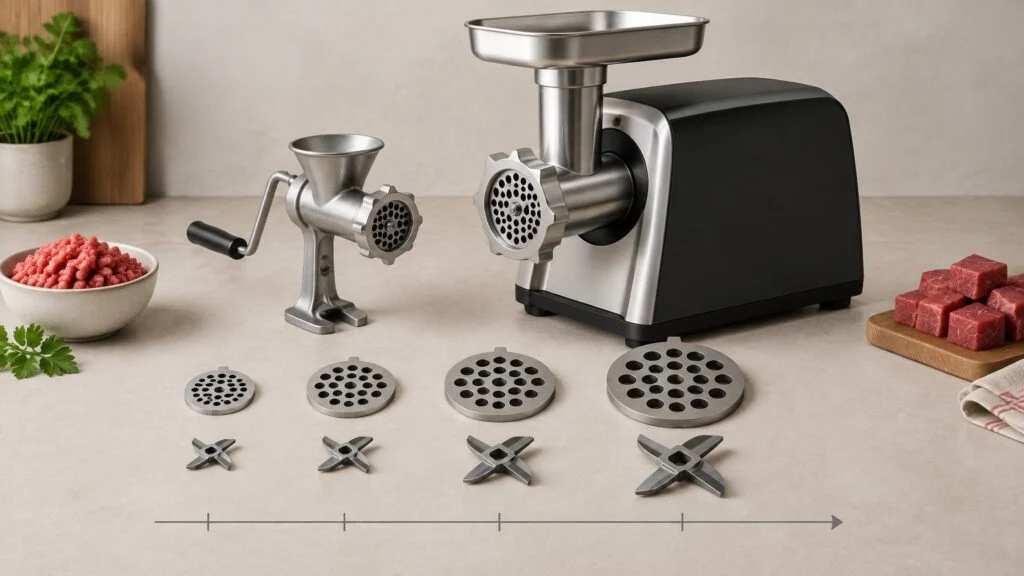
When comparing different meat grinder sizes, three separate measurements get blurred together: the grinder number, the plate diameter it corresponds to, and the motor rating printed on the box. The number tells you which parts fit, the diameters vary by size, and the motor is a separate spec entirely.
The Grinder Number Refers to the Head and Plate, Not Motor Power
A grinder number is a size code for the head opening and the plates, knives and stuffing plates that fit inside it. It says nothing about horsepower.
Two #12 grinders can carry very different motors. LEM’s #12 BigBite runs a 0.75 HP motor with a 2.25″ head opening, while its #32 pairs a 1.5 HP motor with a 3″ opening. Same idea, different scale.
Common Plate Diameters for #5, #8, #12, #22, and #32 Grinders
Across standard meat grinder sizes, plate diameter climbs with the grinder number. LEM’s stuffing plate line lists the diameters clearly, and the grinding plates match them.
| Grinder size | Plate diameter |
|---|---|
| #5 | 2⅛” |
| #8 | 2⅜” |
| #10/12 | 2¾” |
| #20/22 | 3¼” |
| #32 | 3⅞” |
Those figures come straight from LEM’s stuffing plate sizing. If you already own plates and do not know your grinder size, measure one across the face and match it to the chart. Determining your correct meat grinder size ensures replacement parts fit seamlessly.
Why Parts Must Match the Grinder Head Size
Plates and knives are not interchangeable between sizes. A #22 plate will not seat in a #32 head, and forcing a near-fit plate creates a gap between knife and plate that smears meat instead of cutting it.
Buy the plate and knife together. A sharp knife riding against a worn plate dulls quickly, and LEM recommends changing both at the same time.
Which Meat Grinder Size Fits Your Batch and Meat?
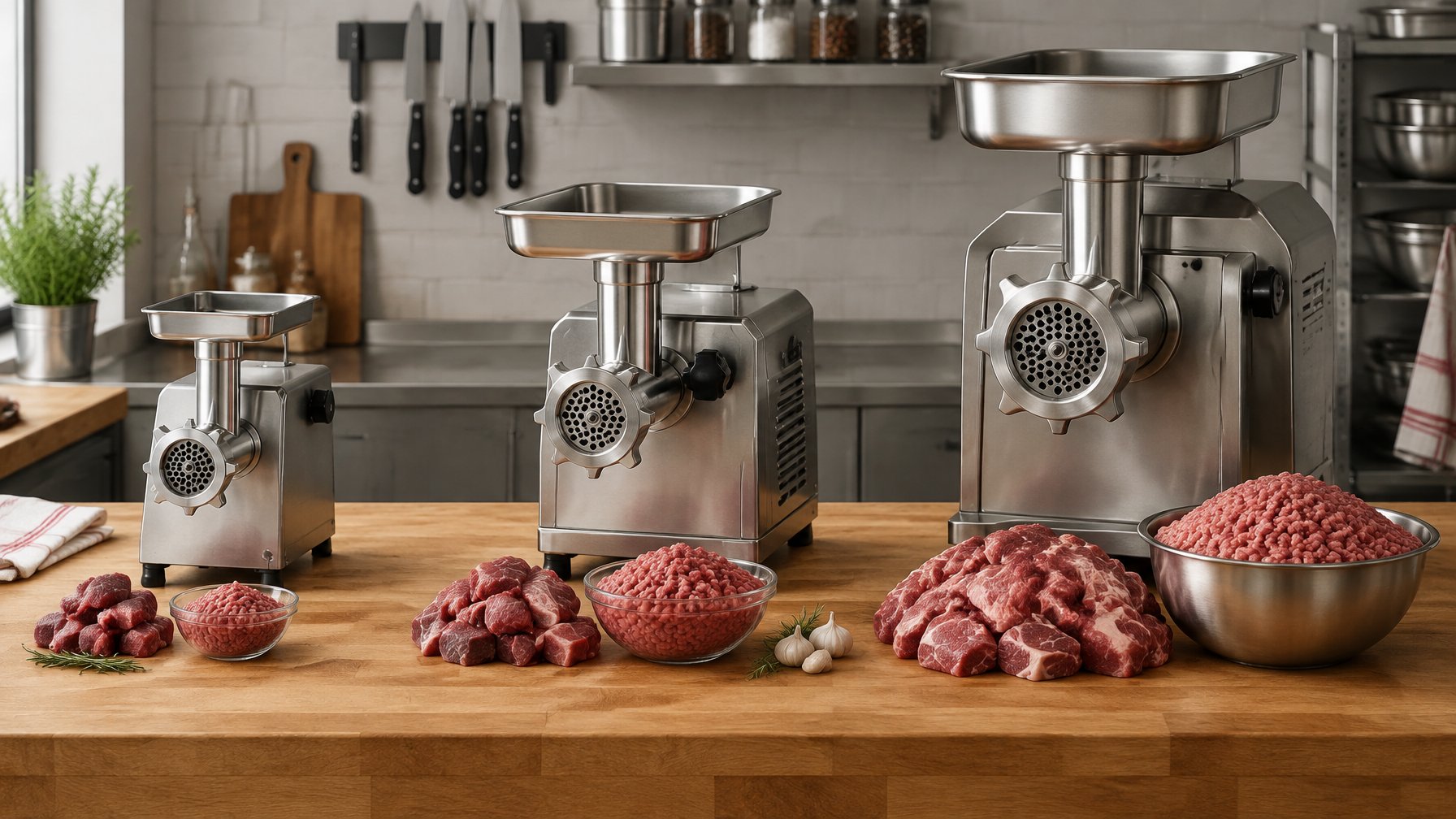
Batch weight and meat type drive the choice of meat grinder size: a few pounds of ground beef at a time, raw pet food batches, one or two deer a year, or a whole elk plus a hog. Feeding tube size and motor design matter once the volume climbs.
Small Batches of Ground Beef, Pork, and Poultry
A #5 or #8 grinder handles 5 to 20 lb batches. LEM’s #8 MightyBite is rated at 4 to 5 lb of meat per minute with a 2″ head opening, which is enough for burger night, breakfast sausage or a tray of chicken thighs.
At that rate, 20 lb takes roughly 5 minutes of grinding time, not counting trimming and chilling.
A #12 Grinder for Regular Family Processing and Venison
A #12 is the practical middle. LEM’s #12 BigBite grinds about 11 lbs. per minute through a 2.25″ head, which clears a single deer’s worth of trim without a long session at the pan.
This is the meat grinder size most home processors settle on after a season or two. It also has good parts availability, since #12 is the common size in light commercial and butcher-shop use.
When a #22 or #32 Makes Sense for Larger Wild Game Batches
Move up when you process more than one large animal a year or split the work with family. The #22 BigBite is rated at up to 13 lbs. per minute, and the #32 at up to 17 lbs. per minute with a 3″ head opening.
Stepping up to larger meat grinder sizes provides a wider throat that swallows larger chunks of venison, which cuts down on pre-cubing.
Feeding Tube Size, Motor Design, and Grinding Speed
Head opening size shapes real grinding speed as much as motor rating does. A 3″ throat takes bigger pieces and needs less stomping than a 2″ throat, directly improving grinding performance during long sessions.
Weight tells you something too. The #12 BigBite weighs 33.07 lbs. and the #32 weighs 57.32 lbs., so a heavy grinder stays put but is harder to move to a garage table.
An Ohio Division of Wildlife study of 115 whitetails found the average deer gave 52.19 pounds of venison (Ohio DNR). Even if you ground all of it, a LEM #8 rated at 7 pounds per minute needs about 8 minutes of motor time. A #12 rated at 11 pounds needs about 5. Real sessions run much longer. Cubing, trimming, chilling between passes and a second grind can each double the time. The bigger head’s real edge is that it takes larger chunks with less pushing.
How Do Plate Diameter and Hole Size Differ?
Plate diameter is a fit measurement; hole diameter is a texture measurement. Getting a replacement right means checking both, then deciding whether a coarse first pass comes before a finer second one.
Match the Replacement Plate Diameter to Your Grinder Number
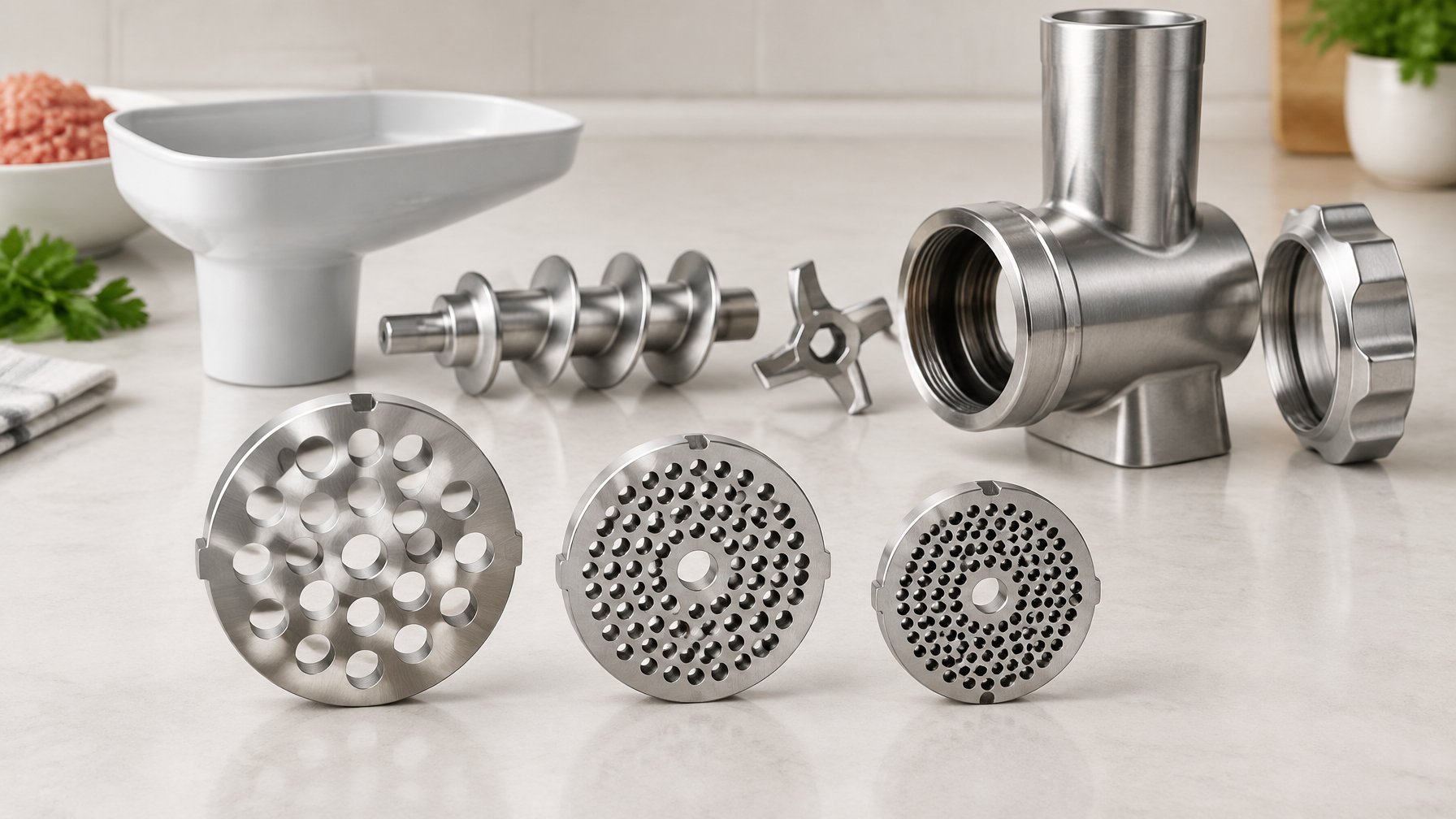
A grinder plate is the perforated stainless steel disc whose outer diameter must match your grinder head, while its hole size sets the grind texture. Understanding common meat grinder plate sizes helps you avoid buying discs that wobble or jam.
LEM’s #8 plates measure 2-3/8″ across. The same hole sizes in the #10/12 plate line measure 2-3/4″, and the #32 plates run 3-7/8″. Order by grinder number, not by grinder plate hole size alone.
Selecting the right meat grinder plate size ensures clean cuts against the knife. Buying replacement meat grinder plates made of solid stainless steel prevents rust and keeps cutting edges crisp.
Whether running a compact unit or a heavy-duty stainless steel grinder, getting the exact grinder plate size is critical. Some plates are hubless, meaning they can be flipped and used on either side to double the working surface.
Choose Hole Diameter for Fine, Medium, or Coarse Grind
Hole size is stated in millimeters or inches, and the two scales line up neatly.
| Hole size | Inch equivalent | Grind |
|---|---|---|
| 3 mm | 1/8″ | Finest |
| 4.5 mm | 3/16″ | Fine |
| 6 mm | 1/4″ | Medium grind |
| 10 mm | 3/8″ | Coarse |
| 12 mm | 1/2″ | Coarsest |
Use a Coarse First Grind Before a Finer Second Pass
Run a 10 mm or 12 mm plate first, then a finer plate second. The coarse pass breaks the meat down without packing the holes, so the second pass cuts cleanly instead of pushing.
Chill the meat again between passes. Warm fat smears.
Which Plate Hole Size Should You Use?
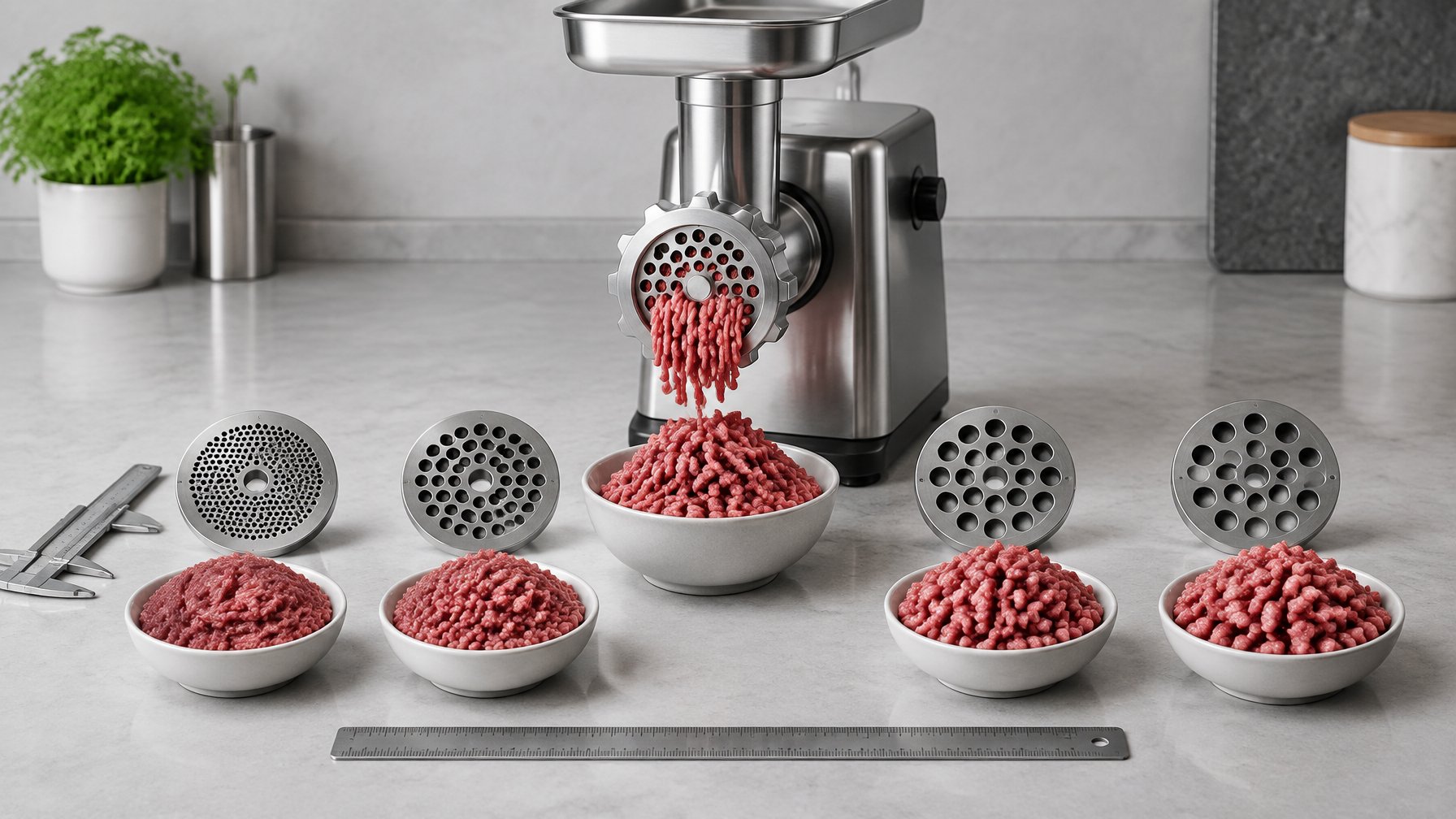
Hole size follows the end product: chunky chili and rustic sausage at the coarse end, everyday ground beef in the middle, hot dogs and bologna at the fine end. In dedicated sausage making, plate selection also determines how well fat and protein bind.
Coarse Plates for Chili, Burgers, and Rustic Sausage
A 10 mm (3/8″) plate is the coarse-grind workhorse and is suited to a first grind, chili, chorizo and linguisa. The 12 mm (1/2″) plate goes coarser still, which fits chunky chili and stew meat.
Some burger makers stop at 10 mm for a loose, open texture that stays juicy on the grill.
Medium Plates for Ground Beef and Fresh Sausage
A 4.5 mm (3/16″) plate provides a versatile medium grind that handles the second grind, coarse hamburger and regular sausage like breakfast, Polish, or German. This is the plate most family kitchens use week to week.
The 6 mm (1/4″) plate sits just above it and suits summer sausage, salami, pepperoni, and snack sticks.
Fine Plates for Hot Dogs, Bologna, and Emulsified Sausage
A 3 mm (1/8″) plate produces the finest standard grind and is called for hamburger, bologna, hot dogs and jerky. Meat through a 1/8″ plate has a smooth, uniform texture with almost no visible grain.
Keep the meat near freezing for fine grinds. Fine plates generate the most friction.
When Two Passes Improve Texture for Snack Sticks and Salami
Two passes help when you want a tight bind without a paste. Grind through 10 mm, mix in cure and seasoning, chill, then finish through 6 mm for snack sticks or salami.
- First pass at 10 mm to break the muscle down.
- Mix seasoning and cure evenly into the coarse grind.
- Chill the mix until it is firm and cold to the touch.
- Second pass at 6 mm or 4.5 mm for final texture.
What You Need and How to Grind Meat Safely
Cold meat, cold steel, and a clean setup produce a clean grind. Proper meat grinding at home preserves flavor and prevents mushy, smeared texture. The workflow below covers gear, chilling, feeding, second passes, safe handling, and the real limits of mixer attachments.
What You Need: Grinder, Correct Plate, Scale, Trays, and Sanitizing Setup
Gather these before the meat leaves the refrigerator:
- Grinder with the knife and plate that match its number
- One coarse plate (10 mm) and one fine plate (4.5 mm)
- Digital scale for fat ratios and cure weights
- Two sheet pans, one nested in ice
- Sharp boning knife for trimming sinew
- Sausage stuffing tubes if you are stuffing that day
- Hot soapy water and a sanitizing solution
Follow your own manufacturer’s manual for assembly and cleaning. No home grinder is built to process bones.
Step 1: Trim, Portion, and Chill the Meat and Grinder Parts
Trim silverskin and heavy sinew first. Sinew wraps the auger and stalls the cut.
Cut meat into strips or cubes that drop into the throat without forcing. KitchenAid advises chilling meat about 30 minutes in the freezer until cold or partially frozen, and chilling the grinder and tray at least 30 minutes as well.
Step 2: Feed Meat Steadily Without Forcing the Pusher
Drop pieces in at a steady pace and let the auger pull them. Use the stomper that came with the grinder, never your hand or a utensil.
If you have to lean on the pusher, the pieces are too big, or the plate is loading up. Stop and clear it.
Step 3: Make a Second Pass Only When the Recipe Needs It
Run the second pass for fine sausage, jerky, and emulsified products. Burgers and chili are usually done after one pass through 10 mm.
Cool the grind between passes by catching it in a bowl nested in ice.
SAFETY: Keep Raw Meat Cold and Prevent Cross-Contamination
SAFETY: USDA FSIS puts the refrigerator at 40 °F or below and the freezer at 0 °F or below, and says to refrigerate perishable food within 2 hours, or 1 hour when the air is above 90 °F. Cook or freeze fresh ground meats within 2 days. Cook ground beef, pork, lamb, and veal to 160 °F and poultry to 165 °F, checked with a food thermometer. Wash hands for 20 seconds, keep raw meat away from other food, and sanitize cutting boards with 1 tablespoon of unscented liquid chlorine bleach in 1 gallon of water. See the USDA FSIS food safety basics.
Can a Mixer Attachment or Food Processor Handle the Job?
A stand mixer attachment works for small batches. Fitted to a KitchenAid stand mixer standard hub on models like the KSM150X, the KitchenAid Food Grinder Attachment ships with a fine and a coarse grinding plate and runs off the mixer’s power hub, which suits a few pounds of burger or sausage at a time.
Entry-level countertop units such as the Cuisinart classic electric meat grinder or the Waring Professional rotary meat grinder offer dedicated alternatives for small kitchen tasks. In contrast, multi-use appliances like a Braun Multifoods 600W food processor chop meat using spinning blades, but lack the auger-and-plate design needed for true grinding.
Grind in small batches with an attachment setup and clean the blade between them. For a whole deer, an electric meat grinder sized #12 or larger saves hours and spares the mixer motor.
The KitchenAid grinder attachment has clear limits. Its product help page says to run the mixer on speed 4 and grind no more than 3 to 5 pounds per session. The mixer then needs at least 45 minutes to cool completely. It also warns that pushing down hard on the attachment can crack the housing. At that pace, one deer’s worth of trim turns into an all-day job with many cool-down breaks.
Common Grinding Problems and Practical Fixes
Most grinding trouble traces to temperature, sinew, a mismatched plate or a rushed cleanup. Each has a direct fix.
Meat Smears Instead of Cutting Cleanly
Warm fat is the usual cause. Put the meat back in the freezer for 20 to 30 minutes and chill the head, auger, knife and plate with it.
Smearing also points to sinew that slipped through trimming, which squeezes meat through the holes without cutting it.
The Grinder Bogs Down or Jams on Sinew
Stop the motor and clear the plate. Sinew wraps the auger and blocks the holes, and pushing harder only packs it tighter.
Trim silverskin more aggressively on the remaining meat, and cut pieces smaller so they enter the throat without wedging.
The Grind Is Uneven or Too Fine
Uneven grind means the knife is not riding flat against the plate. Check the retaining ring tension: tight enough to hold, loose enough that the plate is not bowed.
A grind that comes out finer than expected usually means the wrong plate went in. Check the hole diameter against the chart above before blaming the machine.
A Replacement Plate Does Not Fit
Measure the old plate across the face. A #12 plate is about 2-3/4″ and a #22 about 3-1/4″, so a quarter-inch error puts you in the wrong size entirely.
Confirm the grinder number on the label at the back or side of the machine, then order the plate and knife as a pair.
The Grinder Is Hard to Clean After a Batch
Run a few cubes of bread or a scrap of fat through at the end to push leftover meat clear. Then break the head down right away, before protein dries onto the auger.
With the KitchenAid attachment, the collar, tray, and pusher are top-rack dishwasher safe, while the housing, grind screw, plates, and blade are hand-wash only. Dry metal parts fully to avoid rust.
FAQ’s Meat Grinder Size Guide
Sizing, plate selection, and mixer attachments come up the most. Short answers follow.
What size meat grinder should I get for deer processing?
A #12 grinder is the ideal meat grinder size for one or two deer a year. LEM’s #12 BigBite is rated at about 11 lbs. per minute through a 2.25″ head opening, which clears a whitetail’s trim in one session. If you process elk, multiple deer or split the work with a hunting group, step up to a #22 or #32.
Is a #8 or #12 meat grinder better for home use?
A #12 is the better all-around pick for home processing. It runs faster, takes bigger pieces, and uses parts that are widely stocked. A #8 like LEM’s MightyBite, rated at 4 to 5 lbs. per minute, is plenty for burger, breakfast sausage and poultry in 10 to 20 lb batches.
What does a #12 meat grinder mean?
The #12 refers to the grinder head size and the plates, knives and stuffing plates that fit it. A #12 plate measures about 2-3/4″ across. The number says nothing about motor power; LEM’s #12 BigBite pairs that head with a 0.75 HP motor and a 2.25″ head opening.
What does a #22 meat grinder mean?
A #22 grinder takes plates roughly 3-1/4″ in diameter and is the standard workhorse size in commercial butcher shops. LEM’s #22 BigBite runs a 1.0 HP motor rated at up to 13 lbs. of meat per minute. Parts from a #12 or #32 will not fit a #22 head.
What plate size should I use for hamburger?
Use a 4.5 mm (3/16″) plate for standard hamburger. It gives a fine grind suited to the second pass and coarse hamburger alike. For a looser, chunkier burger, stop at 10 mm (3/8″). For the smoothest texture, the 3 mm (1/8″) plate is the one used for hamburger, bologna and hot dogs.
Can I use a KitchenAid meat grinder attachment for venison?
Yes, for small batches. The KitchenAid Food Grinder Attachment includes fine and coarse grinding plates and runs off any KitchenAid stand mixer’s power hub. Grind cold, trimmed venison a few pounds at a time and clean the blade between batches. For a full deer, a dedicated #12 electric grinder is the better tool.
Next, read SaltRail’s meat grinder buying guide in the Processing section to match a specific model to your yearly volume. This is general guidance based on USDA recommendations. When in doubt, follow the USDA FSIS source linked above.