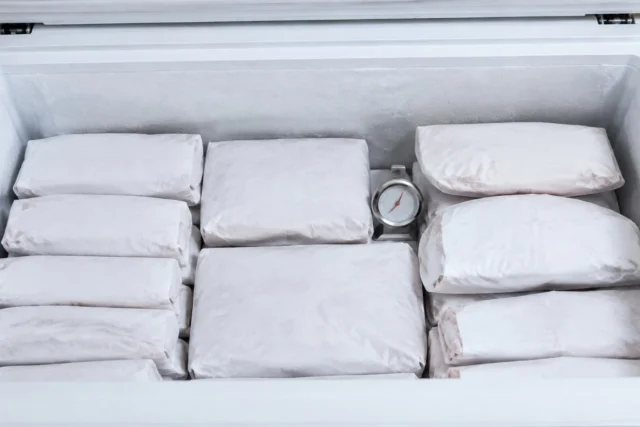
An ENERGY STAR certified chest freezer uses about 215 kWh a year, which costs about $39 a year (roughly $3.25 a month) at the August 2026 US average residential rate of 18.16¢ per kWh. A certified upright runs about $72 a year at the same rate. Your own cost is your freezer’s label kWh times your own rate. Across states, that ranges from about $27 to $101 a year.
By the end, you will be able to work out your own freezer’s cost with numbers from the EnergyGuide label and your power bill. You will see why the dollar figure on the label rarely matches your bill. You will also see the cost per pound of stored meat and which fixes lower the bill without risking the food in it.
What Should You Budget Each Month and Year?
You should budget about $3 to $4 a month for a certified chest freezer at average US rates. The three questions below cover how your state’s rate shifts that number, how a chest compares with an upright, and what the power costs per pound of meat.
The baseline comes from ENERGY STAR. A certified chest freezer uses about 215 kWh a year, and a certified upright uses about 395 kWh. The table uses SaltRail arithmetic: kWh per year × rate = yearly cost.
| Freezer (ENERGY STAR figure) | kWh per year | Per year at 18.16¢ | Per month at 18.16¢ |
|---|---|---|---|
| Certified chest | 215 | $39.04 | ~$3.25 |
| Certified upright | 395 | $71.73 | ~$5.98 |
How Do Electricity Rates Change Your Annual Bill?
The same 215 kWh freezer costs nearly four times as much in the most expensive state as in the cheapest (47.18 ÷ 12.72 = 3.7).
The US Energy Information Administration put the August 2026 US residential average at 18.16¢ per kWh, up from 17.57¢ in August 2025. Nevada was lowest at 12.72¢. Hawaii was highest at 47.18¢.
| State (Aug 2026 rate) | Chest, 215 kWh | Upright, 395 kWh |
|---|---|---|
| Nevada (12.72¢, lowest) | $27.35 | $50.24 |
| Florida (14.99¢) | $32.23 | $59.21 |
| Texas (15.91¢) | $34.21 | $62.84 |
| US average (18.16¢) | $39.04 | $71.73 |
| Pennsylvania (21.77¢) | $46.81 | $85.99 |
| Michigan (22.99¢) | $49.43 | $90.81 |
| New York (28.65¢) | $61.60 | $113.17 |
| Hawaii (47.18¢, highest) | $101.44 | $186.36 |
These are August 2026 rates. EIA updates the table monthly, so your current rate will differ a little.
Is a Chest Freezer Cheaper to Run Than an Upright?
Yes. By ENERGY STAR’s figures, a certified chest freezer uses about 215 kWh a year against about 395 kWh for a certified upright. That is about 46% less power.
At the US average rate, the gap works out to about $33 a year. Over ten years at an unchanged rate, that comes to more than $300 in electricity alone. ENERGY STAR also says manual defrost freezers use half the energy of automatic defrost models.
Running cost is only one part of the choice. Access, floor space and how you organize cuts all play in, and the full chest freezer vs. upright freezer comparison covers them.
What Does Freezer Electricity Cost per Pound of Stored Meat?
Power is a small cost per pound once the freezer is full. Here is one example, with the assumptions stated. This is SaltRail arithmetic, not a sourced figure.
Say a 7 cu ft chest freezer holds the roughly 220 lb order from a half-cow purchase. Assume it uses the 215 kWh figure, which ENERGY STAR does not tie to a size. At $39.04 a year, that is $39.04 ÷ 220 lb ≈ 18¢ per pound per year.
If the same freezer held half as much, the cost per pound would double, assuming the same yearly kWh. No opened source says how fill level changes a freezer’s kWh. If you are sizing a freezer for a deer, a hog or a beef share, the best chest freezer for meat roundup sorts models by capacity.
How Do You Calculate Your Own Freezer’s Running Cost?
You find your freezer’s yearly kWh, find your rate, and multiply. The steps below show where each number lives, why label dollars differ, and how to measure a freezer with no label.
What You Need
You need three things, and none of them cost money:
- The yellow EnergyGuide label or the owner’s manual, for yearly kWh.
- A recent electric bill, for your rate in cents per kWh.
- A calculator or your phone.
If the label is gone, you can use the rating plate inside the lid or on the back. A plug-in electricity usage meter also works.
1. Find Annual kWh on the EnergyGuide Label
Look for the line called “Estimated Yearly Electricity Use.” It shows a number in kWh. This is the number you want.
A kilowatt-hour (kWh) is the amount of energy a 1,000-watt device uses running for one full hour.
The label also shows an “Estimated Yearly Energy Cost” in dollars. Skip that number for now. The next subsection explains why.
2. Find Your Electricity Rate on Your Utility Bill
Find the price per kWh on your bill. It is listed as cents per kWh or dollars per kWh.
Some bills split this into a supply charge and a delivery charge. Add the two per-kWh charges together.
Convert cents to dollars before you multiply. 18.16¢ becomes $0.1816.
3. Multiply Annual kWh by Your Rate
Multiply yearly kWh by your rate in dollars. Divide by 12 for the monthly cost.
- Take the label kWh: 215 kWh.
- Multiply by your rate: 215 × $0.1816 = $39.04 a year.
- Divide by 12: $39.04 ÷ 12 = about $3.25 a month.
Write the result on a strip of tape on the lid. When you compare a replacement freezer later, you will have your current cost on hand.
Why Do ENERGY STAR and EnergyGuide Dollar Estimates Differ?
The DOE example label uses a fixed national-average rate of 12¢ per kWh. ENERGY STAR does not state its rate; its figure works out to about 14¢ by SaltRail’s inference. Both are below the August 2026 average of 18.16¢.
ENERGY STAR says the certified chest freezer costs about $30 a year to run. It does not state the rate it used. By SaltRail’s inference, $30 ÷ 215 kWh works out to about 14¢ per kWh. At the August 2026 average of 18.16¢, the same 215 kWh costs about $39. The $30 is not wrong; it fits a lower rate than today’s, and ENERGY STAR does not say which rate or year it used.
The EnergyGuide label works the same way. The DOE’s example label in its Energy Saver Guide uses a national average of 12 cents per kWh, and the guide notes that your cost will depend on your utility rates and use. Trust the kWh on the label. Redo the dollars with your own rate.
How Can You Measure Electricity Use Without a Label?
You have two options: use the wattage from the rating plate, or plug the freezer into an electricity usage meter.
The DOE formula is energy = power × time, with watts changed to kW first. Divide watts by 1,000, multiply by the hours the compressor runs, then multiply by your rate. Here is the catch: a freezer’s compressor cycles on and off, and the plate only tells you the draw while it runs. You would have to guess the run time.
A plug-in usage meter removes the guess. SaltRail’s suggestion, not from the sources: leave it in place for a full week, read the kWh, and multiply by 52 for a rough yearly figure.
What Can You Fix When Running Costs Seem High?
The sources point to four things that can raise running cost: an old or oversized second freezer, thick frost, a hot or cramped spot, and a setting colder than needed. Check each one before you buy anything.
An Oversized or Old Second Freezer: Check Usage Before Replacing It
Measure first. ENERGY STAR notes that, as a rule, the larger the freezer, the greater the energy use. Its certified models are at least 10 percent more efficient than non-certified ones.
Put a usage meter on the old unit for a week. Compare its yearly kWh with the label of the model you are considering, then run both through your rate. That tells you how many years of savings it takes to cover a new freezer.
The DOE advises recycling an old second refrigerator or freezer. This applies most when you don’t store much in it or when it sits in unconditioned space.
Heavy Frost: Defrost According to the Manufacturer’s Instructions
Defrost before frost passes a quarter inch. ENERGY STAR advises not letting frost build up more than one-quarter of an inch.
Follow your manual’s steps. The step-by-step guide on how to defrost a chest freezer covers keeping meat cold while you work.
A Hot Location or Tight Clearance: Review Placement
ENERGY STAR advises, unless you live in a mild climate, keeping the freezer indoors, such as in a basement, because extreme temperatures are hard on the compressor. It also says to leave a few inches between the freezer and the wall or cabinets.
Pull the freezer out from the wall. Clear boxes off the lid and away from the sides.
If a garage is your only option, check the operating range in the manual. The guide on whether you can put a chest freezer in the garage covers heat and cold limits.
An Unnecessarily Cold Setting: Verify the Temperature
Set the freezer to 0°F and confirm it with a thermometer. ENERGY STAR advises keeping the temperature at 0°F.
FSIS recommends keeping an appliance thermometer in the freezer to check the temperature. Never set it warmer than 0°F to save power.
SAFETY: USDA FSIS advises keeping frozen food at 0°F or below for long-term storage and keeping an appliance thermometer in your freezer to check the temperature.
More detail is in the guide on what temperature a chest freezer should be.
Frequently Asked Questions
How much electricity does a chest freezer use per day?
A certified chest freezer uses about 0.59 kWh per day. That comes from ENERGY STAR’s 215 kWh per year divided by 365 days. At the August 2026 US average rate of 18.16¢, that is about 11¢ a day. Older or larger freezers use more, so check your own label kWh or use a plug-in meter for a week.
How many watts does a chest freezer use?
The rating plate on your freezer lists its watts or its amps and volts. Watts tell you the draw only while the compressor runs. Since the compressor cycles on and off, yearly kWh from the EnergyGuide label is a better number for cost. If you only have watts, divide by 1,000 and multiply by run hours.
Does a full chest freezer cost less to run?
None of ENERGY STAR, DOE or FSIS puts a number on full versus empty running cost. What is clear is the cost per pound. A freezer’s yearly power bill is spread across whatever you store in it. A full freezer holding 220 lb works out to about 18¢ per pound per year at average rates. Half full, that figure doubles if the yearly kWh stays the same, which no opened source confirms.
Should I unplug an empty second freezer?
The sources opened here do not cover unplugging. The DOE advises recycling an old second freezer, particularly if you don’t store much in it or it sits in unconditioned space. If you will fill it again during hunting season, see the guide on how to defrost a chest freezer before you shut it down.
Does keeping a chest freezer in the garage raise the bill?
ENERGY STAR advises keeping freezers indoors unless you live in a mild climate, because extreme temperatures are hard on the compressor. None of the agency guidance puts a dollar figure on the garage effect. The amount depends on your climate and the model’s rated operating range. Read the manual for its temperature limits, and leave a few inches between the freezer and the wall or cabinets.
If you are ready to pick a freezer that fits your meat and your power bill, start with the freezers category on SaltRail.