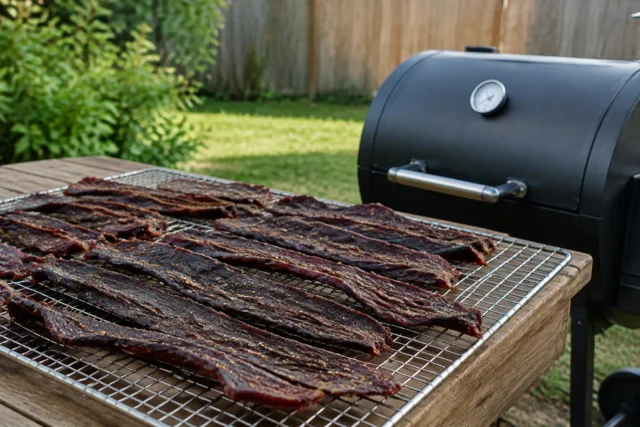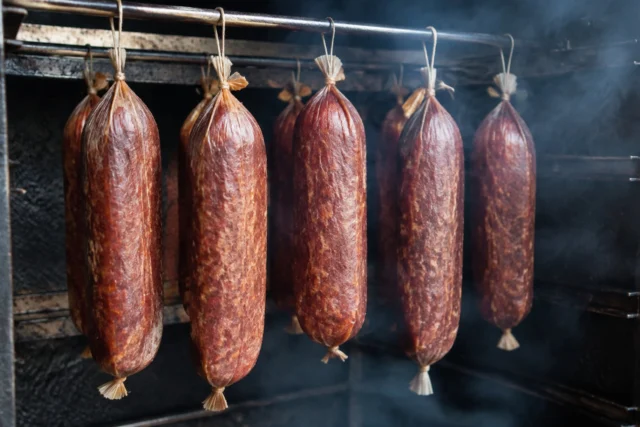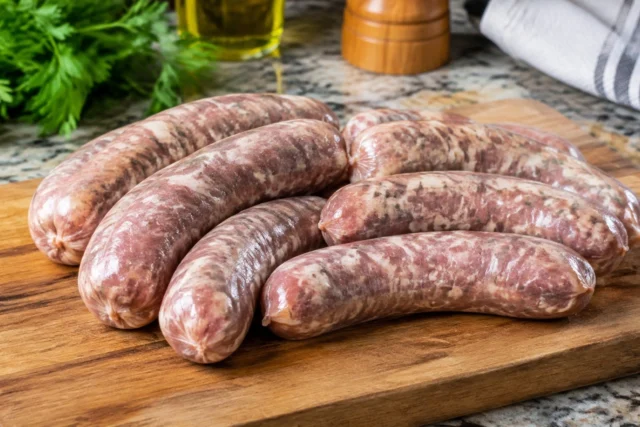

You need 3.5 lb ground venison, 1.5 lb fatty pork shoulder, 5.7 g of Cure #1, and about 51 g of salt for a 5-lb batch. Mix the meat and seasonings cold, stuff it into 2.5-inch fibrous casings, then smoke until the center reads 160°F, the USDA FSIS minimum for ground meat. Let the thermometer decide when the sausage is done. The clock does not.
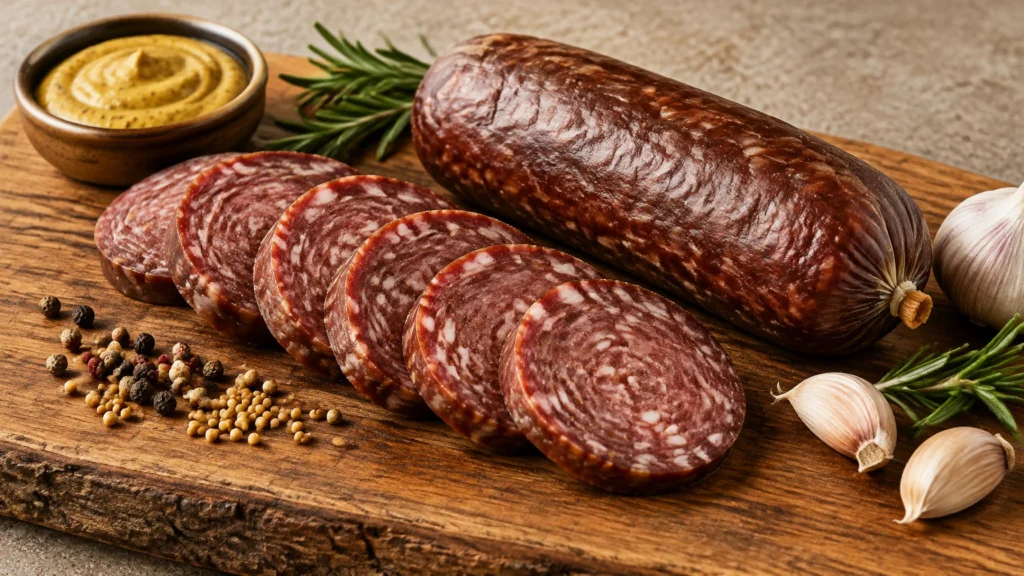
You will be able to weigh every ingredient in grams, check your cure math against the FSIS nitrite limit, and smoke a sliceable log that holds together. If you are learning how to make venison summer sausage, precision is key.
This venison summer sausage recipe addresses three critical details that most instructions skip. It explains why a 70/30 meat ratio is not 30% fat, how to fix crumbly slices, and why home-smoked sausage belongs in the fridge or freezer.
A dependable summer sausage recipe balances lean wild game with seasoned fat and controlled smoke to produce tender, uniform slices every time.
What You Need for a 5-Lb Batch
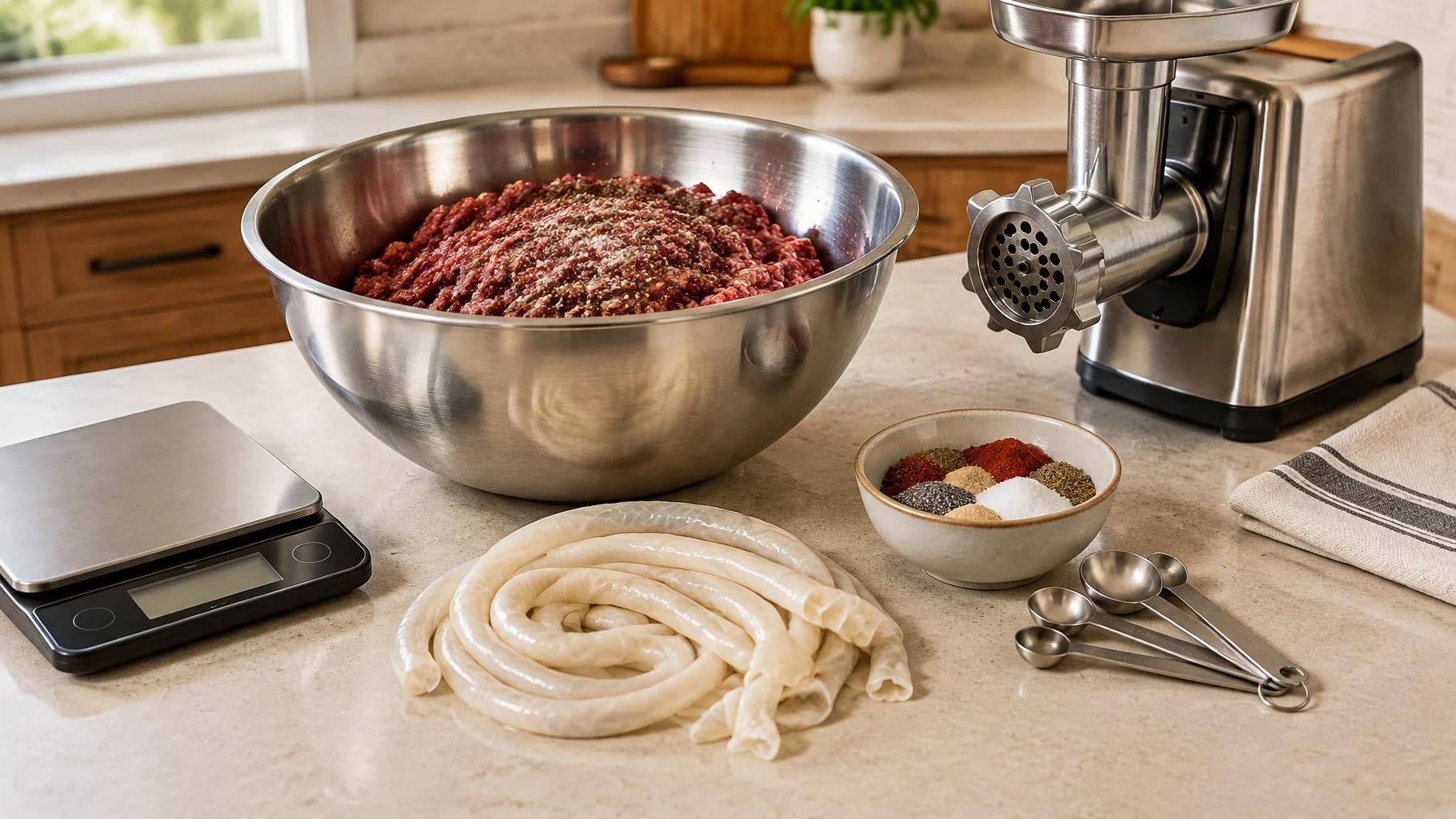
A good batch starts with the meat-to-fat split and exact seasoning weights. Next come the Cure #1 and salt math in grams, then the gear: grinder, stuffer, casings, smoker, and two thermometers.
Meat, Fat, and Seasonings by Weight
Weigh everything on a kitchen scale. Teaspoons drift, and grams do not.
Yield: about 4.5 to 5 lb finished sausage (two or three 2.5-inch logs)
Prep time: about 1 hour
Rest time: overnight (8 to 24 hours) in the fridge
Cook time: set by the thermometer, not the clock
- 3.5 lb (1,588 g) venison, trimmed of silver skin, cubed
- 1.5 lb (680 g) pork shoulder (Boston butt), fattiest pieces, cubed
- 5.7 g Cure #1 (Prague Powder #1, pink curing salt)
- 51 g non-iodized kosher or pickling salt
- 15 g sugar
- 10 g coarse ground black pepper
- 8 g whole yellow mustard seeds
- 6 g garlic powder
- 4 g ground coriander
- 30 g nonfat dry milk (optional binder)
- 120 ml (1/2 cup) ice water
The seasoning blend gives this venison summer sausage recipe its classic tangy profile. Whole mustard seeds provide the signature snap in every slice, while coarse black pepper delivers a warm kick.
Ground coriander rounds out the spices with subtle citrus notes that brighten the rich game meat. This balance makes any homemade summer sausage recipe stand out on the table.
Here is the part most recipes get wrong. A 70/30 venison-to-pork-shoulder ratio is a meat ratio, not a 30% fat ratio. Pork shoulder is mostly lean muscle itself, and venison carries very little fat. So the finished mix lands well under 30% fat. If you want a richer slice, swap some shoulder for straight pork fat or fatback. The venison burger fat ratio guide shows how fat percentage changes the bite.
How Much Cure #1 and Salt Do You Need?
Cure #1 is pink curing salt with 6.25% sodium nitrite. It protects slow-smoked sausage from Clostridium botulinum and sets the cured color and flavor.
USDA FSIS rules for inspected processors (9 CFR 424.21) allow 1/4 oz of sodium nitrite per 100 lb of chopped meat, which works out to about 156 ppm, and no more than 200 ppm of nitrite in the finished product. Cure #1 is 6.25% sodium nitrite, so 1 oz of Cure #1 per 25 lb of meat equals that 1/4 oz per 100 lb, and 1 oz per 30 lb works out to about 130 ppm. Here is the math for 5 lb (2,268 g):
| Item | Rate | Grams for 5 lb |
|---|---|---|
| Cure #1, this recipe (about 157 ppm) | 0.25% of meat weight | 5.7 g |
| Cure #1, lower option (130 ppm) | about 0.21% of meat weight | 4.7 g |
| Total salt target | 2.5% of meat weight | 56.7 g |
| Salt already in 5.7 g Cure #1 | 93.75% of cure | 5.3 g |
| Added kosher salt | total minus cure salt | about 51 g |
5.7 g of Cure #1 in 5 lb of meat works out to about 157 ppm (5.7 g × 0.0625 = 0.356 g of sodium nitrite, divided by 2,268 g). That is about half a percent above the 156 ppm the processor rule gives, and under its 200 ppm finished-product limit.
SAFETY: Use Cure #1, never Cure #2, for cooked and smoked sausage. Cure #2 adds sodium nitrate for long dry-cured products. Weigh the cure exactly and never add more than the recipe lists. This recipe’s 5.7 g works out to about 157 ppm, and the FSIS processor rule (9 CFR 424.21) gives 156 ppm ingoing and 200 ppm in the finished product. Keep cure labeled and out of reach. It looks like table salt.
Grinder, Stuffer, Casings, Smoker, and Thermometer
Equipment for this job is judged the way a commercial kitchen judges it: will it hold up through a full batch without heating up or leaking?
| Gear | What to look for | Why |
|---|---|---|
| Meat grinder | Metal head, 3/16-inch (4.5 mm) plate | Cold steel cuts clean. Plastic and dull plates smear fat. |
| Sausage stuffer | Vertical piston type, 5 lb capacity or more | Grinder-mounted stuffing tubes rework the meat and warm it. |
| Sausage casings | Fibrous, 2.5-inch diameter | Holds shape for even slices. Soak before use. |
| Smoker | A built-in or separate air thermometer | FSIS says to monitor smoker air with its own thermometer. |
| Thermometers | Leave-in probe plus instant-read | One reads the smoker air. One checks the center. |
For a 5-lb batch, a #8 or #12 electric grinder is plenty. Our best meat grinder for deer roundup covers models by motor rating and plate size.
How Do You Make and Smoke the Sausage?
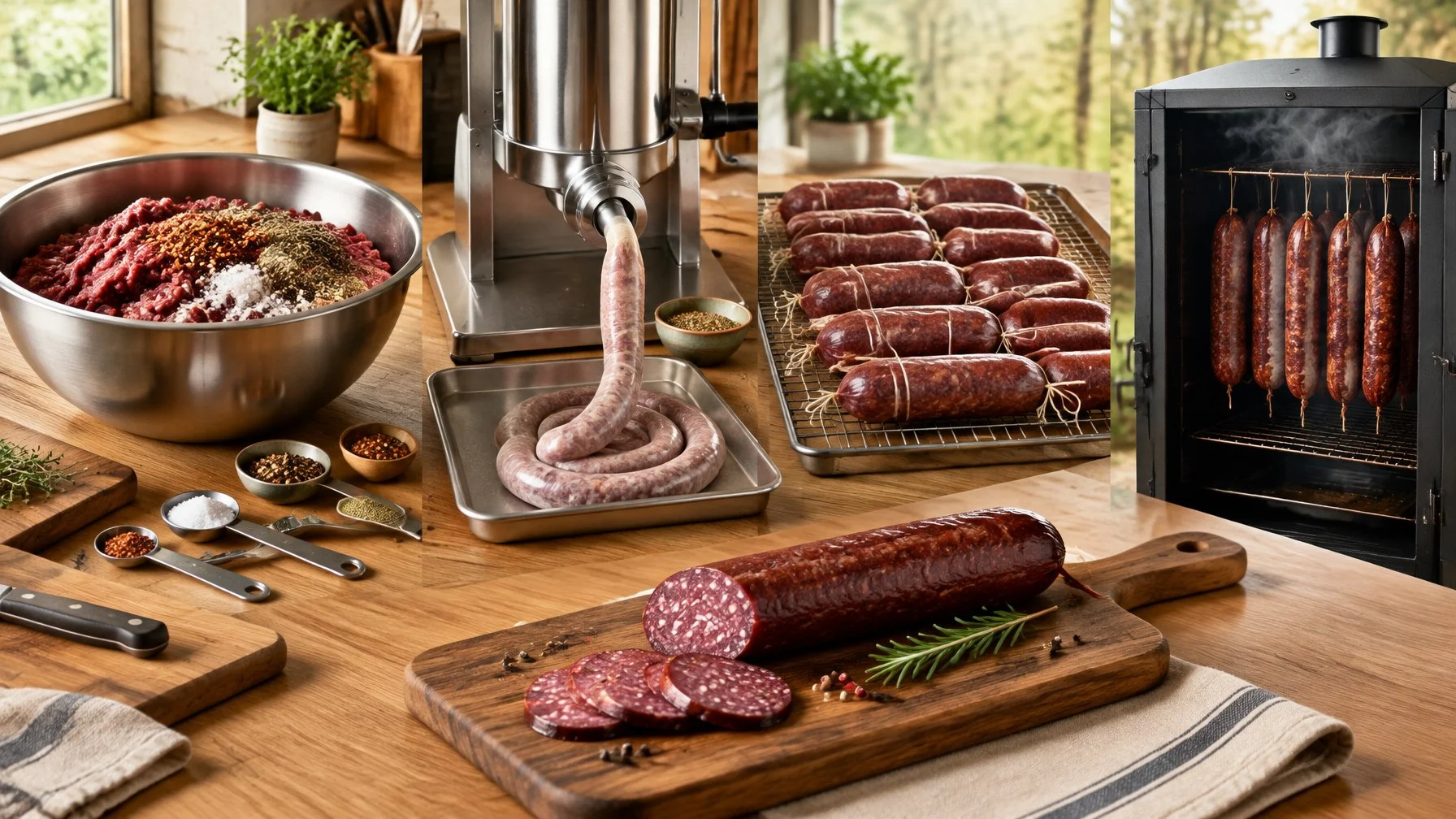
The process runs in five steps: chill and grind, mix until tacky, stuff and rest overnight, smoke to 160°F at the center, then cool and package. Cold meat and a reliable thermometer carry most of the weight.
Venison summer sausage is a cured, smoked, semi-dry venison sausage made from ground deer meat and pork, sliced and served cold.
Here is the full method at a glance:
- Freeze the cubed meat and grinder parts until firm. Cold fat cuts clean.
- Grind through a 3/16-inch plate. Even pieces bind evenly.
- Mix with cure, salt, seasonings, and ice water until tacky. Tacky meat holds together when sliced.
- Stuff tight into soaked fibrous casings. Air pockets cause gaps and gray spots.
- Rest overnight in the fridge. The cure needs time to spread.
- Smoke on a step-up schedule from 130°F to 175°F (this schedule is not taken from an FSIS or extension page; see the temperature comparison below the stage table).
- Pull at 160°F internal. That is the FSIS safe minimum for ground meat.
- Chill in ice water, then refrigerate. Fast cooling stops fat rendering.
1. Chill and Grind the Meat
Spread the cubes on a sheet pan and freeze them for 30 to 60 minutes, until the edges feel stiff. Put the grinder head, auger, knife, and plate in the freezer too. Warm steel smears fat. The guide on how long to freeze meat before grinding gives firmness cues by cube size.
Grind the venison and pork together through a 3/16-inch plate. Keep the meat below about 40°F the whole time. If it starts to look shiny or pasty, stop and chill everything again. Some cooks grind meat twice for a finer, more even texture.
2. Mix Until the Meat Turns Tacky
Dissolve the Cure #1, salt, and sugar in the ice water first. This spreads the cure evenly through all 5 lb. Add the spices and dry milk, then pour the liquid over the meat.
Mix by hand or with a stand mixer paddle on low for 2 to 4 minutes. Stop when the meat turns sticky and stringy and clings to your palm when you turn your hand over. Salt pulls out proteins that act as glue. Skip this step and your slices fall apart.
Fry a small patty and taste it to check the flavor balance. Adjust the black pepper, coriander, or garlic now if you prefer more seasoning. The salt and cure stay as written.
3. Stuff the Casings and Refrigerate
Soak fibrous sausage casings in warm water for about 30 minutes. Load the stuffer tightly, pressing out air as you go.
Stuff each casing firm, so it feels like a full water balloon. Tie or clip the end. Prick any air pockets with a clean pin.
Refrigerate the logs uncovered overnight, 8 to 24 hours. The cure finishes spreading and the casings dry, which helps smoke stick.
4. Smoke and Check the Center Temperature
Hang the logs or lay them on racks so they do not touch. A gentle step-up schedule keeps fat inside your smoked venison summer sausage instead of pooling under the casing:
| Stage | Smoker air temp | Goal |
|---|---|---|
| Dry | 130°F, no smoke | Casing dries to the touch |
| Smoke | 150°F, smoke on | Color and flavor |
| Finish | 170 to 175°F | Center climbs to 160°F |
FSIS advises two thermometers when smoking: one for smoker air and one for the meat. FSIS says to keep smoker air between 225 and 300°F. NDSU Extension’s FN155 uses a staged smokehouse schedule of 140°F for 1 hour, 160°F for 1 hour, then 180°F until the sausage reaches 152°F inside, which is below the FSIS 160°F. This recipe’s own schedule (130°F, 150°F, then 170 to 175°F) comes from neither page. The sources differ on air temperature. This recipe finishes at the FSIS 160°F, measured at the center of the thickest log. Skip guessing by time; weather, log size, and smoker type all change it. For the FSIS and NDSU smoking temperatures side by side, see how to smoke sausage in an electric smoker.
5. Cool, Package, and Refrigerate
Plunge the hot logs into ice water for 10 to 20 minutes until the center drops near 100°F. This stops the cooking and keeps the casing from wrinkling.
Pat them dry and let them bloom at room temperature for about an hour for deeper color. Then refrigerate. Vacuum seal what you will not eat soon and use clear labels on frozen meat with the date and the batch.
How Do You Handle It Safely and Store It?
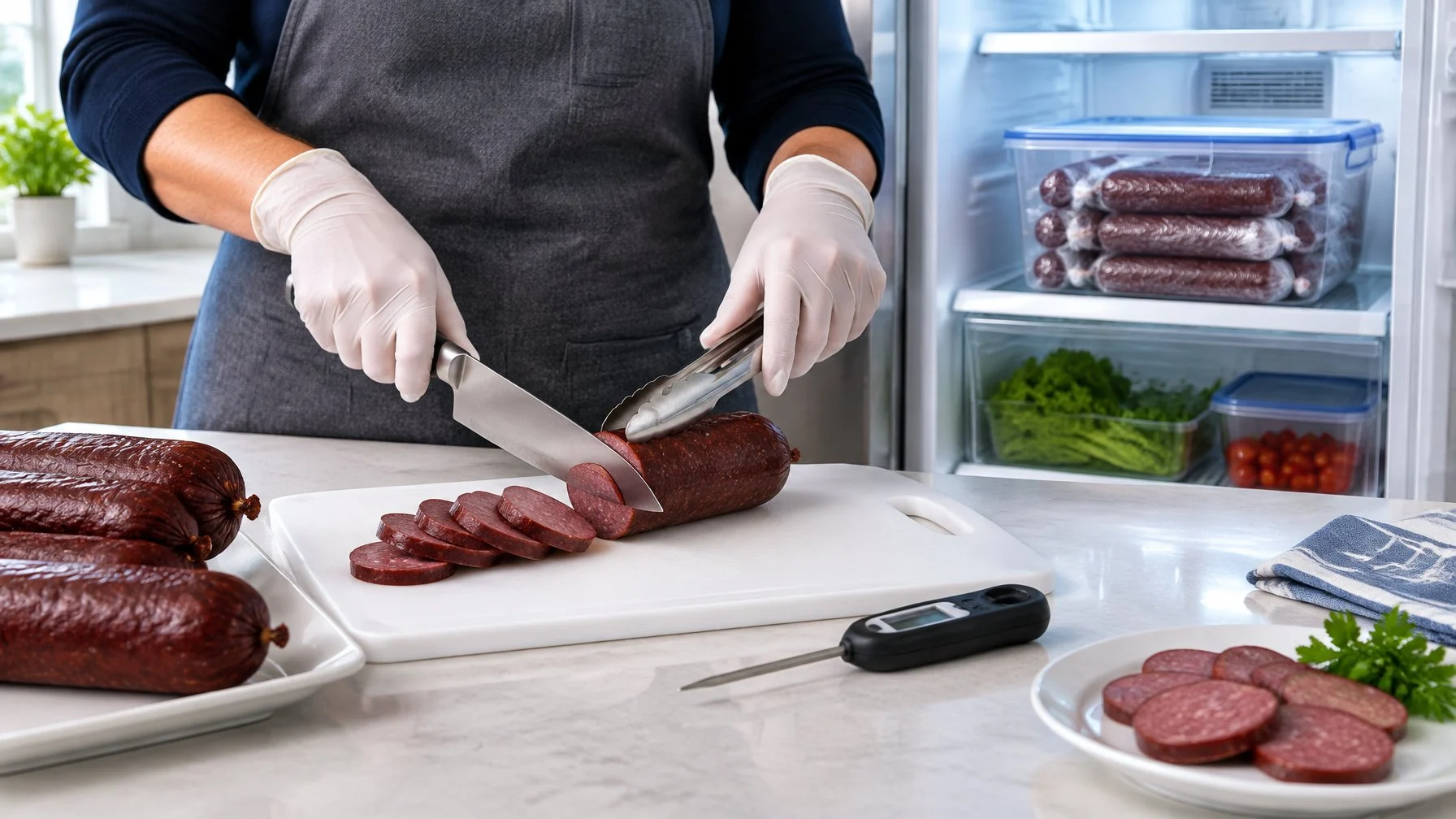
Safe deer sausage depends on two checks: the right cure at the right rate, and a verified center temperature. Following these guidelines ensures your venison sausage is both safe and delicious.
Safety: Check Cure Labels and Follow USDA FSIS Temperature Guidance
SAFETY (USDA FSIS): Cook all ground meat to an internal temperature of 160°F, measured with a food thermometer in the thickest log. Weigh the Cure #1 exactly; this recipe works out to about 157 ppm (see the cure section). Refrigerate smoked meat within 2 hours of removing it from the smoker.
Read every cure label before you weigh it. “Cure #1,” “Prague Powder #1,” and “pink curing salt” are the same product at 6.25% sodium nitrite. Morton Tender Quick is a different product with its own rate, so never swap it in gram for gram. See Prague Powder #1 vs #2 for what each cure contains.
Check your thermometer in ice water before each batch. USDA FSIS says to fill a large glass with ice cubes, add drinking water and stir well, put the stem at least 2 inches in without touching the sides or bottom, wait at least 30 seconds, and read it without removing the stem. It should read 32°F (FSIS, Food Thermometers). FSIS says most food thermometers read within 2 to 4°F, so a probe reading 4°F high can show 160°F when the sausage is at 156°F.
Refrigeration, Freezing, and Serving
Treat homemade batches as perishable cooked meat, not shelf-stable food. Smoked venison summer sausage made without starter cultures lacks the acid and drying required for pantry storage.
FSIS lists commercial semi-dry summer sausage at 3 months unopened in the fridge. This recipe skips fermentation, so that window does not apply.
| Storage | Guideline |
|---|---|
| Counter | No more than 2 hours |
| Fridge, sliced or opened | Use within 4 days (FSIS smoked-meat guidance) |
| Freezer at 0°F | Safe indefinitely; best quality in a few months |
Vacuum seal logs in meal-size portions and freeze right away. A dedicated chest unit from our freezers category holds 0°F steadier than a kitchen fridge freezer.
When assembling a charcuterie board, slice the sausage cold so it holds clean edges. Pair it with sharp cheese and crackers for a classic snack.
Always return leftover slices from your charcuterie board to the fridge within 2 hours to keep them safe and fresh.
What Went Wrong with the Texture?
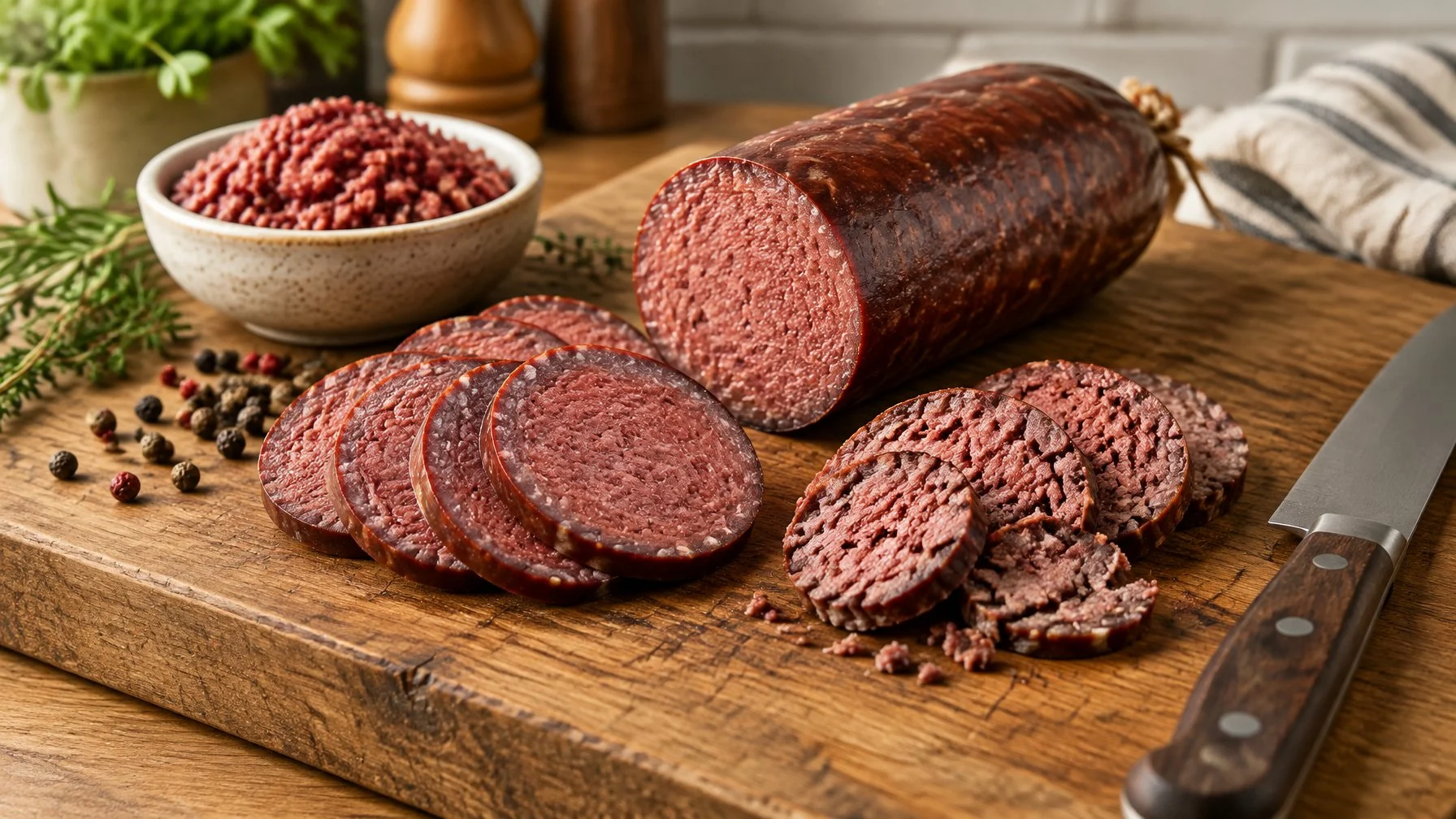
Texture problems trace back to fat, temperature, and mixing. Dry, crumbly slices point one direction. Greasy logs and air gaps point another.
Fix Dry or Crumbly Slices
Crumbly slices almost always mean the protein bind never formed. Check these causes in order:
- Short mixing. Mix until the meat is sticky and stringy. Two to four minutes is normal for 5 lb.
- Too little fat. Lean shoulder plus venison can fall short. Add 0.5 lb pork fat in place of some shoulder next time.
- Overcooking. Pushing the center past 165°F tightens proteins and squeezes out moisture. Pull at 160°F.
- Warm grinding. Smeared fat coats the meat and blocks binding.
Dull blades cause smear too. Keep the knife and plate clean and sharp, and follow the steps on how to clean a meat grinder so dried residue does not drag on the next batch.
Fix Greasy Sausage or Air Gaps
Grease pooling under the casing means the fat melted out, called “fatting out.” Warm meat at grinding makes it worse. If the smoker air jumped quickly, lower it and go by the center temperature.
Air gaps come from loose stuffing. Pack the stuffer canister in tight balls, press out air, and stuff each casing firm. Prick visible bubbles before smoking. Gray rings near the gaps show where the cure color did not set.
Frequently Asked Questions
These answers cover oven cooking, casings, meat blends, cure swaps, cooking, and storage.
Can you make venison summer sausage in the oven?
Yes. Set the oven as low as it goes, ideally 170°F, and bake the logs on a rack until the center reads 160°F. You lose smoke flavor, so some cooks add a small amount of liquid smoke to the mix. Cure #1 and the 160°F internal target stay the same as in the smoker method.
Can you make it without sausage casings?
Yes. Roll the mixed meat into tight logs about 2 inches thick and wrap them in plastic wrap or foil. Rest them overnight in the fridge, then unwrap and cook on a rack until the center hits 160°F. The logs hold shape less evenly than fibrous sausage casings, but they slice fine once fully chilled.
What do you mix with deer meat for summer sausage?
Pork shoulder is the standard partner for venison sausage, at about 70% venison to 30% pork. It adds fat and mild flavor that complements whole mustard seeds and traditional spices. Beef fat or 80/20 ground beef also works if you avoid pork. Pages covering where to buy beef fat for venison help when your butcher shop is short on trim.
Can you substitute Tender Quick for Cure #1?
Not gram for gram. Morton Tender Quick is a blend of salt, sugar, and nitrite at a much lower strength than Cure #1. If you use it, follow Morton’s label rate and cut the added salt, since Tender Quick is mostly salt. Never mix both cures in one batch.
Are you supposed to cook venison summer sausage?
Yes. This recipe is fully cooked in the smoker to a 160°F center, so it is ready to eat cold. Home cooks without a fermentation chamber and starter culture should always cook summer sausage to that temperature. Raw or partly cooked ground venison carries real food safety risk.
Is homemade venison summer sausage shelf-stable?
No. Home-smoked summer sausage is not fermented or dried to commercial standards, so keep it in the fridge and eat sliced portions within 4 days. Vacuum seal and freeze the rest at 0°F. Store-bought summer sausage keeps longer because it is made under controlled processing.
Mastering this venison summer sausage recipe gives you a dependable way to process deer into sliceable deli meat. The sausage making guides cover casings, stuffers, and other tips for your next batch.
This is general guidance based on USDA recommendations. When in doubt, follow the USDA FSIS source linked above.