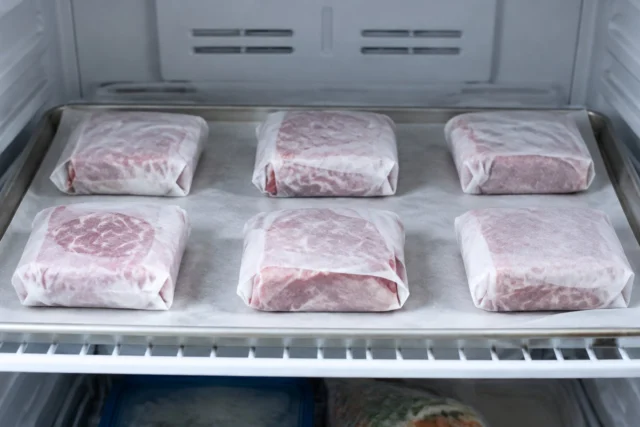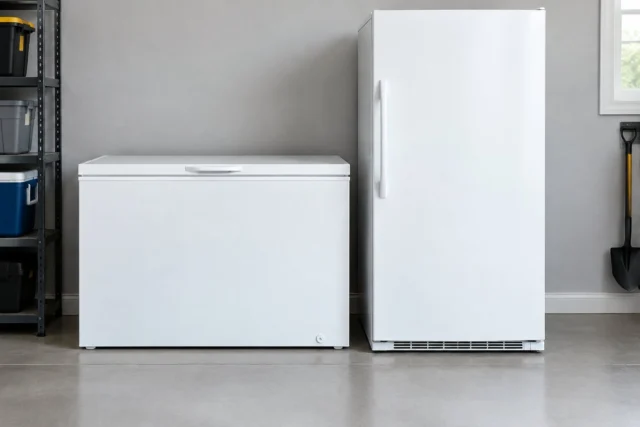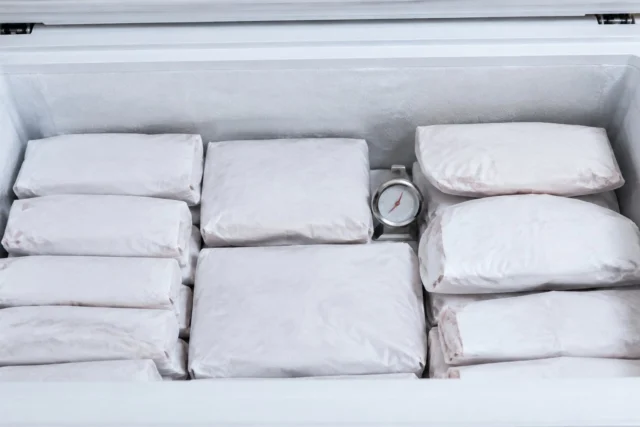

Defrost a manual-defrost chest freezer at least once a year, or when frost over a large area is more than one-fourth inch thick, says the National Center for Home Food Preservation. Unplug it, move the food into insulated coolers, scrape off the loosened frost, wash with baking soda solution, dry, then run it 15 to 30 minutes before reloading.
Defrosting a chest freezer is the job of turning it off and removing the frost that builds up on the inside walls. This guide shows how to defrost a chest freezer with the steps from the National Center for Home Food Preservation (NCHFP), shows where manufacturers disagree on using hot water, and covers keeping the meat frozen while the freezer is empty.
How Often Should You Defrost a Manual-Defrost Chest Freezer?
NCHFP says manual-defrost freezers need defrosting at least once a year, or when there is more than one-fourth inch of frost over a large area of the freezer surface. It says accumulated frost reduces storage space and increases operating costs. ENERGY STAR agrees on the frost limit: do not allow frost to build up more than one-quarter of an inch.
A frost-free freezer does not need defrosting, NCHFP says, but it should be cleaned out once a year, or more often if dirt or food residue is visible.
What Do You Need Before You Start?
- Large cardboard cartons or insulated coolers for the food, with several layers of newspaper for extra insulation in a carton (NCHFP)
- Towels to catch water and frost
- A wooden or plastic scraper
- Baking soda and water for cleaning (one tablespoon per quart)
- An absorbent cloth for drying
- An appliance thermometer (FSIS says to keep one in the freezer); see what temperature a chest freezer should be
How Do You Defrost a Chest Freezer Step by Step?
These steps follow NCHFP’s advice for manual-defrost freezers, so they apply whether you defrost a freezer that is a chest or an upright freezer. Check your owner’s manual first, because NCHFP says to clean the freezer following your manufacturer’s instructions.
- Pick a time when the food inventory is low and the job can be finished within one to two hours.
- Disconnect the freezer from the electrical supply.
- Move the frozen packages into large cardboard cartons or insulated ice chests. In a carton, add several layers of newspaper for insulation.
- Place towels in the bottom of the freezer to catch water and frost.
- Let the frost loosen, then remove it with a wooden or plastic scraper.
- When all the frost is gone, sponge out the inside with one tablespoon of baking soda per quart of water.
- Sponge with clean water and dry with an absorbent cloth.
- Turn the freezer on and close it for 15 to 30 minutes to chill before returning the food.
Should You Use Hot Water When Defrosting a Chest Freezer?
Manufacturers disagree, according to NCHFP, and we do not pick a side.
| Approach | What NCHFP reports | Condition |
|---|---|---|
| Pans of hot water | A few manufacturers say to place pans of hot water in the freezer and close it, remove the frost as it loosens and replace the water as it cools | Make sure the freezer is completely cool before restarting it |
| No hot water | Other manufacturers do not recommend hot water, because in their freezers refrigerant pressure could build up in the evaporator, making restarting difficult | They recommend letting the frost thaw naturally or with the aid of a fan |
Follow your freezer’s manual. NCHFP gives no default when the manual is silent; the no-hot-water option it reports is to let the frost thaw naturally or with the aid of a fan.
How Do You Keep the Meat Safe While It Is Out?
Keep the packages frozen in insulated coolers or cartons, and keep the job short: NCHFP says to schedule defrosting when it can be completed within one to two hours. The FSIS freezing page says not to refreeze any food left outside the refrigerator longer than 2 hours, or 1 hour in temperatures above 90°F.
If the power goes out instead of a planned defrost, see how long a chest freezer stays cold without power. For how long meat keeps once it is back in, see how long vacuum-sealed meat lasts in the freezer.
SAFETY: USDA FSIS: food stored constantly at 0°F will always be safe. Do not refreeze food that has been left outside the refrigerator longer than 2 hours, or 1 hour above 90°F (FSIS).
How Do You Clean It and Remove Odors?
For odors, NCHFP says to wash the inside with one tablespoon of baking soda in a quart of tap water, or one cup of vinegar in a gallon of tap water, and let it dry. If the odor stays, it suggests activated charcoal, which it says absorbs odors more quickly than cooking charcoal.
What Do You Do After It Is Running Again?
NCHFP says to scrape or wipe frosty packages before putting them back, load them in an organized way, and mark those packages for first use. Dated labels help; see how to label frozen meat. FSIS says to keep an appliance thermometer in the freezer and to hold a freezer used for long-term storage at 0°F or below, so check that it reads 0°F or lower once it has chilled.
Choosing a new freezer? See chest freezer vs upright freezer for manual defrost versus frost-free, and our best chest freezer for meat picks. For garage placement, see putting a chest freezer in the garage.
Defrosting a Chest Freezer: Quick Answers
Can I use hot water to defrost a chest freezer faster?
It depends on the maker. NCHFP says a few manufacturers recommend pans of hot water, while others do not, because refrigerant pressure could build up in the evaporator. Follow your manual. NCHFP gives no default when the manual is silent; the no-hot-water option it reports is to let the frost thaw naturally or with a fan.
Do frost-free chest freezers need defrosting?
No. NCHFP says a frost-free freezer does not need defrosting, but it should be cleaned out once a year, or more often if dirt or food residue is visible.
Can I refreeze meat that softened during defrosting?
FSIS says not to refreeze food left outside the refrigerator longer than 2 hours, or 1 hour above 90°F. Keep the packages in insulated coolers and finish within NCHFP’s one to two hours. For a power outage, FSIS also says food that is still partly frozen, has ice crystals or is as cold as a refrigerator (40°F) is safe to refreeze or use.
How do I know it is time to defrost?
NCHFP says when there is more than one-fourth inch of frost over a large area, or at least once a year. ENERGY STAR also says not to let frost build up more than one-quarter of an inch.
Your next step: check your freezer temperature with our guide to what temperature a chest freezer should be.