In a 34°F cooler, PNW Extension says to age cow elk up to 7 days and bull elk up to 14. Clemson also caps aging at two weeks. At home, age for less time, and stop at any slime, mold or off-odor. NCHFP’s venison guide says no more than 2 to 3 days at 40°F or below. Don’t age meat you’ll grind.
This guide compares four sources: Pacific Northwest Extension’s PNW 517, Big Game from Hunt to Home (revised August 2022), the University of Wyoming elk bulletin B-594R (August 2003), Clemson Extension’s Safe Handling of Wild Game Meats (revised March 8, 2007) and the National Center for Home Food Preservation venison post (November 15, 2013). Each figure is shown with its temperature. SaltRail does not pick one.
How Long Should You Age Elk Meat?
The sources give very different limits, and each one assumes a different temperature:
| Source | Aging limit | Temperature | Notes |
|---|---|---|---|
| PNW Extension (2022) | Cow elk up to 7 days; bull elk up to 14 days | 34°F cooler | Ideal conditions: minimum stress and gunshot damage, carcass in the cooler the day of the kill |
| PNW Extension (2022) | Aging in general: 1 to 14 days | 30 to 37°F | Home aging should be shorter, especially above 34°F |
| Clemson Extension (2007) | 7 to 14 days; a maximum of two weeks | 34 to 37°F | For game carcasses in general |
| NCHFP (2013) | No more than 2 to 3 days | 40°F or less | Written about venison; never at room temperature |
SaltRail’s reading, not a source’s: the longer limits assume a cooler held at 34 to 37°F. NCHFP’s 2 to 3 days is for an air temperature of 40°F or less, and it was written for venison rather than elk.
SAFETY: Never age meat at room temperature (NCHFP). If you see mold, slime or off-odors, PNW Extension says to cut and freeze the carcass immediately, and that sour meat from excessive aging may make you sick.
Should You Age a Bull or a Cow Longer?
PNW Extension gives bull elk the longer limit: up to 14 days at 34°F, against up to 7 days for cow elk.
The University of Wyoming measured tenderness instead. It aged 12 elk sides for two weeks in a 38°F cooler at 70% relative humidity and measured them with a shear-force device, where lower numbers mean more tender meat:
| Elk | After 1 day | After 14 days |
|---|---|---|
| Bulls | 8.33 | 6.65 |
| Cows | 8.92 | 4.95 |
Source: University of Wyoming B-594R (2003), Table 6. Wyoming concluded that for cow elk, one week of aging probably would have been sufficient for tenderness, and that meat from bull elk did not benefit as much from aging as meat from cow elk.
The two sources do not say the same thing. PNW allows bulls more time; Wyoming found bulls gained less from the extra time. This post shows both.
When Should You Not Age Elk at All?
PNW Extension and Clemson list cases where aging should be skipped:
- The elk was shot in warm weather and not chilled rapidly (PNW, Clemson).
- The animal was severely stressed. PNW says meat from a stressed animal may go bad if aged.
- It has extensive gunshot wounds (PNW, Clemson).
- The carcass has already hung in camp for a week. PNW says aging has already occurred.
- The animal is under 1 year old (PNW, Clemson).
- The meat is going to be ground, cured or made into sausage. PNW says unaged meat makes much higher quality sausage and ground meat; Wyoming says aging is not necessary for ground meat or cooked sausage.
- The meat will be braised, pot roasted or stewed. PNW lists these moist-heat methods, and Wyoming says moist-heat cooking tenderizes without aging.
PNW also notes that a locker plant that requires skinning dries the meat, and Clemson says carcasses with little fat may dry out. For the grind itself, see how to grind venison.
Hide On or Off While Aging?
PNW Extension and Clemson say to leave the hide on while aging, and Wyoming says many of the disadvantages of aging can be eliminated by leaving it on. Wyoming found the hide-on side lost less weight over its two-week study, 6.2 pounds against 8 pounds skinned, and resisted mold, darkening and drying. Clemson adds: do not trim fat before aging; trim it after.
Wyoming also gives a field exception: if nights in camp are above freezing, skinning will be necessary to prevent spoilage; if nights are below freezing, skinning is not recommended. That is about cooling in camp, not about aging in a cooler.
For getting the carcass cold fast, see how to cool a deer carcass.
Can You Age Elk at Home?
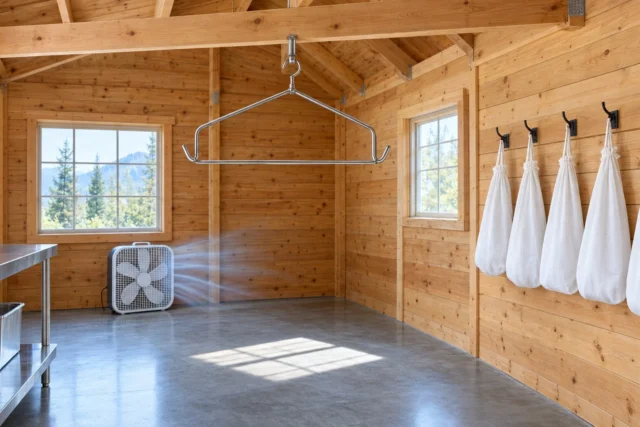
PNW Extension says aging periods at home should be shorter than its cooler limits, particularly if your storage area rises above 34°F. It says to age in a clean, cool, well-ventilated place free of strong odors such as gas, oil or paint, and to leave the hide on.
PNW also gives a middle path: process everything except the loin and rib once the carcass is chilled, then age only the loin and rib longer.
NCHFP’s rule for venison is the tightest: age at an air temperature of 40°F or less for no more than 2 to 3 days in a clean, dry, well-ventilated space, and never at room temperature.
Elk shot in freezing weather is a different problem. PNW says elk meat ideally should not be allowed to freeze while hanging in camp, and that a cold storage locker can keep it from freezing. For deer hanging times, see how long to hang a deer.
How Do You Know Aging Has Gone Too Far?
PNW Extension says to cut and freeze the carcass immediately if you notice mold, slime or off-odors developing. Clemson says that after two weeks at 34 to 37°F tenderization slows down and bacterial slime develops, which then must be trimmed. For general spoilage signs, see how to tell if meat is spoiled.
What Do the Sources Not Say?
None of the sources opened for this post gives a method for dry-aging bags or for dry-aging elk in a home refrigerator. Only Wyoming’s study cooler gives a humidity figure (70%), and it is a study setting, not a recommendation. NCHFP’s 2 to 3 days was written for venison, not elk. For yield after aging, see how much meat from an elk, and for flavor, how to get the gamey taste out of venison.
To break the carcass down after aging, see how to quarter a deer.
Frequently Asked Questions
How long should you hang an elk?
PNW Extension says up to 7 days for cow elk and up to 14 days for bull elk in a 34°F cooler under ideal conditions, and less at home. NCHFP’s venison guide says no more than 2 to 3 days at 40°F or less.
Do you need to age elk meat?
No. PNW Extension lists cases where it should be skipped, including meat for grinding or sausage, and the University of Wyoming says aging is not necessary for ground meat or cooked sausage.
Should you age elk with the hide on?
PNW Extension, Clemson and the University of Wyoming all say to leave the hide on for aging. Wyoming says to skin in camp if nights are above freezing, to prevent spoilage.
Can you age elk in a garage?
PNW Extension says home aging should be shorter than its cooler limits, especially above 34°F, in a clean, cool, well-ventilated place. NCHFP says no more than 2 to 3 days at 40°F or less, never at room temperature.
Should you age elk you plan to grind?
No. PNW Extension says unaged meat makes much higher quality sausage and ground meat, and the University of Wyoming says aging is not necessary for ground meat or cooked sausage.
This is general information based on university extension and NCHFP guidance. When in doubt, follow the sources linked above.