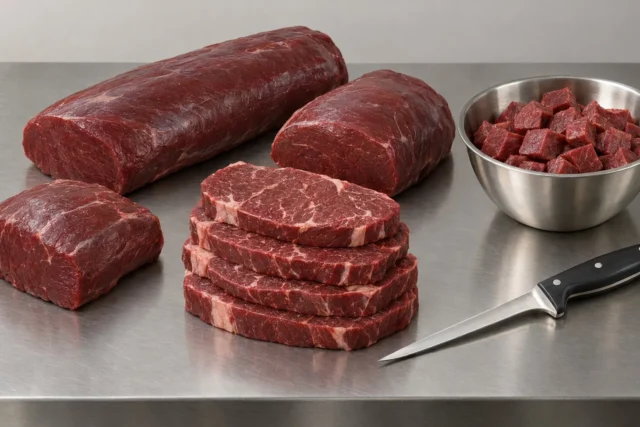
Expect boneless meat equal to roughly 43% to 50% of an elk’s field-dressed weight. A University of Wyoming study got 50%; a Wyoming locker plant averaged 43%, and a Pacific Northwest Extension table runs about 43%. Wyoming’s average elk, 328 pounds field dressed, gave about 164 pounds of boneless meat. Bulls run heavier than cows.
This guide uses two extension publications: the University of Wyoming elk carcass bulletin B-594R (August 2003) and Pacific Northwest Extension’s PNW 517, Big Game from Hunt to Home (revised January 2010, archived copy). Both are older sources, and their dates are given with each figure.
How Much Boneless Meat Does an Elk Give?
The two sources give two ratios:
| Source | Boneless meat as a share of field-dressed weight | Basis |
|---|---|---|
| University of Wyoming study | 50% | 12 hunter-harvested elk (6 bulls, 6 cows), aged two weeks in a 38°F cooler |
| Wyoming locker plant (Dubois, WY) | 43% | 56 hunter-harvested carcasses, mostly bulls |
| PNW 517 elk and moose table | About 43% (SaltRail’s arithmetic from the table) | Adapted from Field and Raab (1983) |
Wyoming says its study came out higher because the carcasses were kept clean, most of the elk were shot in the ribs, and all edible lean from every cut was included. Across all Wyoming elk, including calves, the bulletin gives a weighted average of 328.2 pounds field dressed and 164.1 pounds of boneless meat.
The locker plant’s carcasses averaged 305 pounds clean-dressed (field dressed minus head and hide) and gave 159 pounds of boneless cuts.
How Much Meat From a Bull vs a Cow Elk?
In Wyoming’s 12-elk study, bulls averaged 437 pounds field dressed and 218 pounds boneless, and cows averaged 339 pounds field dressed and 169 pounds boneless. Those boneless totals include 17.7 pounds (bulls) and 18.6 pounds (cows) from the brisket, plate and flank, which the bulletin says are sometimes discarded because of contamination.
Wyoming’s age table applies the 50% ratio to average field-dressed weights. The bulletin says the boneless figure can vary by as much as 20 pounds.
| Age (years) | Bull field dressed (lb) | Bull boneless (lb) | Cow field dressed (lb) | Cow boneless (lb) |
|---|---|---|---|---|
| Calf | 184 | 92 | 176 | 88 |
| 1½ | 280 | 140 | 244 | 122 |
| 2½ | 337 | 168 | 304 | 152 |
| 3½ to 4½ | 400 | 200 | 329 | 164 |
| 5½ to 6½ | 504 | 252 | 359 | 179 |
| 7½ to 8½ | 506 | 253 | 355 | 177 |
| 9½ | 509 | 254 | 369 | 184 |
| 10½ and older | 540 | 270 | 394 | 197 |
Source: University of Wyoming B-594R (2003), Table 3.
Quick Conversion Table
The 43% and 50% columns are SaltRail’s arithmetic from the two sources’ ratios. The PNW columns are PNW 517’s own figures for elk and moose. For moose field care and yield, see how to process a moose.
| Field dressed (lb) | Boneless at 43% (SaltRail’s math) | Boneless at 50% (SaltRail’s math) | PNW bone-in (lb) | PNW boneless (lb) |
|---|---|---|---|---|
| 200 | 86 | 100 | 111.2 | 86.0 |
| 300 | 129 | 150 | 168.2 | 129.0 |
| 400 | 172 | 200 | 225.2 | 172.0 |
| 500 | 215 | 250 | 282.2 | 215.0 |
| 600 | 258 | 300 | 339.2 | 258.0 |
| 700 | 301 | 350 | 396.2 | 301.0 |
PNW says individual carcasses could easily vary by 7%, and in extreme cases by as much as 21%. It names the extent of the gunshot area, aging time, closeness of trim and the amount of fat on the carcass as some of the factors.
What Lowers Your Elk Meat Yield?
Wyoming and PNW list these factors:
- Shot placement: Wyoming says yields are lower when elk are shot in the shoulders or hind legs; PNW names the extent of the gunshot area.
- Dirt and flies: Wyoming says trim discarded for fly strike or dirt lowers the yield.
- Fat trim: Wyoming says yields drop when fat is trimmed from very fat, barren cows; PNW names closeness of trim and the amount of fat.
- Brisket, plate and flank: Wyoming says these are sometimes discarded because of contamination.
- Aging time: PNW lists it as a factor.
Wyoming adds that mixing beef or pork fat into ground meat, or making salami, increases the weight of boneless product. For fat ratios, see how to grind venison.
How Do You Weigh an Elk to Use These Numbers?
Use the same weight the source used. In the Wyoming bulletin, field-dressed weight includes the head and hide, with the legs removed at the knees and hocks. PNW’s elk table does not define field-dressed weight.
Wyoming’s Table 1 example uses a bull with a whole weight 1.42 times its field-dressed weight: 568 pounds whole for 400 pounds field dressed, and a skinned carcass of 332 pounds, 0.83 times the field-dressed weight.
How Do You Keep More of the Meat?
The handling lines in both sources are about cooling the meat fast:
- Skin it soon if nights stay above freezing. PNW says an eviscerated elk left overnight with the skin on may spoil by morning. Wyoming says skinning will be necessary to prevent spoilage if nights are above freezing.
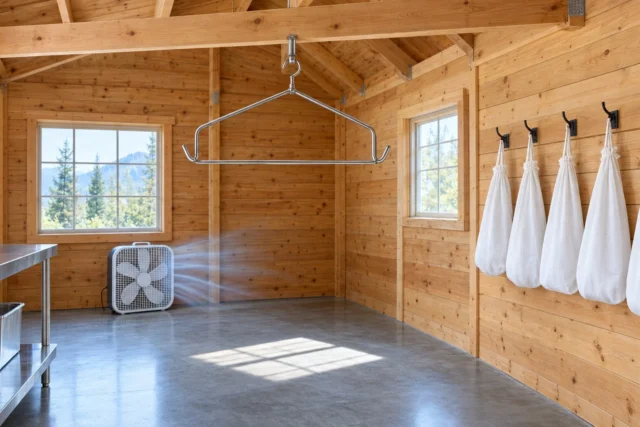
- Let air reach it. Wyoming says to hang or prop the carcass for air circulation. Even on cool days, it measured the round at 88.5°F about 5¾ hours after harvest.
- Get it to a cooler the day of the kill if you can. PNW says taking a whole, unskinned elk to a processor that day gives a higher quality product and greater meat yield after aging.
- Keep aging within limits. Under ideal conditions in a 34°F cooler, PNW gives cow elk a maximum of 7 days and bull elk up to 14 days.
For carcass cooling in general, see how to cool a deer carcass; for aging, how long to hang a deer; and for breaking a carcass down, how to quarter a deer.
What About Elk From CWD Areas?
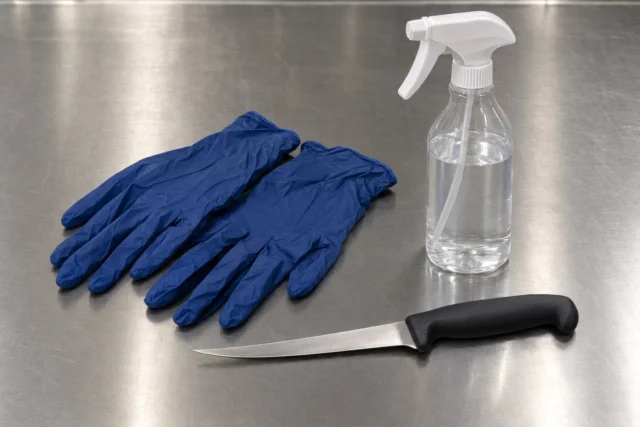
Wyoming recommends boneless cutting for elk harvested in areas where chronic wasting disease exists. Its precautions are to avoid sick elk, wear latex or rubber gloves, avoid the brain, spinal cord, lymph nodes, spleen, tonsils and eyes, and wash knives.
SAFETY: In CWD areas, the University of Wyoming recommends boneless cutting, gloves and avoiding the brain, spinal cord, lymph nodes, spleen, tonsils and eyes. See is venison safe to eat with CWD for testing guidance.
What Do the Sources Not Say?
Neither source gives a freezer-space figure for an elk; for packing a freezer, see how to organize a chest freezer. Neither gives processor prices. The Wyoming bulletin dates from 2003. The PNW figures come from the January 2010 edition of PNW 517; the current edition (revised August 2022) no longer includes the elk yield table.
One line in Wyoming’s Table 1 lists 166 pounds of boneless lean for a 400-pound field-dressed bull, which is half the skinned weight rather than half the field-dressed weight. This post uses the bulletin’s 50% statement and its Tables 2 and 3, which match each other.
For deer, see how much meat do you get from a deer; for pork, how much meat from a half hog.
Frequently Asked Questions
How much meat do you get from a bull elk?
In a University of Wyoming study, bulls averaged 437 pounds field dressed and 218 pounds of boneless meat. Wyoming’s age table runs from 92 pounds for a bull calf to 270 pounds for a bull 10½ or older.
How much meat from a cow elk?
In the same Wyoming study, cows averaged 339 pounds field dressed and 169 pounds boneless. Wyoming’s age table runs from 88 pounds for a cow calf to 197 pounds for a cow 10½ or older.
What percentage of an elk is meat?
Boneless meat ran 50% of field-dressed weight in a University of Wyoming study and 43% at a Wyoming locker plant. A Pacific Northwest Extension table works out to about 43%.
How much does an elk weigh field dressed?
In Wyoming’s 12-elk study, bulls averaged 437 pounds and cows 339 pounds field dressed, with head and hide on. Wyoming’s weighted average for all elk, including calves, is 328.2 pounds.
Is it legal to take only the backstraps and hindquarters?
The University of Wyoming bulletin says hunters violate the law when they take only the backstrap and hindquarters, leaving more than half of the boneless lean on the carcass. That statement is about Wyoming; check your state’s rules.
This is general information based on University of Wyoming and Pacific Northwest Extension publications. When in doubt, follow the sources linked above and your state’s hunting regulations.