There are two common ways. Washington’s WDFW rolls the elk on its back, opens it from the ribcage to the anus, ties off the anus and windpipe, and rolls the entrails out. PNW Extension’s gutless method removes the quarters, backstraps and tenderloins without opening the body cavity, which it calls CWD-safe. Check your state’s rules either way.
This guide uses four sources: the Washington Department of Fish and Wildlife’s The Basics of Elk Hunting in Washington (April 2019), Pacific Northwest Extension’s PNW 517, Big Game from Hunt to Home (revised August 2022), the Wyoming Game and Fish gutless field dressing FAQ and the University of Wyoming elk bulletin B-594R (August 2003). Each step is attributed to its source. SaltRail does not pick a method for you.
Gutted or Gutless: Which Method Should You Use?
Each source gives its own reasons. The table puts them side by side:
| Situation | What the sources say |
|---|---|
| Hunting alone | PNW says solo hunters should strongly consider the gutless method, with a block and tackle for hanging the meat. |
| Backcountry or near-country | PNW says the gutless method is good for near- or backcountry situations. |
| CWD area | PNW calls the gutless method a chronic wasting disease-safe way of harvesting game meat. |
| Saving the cape for a mount | PNW says the gutless method is compatible with saving the cape. |
| You want the heart and liver | WDFW’s method removes the organs; it says to keep the heart and liver in a game bag. SaltRail’s note: the gutless method leaves the body cavity closed, so the organs stay unless you open it. |
| Vehicle access to a processor | PNW says a whole, unskinned carcass taken to a processor on the day of the kill gives a higher quality product and greater meat yield after aging. |
What Do You Need?
A combined kit from the two field guides:
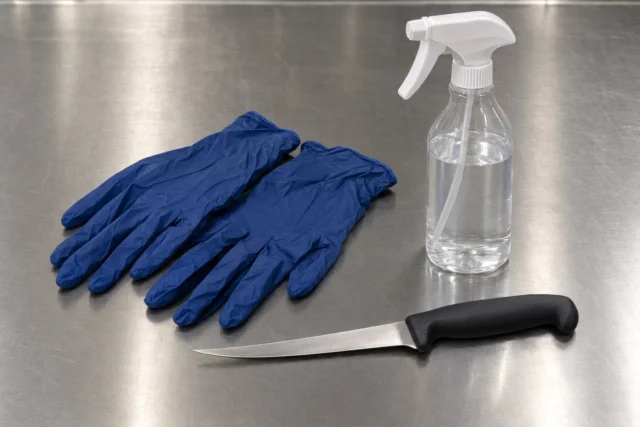
- Replaceable-blade scalpel knife and spare blades (PNW, gutless method)
- A sturdy folding knife that can take friction and leverage (PNW)
- A gut hook, optional, for opening the belly (WDFW)
- A bone saw or sharp hatchet for the pelvis (WDFW)
- Synthetic game bags with drawstrings (PNW); WDFW uses a game bag for the heart and liver
- String to tie off the anus and windpipe (WDFW)
- Rope, since PNW says a helper or an anchor point to tie off a rope makes the work more efficient
- Soap and water for hand-washing and bleach to sanitize your blades (PNW)
For knife choices, see our roundup of the best knife for processing deer. For full processing kits, see best deer processing kit.
How Do You Field Dress an Elk the Traditional Way?
WDFW says field dressing is removing the internal organs, and that it should be done as soon as practical after the animal is recovered, which lowers the chance that the intestines and stomachs rupture. It also says there are many valid ways to field dress elk. These are WDFW’s steps:
- Roll the elk onto its back.
- Open the chest. Insert the knife just below the bottom of the ribcage, angled toward the head, and split the breastbone to the base of the neck.
- Open the belly. From the ribcage, cut down the belly to the anus with the knife between your index and middle fingers so the blade tip stays covered. A gut hook works too. Leave proof of sex naturally attached.
- Free the anus. Cut around it and tie it off with a knot or string so no droppings get on your meat.
- Split the pelvis with a bone saw or a sharp hatchet.
- Free the windpipe. Sever it as high as you can and tie it off.
- Keep the organs you want. Remove the heart if you want it, and put the heart and liver in a game bag to keep them clean and cool.
- Cut the diaphragm, making sure not to puncture any organs.
- Detach the innards close to the backbone and pull the lower intestines through the split pelvis.
- Roll the elk onto its side and slide the entrails out.
WDFW says skinning will help cool the meat faster, on the ground or hanging from a gambrel and pulley. For the same job on a deer, see how to field dress a deer, and for organ safety, is deer liver safe to eat.
How Do You Use the Gutless Method?
PNW Extension describes the gutless method as skinning and removing the meat without opening the body cavity. Its steps, in order:
- Cut a handhold above the hock.
- Take the uppermost hindquarter. Skin it, then cut the tendon at the hip ball and socket so the quarter comes free without exposing the gut or seeing bone. Bag it.
- Make the dorsal cut from the skull to the hip. If you are saving the cape, make a “Y” from the antler bases. Cut from under the skin, with the grain of the hair.
- Take the front quarter. Cut in the “armpit,” remove the lower leg at the knee, skin it, then lift and free the quarter at the brisket and behind the shoulder. Bag it.
- Cut the backstrap free along the spine and the tops of the ribs. Slow down over the short ribs; PNW warns that poking your knife into the gut could be a disaster.
- Free the tenderloin from under the spine by carefully separating the connective tissue of the gut sack.
- Trim the rest: the neck, brisket and rib meat.
- Flip the animal and repeat on the other side. Remove the head at the joint between the skull and the first vertebra, without a saw.
PNW’s skinning tip: pull the hide tight and keep the blade parallel to the hide, angled slightly toward the meat, cutting with the grain. PNW also points readers to a video demonstration of the gutless method.
SAFETY: Do not cut into the gut cavity while freeing the backstrap or tenderloin (PNW Extension). In the traditional method, tie off the anus and windpipe and cut the diaphragm without puncturing organs (WDFW). Wash your hands and sanitize blades with bleach (PNW).
Is the Gutless Method Legal?
In Wyoming, yes. Wyoming Game and Fish says it is legal to gutless field dress a big game animal, as long as you bring out all four quarters, whether shot or not, plus the backstraps and inside tenderloins. It says you can cut slits along the back and reach in to remove the inside tenderloins, and that leaving organs such as the heart and liver in the field is not considered waste. If you debone, make sure you have all of the meat in case a warden stops you and weighs it.
Other states may differ. PNW Extension says to comply with your state’s rules on evidence of sex, and that other parts may be needed, such as for chronic wasting disease testing. Check your state’s hunting regulations before you choose a method.
How Do You Cool and Carry the Meat Out?
- Skin it if nights stay above freezing. The University of Wyoming says skinning will be necessary to prevent spoilage if nights are above freezing, and is not recommended if nights are below freezing.
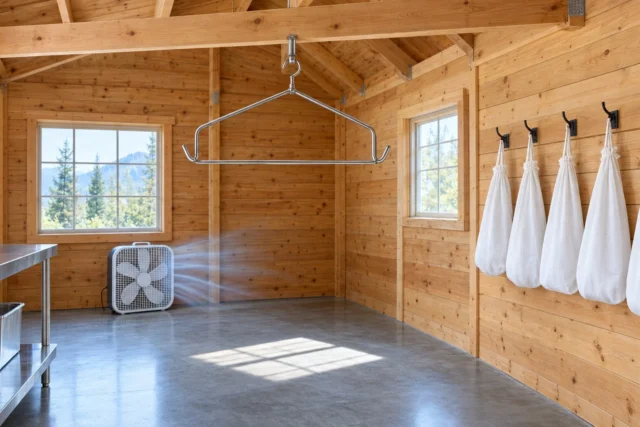
- Let air reach the meat. Wyoming says to hang or prop the carcass for air circulation, and that game bags keep off flies and dust.
- Cool it before you cover it. PNW says wrapping meat in game bags or canvas will also hold in heat, so be sure it has cooled thoroughly, below 40 degrees, before covering it for transport.
- Do not let it freeze. PNW says elk meat ideally should not be allowed to freeze while hanging in camp.
Wyoming measured how slowly a big carcass cools: even on cool days, the round was 88.5°F about 5¾ hours after harvest. For cooling steps, see how to cool a deer carcass; for breaking a carcass down, how to quarter a deer and how to butcher a deer; and for yield, how much meat from an elk. For aging after the pack-out, see how long to age elk meat. For a bigger animal, see how to process a moose.
What Do the Sources Not Say?
None of the sources opened for this post gives a time limit in hours for gutting an elk, elk-specific CWD testing steps, or gutless-method rules for states other than Wyoming. The Wyoming Game and Fish FAQ shows no date. For CWD guidance, see is venison safe to eat with CWD.
Frequently Asked Questions
Can you field dress an elk by yourself?
PNW Extension says solo hunters should strongly consider the gutless method and have a block and tackle for hanging the meat. It says a helper or an anchor point to tie off a rope makes the work more efficient.
What is the gutless method?
PNW Extension describes it as skinning and removing the quarters, backstraps, tenderloins and trim meat without opening the body cavity. It calls it a chronic wasting disease-safe way of harvesting game meat.
Do you have to gut an elk?
No. Wyoming Game and Fish says gutless field dressing is legal in Wyoming if you bring out all four quarters, the backstraps and the inside tenderloins. Check your state’s rules.
How do you get the tenderloins out without gutting?
PNW Extension frees the tenderloin from under the spine by carefully separating the connective tissue of the gut sack. Wyoming Game and Fish says you can cut slits along the back and reach in to remove them.
Is it legal to leave the guts and organs?
Wyoming Game and Fish says leaving organs such as the heart and liver in the field is not considered waste in Wyoming. Other states may differ, so check your state’s rules.
This is general information based on state wildlife agency and university extension guidance. Hunting rules vary by state; when in doubt, follow the sources linked above and your state’s regulations.