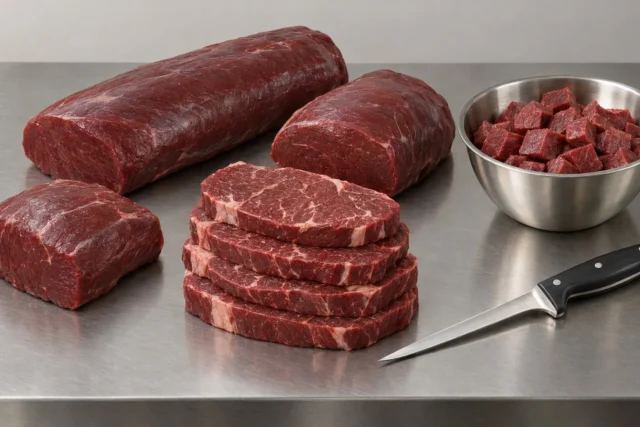
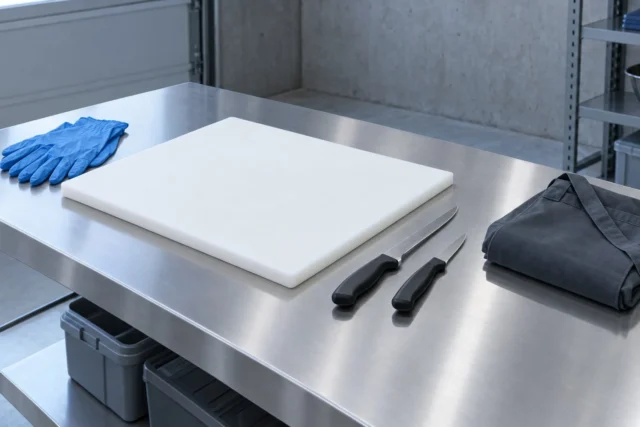
To butcher a goat at home, hold it off feed overnight with water available, stun it and bleed it only once it is fully unconscious, then hang it by the hind legs and skin it. Tie off the bung in a plastic bag, remove the digestive tract in one piece and wash the carcass. Cook the meat within 2 hours, or chill it below 40°F (WSU Extension). Sanitize your knife and hands between steps.
These steps come from Home Processing of Sheep and Goats for Meat by Washington State University Extension (WSU, 2020) and Steps of Small Ruminant Slaughter (APSC-202) by Virginia Cooperative Extension (VCE). Storage, cooking and inspection rules come from USDA FSIS. Where WSU and VCE differ, both are shown.
Before You Start: Safety and the Law
WSU says it is very important to understand that meat from home-slaughtered animals cannot be sold; it is for personal use only. WSU also says to check local zoning ordinances to make sure home butchering is allowed on your property, and to find out how inedible parts of the carcass can be discarded legally.
USDA FSIS says goats are covered under the Federal Meat Inspection Act of 1906, and any carcass slaughtered for sale must be inspected. The difference between custom exempt and USDA inspected meat explains the basics. Rules differ by state, so check yours.
SAFETY: VCE says to keep a backup stunning method on hand in case the first one malfunctions, and not to bleed an animal until it is fully unconscious. WSU says to sanitize and dry your knife and hands after each step, because safe food handling must be used throughout home slaughter and processing.
Which Goats Are Ready?
WSU says goat kids are usually slaughtered at 40 to 85 pounds. Some people prefer larger kids up to 130 pounds, and others prefer mature goats up to 250 pounds.
What You Need
These are the items WSU and VCE name for the job:
| Item | What it is for | Source |
|---|---|---|
| Captive bolt stunner, or a .22 rifle | Stunning | WSU; VCE also lists an electric stunner or firearm |
| A backup stunning method | In case the first one malfunctions | VCE |
| Sharp knives, sanitized | Bleeding, skinning and gutting | WSU, VCE |
| Sanitizer, such as chlorine bleach | Cleaning the work area, knife and hands | WSU |
| A shackle and a gambrel or trolley | Hanging the carcass by the hind legs | VCE |
| A plastic bag and string | Tying off the bung | WSU |
| Water, ideally under pressure | Washing the carcass | VCE |
| A refrigerator or an ice bath | Chilling the carcass | VCE |
For blade types, see our guide to the best knife for processing deer, which covers what to look for in a processing knife.
How Do You Butcher a Goat, Step by Step?
WSU numbers its steps and VCE adds detail to several. WSU says to sanitize and dry your knife and hands between every step. Each step gives the action and, where the source gives one, the reason. For a larger animal done the same day, see how to butcher a pig. For lamb, see how to butcher a lamb.
- Prepare the animal and the area. WSU says to start with a clean animal held off feed overnight, because a full belly makes skinning and especially gutting much harder. The animal should always have access to water. Clean and then sanitize the work area; WSU notes that sanitizers such as chlorine bleach do not work on surfaces that are not clean first.
- Stun the goat. WSU says someone proficient with firearms should do this step if a rifle is used, with extreme care for human safety. With a captive bolt stunner or a .22 rifle, WSU aims where an imaginary line from the left eye to the right ear crosses a line from the right eye to the left ear. VCE places a captive bolt slightly behind the poll, perpendicular to the skull, in full contact with the head, and says to stun again if the animal is not fully unconscious.
- Bleed it. WSU bleeds with a sharp, sanitized knife through the jugular veins at the throat, where the neck joins the head. VCE inserts the knife through the neck behind the jaw bone to sever the carotid artery or jugular vein.
- Hoist it and skin the hind legs. WSU hoists the animal by one hind leg, skins the opposite hind leg and removes its lower part, then hangs the carcass by the Achilles tendon of the skinned leg and skins the other leg. VCE moves the legs to a gambrel or trolley once the Achilles tendons are exposed.
- Tie off the bung. WSU removes the skin from the groin area, cuts around the bung (anus and rectum), places a plastic bag over its end and ties a string around it to prevent fecal contamination of the carcass.
- Skin the front and fist off the sides. WSU skins the front of the animal with a knife, then uses a fist to remove the hide from the sides, sanitizing hands before, between sides and after. VCE says fisting keeps the external flank muscle on the carcass, and that a knife used under the skin should face outward so it does not push feces or hair into the meat.
- Finish the hide. WSU skins around the front legs, shoulders and the front of the neck with a knife, then pulls the hide from the back and neck. Do not let the hair side of the hide touch the meat (WSU).
- Remove the head. VCE says to find the atlas and axis joint where the skull meets the neck and cut between them.
- Tie off the esophagus. WSU cuts the esophagus and windpipe free from the neck and ties off the esophagus so stomach contents cannot spill.
- Gut the carcass. WSU makes an incision down the belly midline with the sharp side of the knife facing out, then removes the organs without cutting into or tearing them. Organs you keep go into sanitized, covered containers and are cooled as soon as possible. VCE’s goal is to remove the whole digestive system in one piece, from rectum to esophagus.
- Trim and wash. Trim any fecal or other contamination. WSU washes the carcass with warm water. VCE washes for 2 to 3 full minutes at high pressure, starting at the hind legs, and names a lactic acid spray as an option, applied according to the manufacturer’s instructions.
- Dispose of the offal legally. WSU says offal you do not keep should be buried, landfilled or composted, following local ordinances.
- Chill it, or cook it. The next section shows both paths.
How Do You Chill or Age a Goat Carcass?
WSU and VCE give two different paths after dressing:
| Path | What to do | Source |
|---|---|---|
| Cook the same day | Bone out the carcass or cut it for cooking, and start cooking within 2 hours of slaughter. WSU says the meat will be tender if it is cooked before it goes into rigor mortis. | WSU |
| Chill and age | With a place to keep the carcass below 40°F, age it for 3 to 7 days to increase tenderness, especially for dry-heat cooking. | WSU |
| Chill | Use a refrigerator or an ice bath. If the carcass is too large for the fridge, cut it into primals: shoulder, foreshank, breast, rack, flank, loin and leg. | VCE |
| Freeze | Wrap the meat and freeze it at less than 0°F for longer storage. | WSU |
VCE says chilling reduces the likelihood of microbial growth and allows the chemical conversion of muscle to meat, which increases tenderness. For the folds, see how to wrap meat in freezer paper, and mark each pack as shown in how to label frozen meat.
How Long Does Home-Processed Goat Keep?
USDA FSIS gives these limits for goat meat:
| Storage | Time (FSIS) |
|---|---|
| Refrigerator, 40°F or below | 3 to 5 days for larger cuts; 1 or 2 days for ground goat |
| Freezer, 0°F or below | Safe indefinitely if kept frozen continuously |
| Freezer, best quality | The page says “up to a year” in one place; elsewhere it gives larger cuts 6 to 9 months and ground or cubed goat 4 months (and ground meat 3 to 4 months) |
FSIS gives more than one best-quality figure on the same page, so both are shown. SaltRail’s suggestion: use the shorter figure if you want to stay inside all of them.
What Temperature Should Goat Be Cooked To?
USDA FSIS says to cook ground goat to 160°F and goat steaks, chops and roasts to at least 145°F, measured with a food thermometer, then let the meat rest at least 3 minutes before carving or eating. WSU gives the same 145°F and 160°F figures.
Can You Sell Goat Meat You Butcher at Home?
No, according to WSU: meat from home-slaughtered animals is for personal use only. FSIS says any goat carcass slaughtered for sale must be inspected, under federal or state inspection. Check your state’s rules before you plan anything else.
Common Problems and Fixes
- The goat is not fully unconscious after the stun: VCE says to stun it a second time, and not to bleed it until it is fully unconscious. Have the backup method ready before you start.
- Hair or feces got on the meat: VCE says to trim those areas away, then wash the carcass. Keeping the blade facing outward under the skin helps prevent it.
- The carcass will not fit in the fridge: VCE says to cut it into primals first.
- A strong goat flavor: WSU says some people cover and refrigerate the meat in a salt solution overnight, then pour off the salt water, rinse the meat, add spices and cook. That is WSU’s description of what some people do, not a SaltRail recommendation.
- Contamination from the rectum: tie off the bung in a plastic bag before you open the carcass (WSU).
For more on mild flavor with game meat, see how to get the gamey taste out of venison.
What Do the Sources Not Say?
No source opened for this post gives a dressing percentage or yield for goats, a cut-by-cut chart beyond VCE’s list of primals, or aging times longer than WSU’s 3 to 7 days. VCE mentions ritual slaughter (Halal or Kosher) only briefly, and it is not covered here. The VCE fact sheet text shows no date; it cites the 2024 AVMA slaughter guidelines.
Frequently Asked Questions
What weight should a goat be for butchering?
WSU Extension says goat kids are usually slaughtered at 40 to 85 pounds. Some people prefer larger kids up to 130 pounds, and others prefer mature goats up to 250 pounds.
Do you have to age goat meat?
No. WSU says to start cooking within 2 hours of slaughter, before rigor mortis, for tender meat. If you can hold the carcass below 40°F, WSU says aging it 3 to 7 days increases tenderness, especially for dry-heat cooking.
What temperature should goat meat be cooked to?
USDA FSIS says to cook goat steaks, chops and roasts to at least 145°F and rest them at least 3 minutes, and to cook ground goat to 160°F, measured with a food thermometer.
Can you sell goat meat you butcher at home?
WSU Extension says meat from home-slaughtered animals cannot be sold and is for personal use only. USDA FSIS says any goat carcass slaughtered for sale must be inspected.
How do you keep goat meat from tasting strong?
WSU Extension says some people cover and refrigerate the meat in a salt solution overnight, then pour off the water, rinse the meat, add spices and cook it.
Raising smaller animals too? Our guide on how to butcher a rabbit covers the extension steps for meat rabbits.
This is general guidance based on university extension and USDA FSIS recommendations. When in doubt, follow the sources linked above and your state’s rules.