
As an Amazon Associate I earn from qualifying purchases.
Plenty of grinders sold for deer processing can’t keep up with an actual deer. They heat up by the second batch, smear the fat, and turn good venison into gray paste.
I spent 25 years running commercial kitchens, where a grinder that overheats on a Saturday night costs you the night. This guide picks the best meat grinder for deer by what matters at home: rated speed, whether owners report the motor overheating on a full deer, and whether the fat stays white. We compared maker specs and read owner reviews from Amazon, retailers, Reddit, and hunting forums, looking for the patterns that repeat.
Still deciding whether to process your own deer? Run your numbers in our deer processing cost calculator first, or go straight to the quick picks below if you’re ready to buy.
Quick Picks: The Right Grinder for How Much Deer You Process
| Pick | Best for | Motor | Maker’s rated speed |
|---|---|---|---|
| LEM Big Bite #12 | Most hunters (1–3 deer a season) | 0.75 HP | up to 11 lb/min |
| LEM Big Bite #22 (Dual Grind) | 3+ deer or an elk | 1 HP | about 13 lb/min |
| Weston Pro Series #22 | Big batches and sausage stuffing | 1.5 HP, 1,120 W | up to 14 lb/min |
| LEM Big Bite #8 | One deer a season, small kitchens | 0.5 HP | up to 7 lb/min |
| STX Turboforce II 4000 (#12) | Tight budgets, occasional use | “2,000 W peak” | 175–225 lb/hour |
Rated speeds are the manufacturers’ figures. What owners report is summarized under each pick below.
Before You Buy: Four Answers That Change Your Pick
- What size do you need? Match the head size to your deer count, not your budget. Our meat grinder buying guide walks through sizing a grinder to your largest batch.
- Which plates? A coarse plate for the first grind and a fine plate for the second. Here’s how meat grinder plate sizes work.
- How much fat? Venison is lean, so most hunters add beef or pork fat. Start with our venison burger fat ratio guide.
- How cold? Cold meat and cold steel prevent smear. Here’s how long to freeze meat before grinding.
How We Researched the Best Meat Grinder for Deer
We haven’t run these grinders ourselves. Here’s how we researched them instead. Our general method is on our How We Research page.
We start with each maker’s spec sheet and manual: horsepower, head size, rated speed and warranty. Then we read owner reviews on Amazon, retailer sites, Reddit hunting communities and hunting forums, and watch owner videos on YouTube. We give the most weight to owners who processed whole deer, and we log every recurring report: motor heat and shutoffs, fat smear, sinew jams, rust, broken parts, and how warranty claims went.
A single angry review doesn’t move a pick. A complaint that repeats across sources does. And we choose products before we check what they pay us. The full grinding method is in our guide on how to grind venison.
| Grinder | Overheating reports | Most common praise | Most common complaint | Warranty |
|---|---|---|---|---|
| LEM Big Bite #12 | Rare | Quieter than owners expected | No repeated complaint found | 5 years (LEM) |
| LEM Big Bite #22 | Rare | Pulls meat through with little stomping | No repeated complaint found | 5 years (LEM) |
| Weston Pro Series #22 | Some | Heavy, commercial-feeling build | Auger and bushing wear over time | 5 years, limited |
| LEM Big Bite #8 | Some, mostly on the second, fine grind | Easy to take apart and clean | No repeated complaint found | 5 years (LEM) |
| STX Turboforce II 4000 | Some (the manual calls for cool-down breaks) | Lots of power for the price | Loud while running | 3 years, repair (STX) |
The Best Meat Grinder for Deer: Our 5 Picks
1. LEM Big Bite #12: Best for Most Deer Hunters
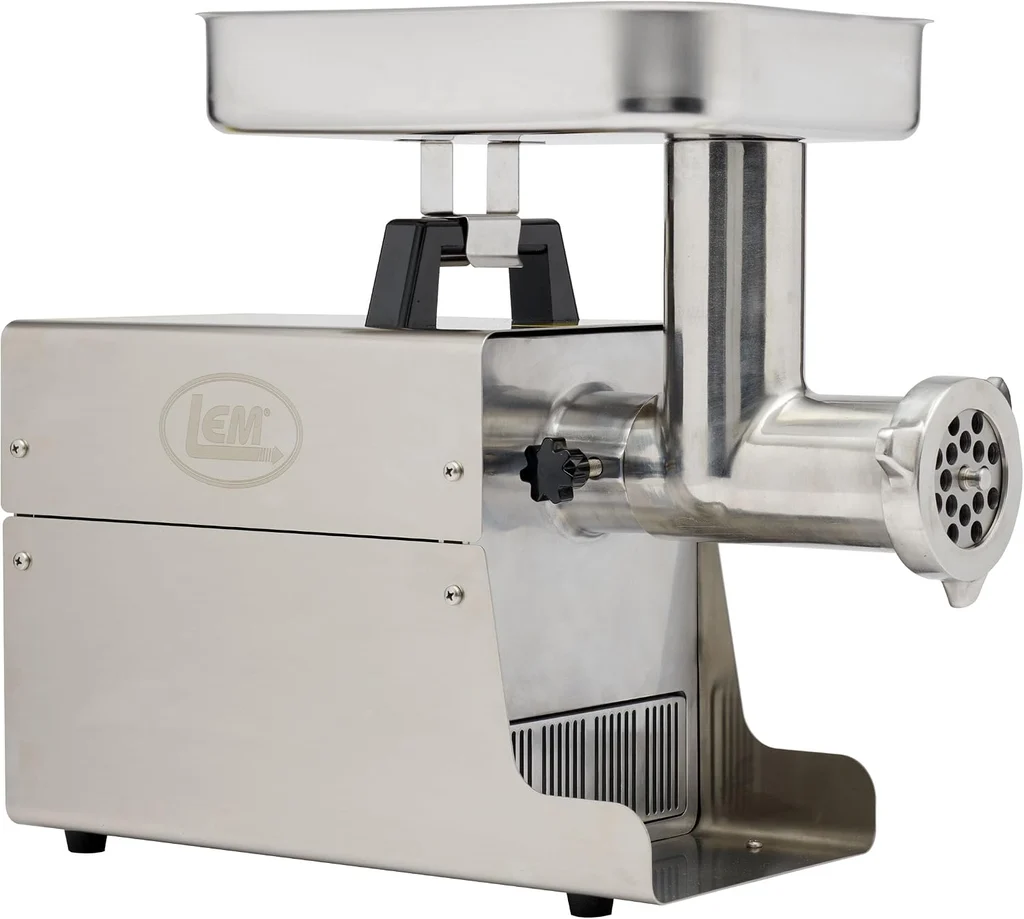
Best for: one to three deer a season. Specs (LEM): 0.75 HP, size #12 head, Big Bite auger, up to 11 lb per minute.
The #12 is the size I’d tell most hunters to buy. It’s big enough that feeding it doesn’t become the bottleneck, and small enough to live on a kitchen counter.
LEM designed the Big Bite auger to grab larger chunks and pull them into the head. That means less cubing and less pushing, which matters most on your second deer, when you’re tired and the meat is warming up.
What owners report: Owners often say it runs quieter than they expected. We found no complaint that repeats across sources, and reports of overheating or breaker trips are rare.
- Worth knowing: #12 plates and knives are a common size, so spares and extra plates are easy to find.
- Skip it if: you grind an elk or several deer every year. Go straight to the #22.
Check today’s price on the LEM Big Bite #12 →
2. LEM Big Bite #22: Best for Multiple Deer or Elk
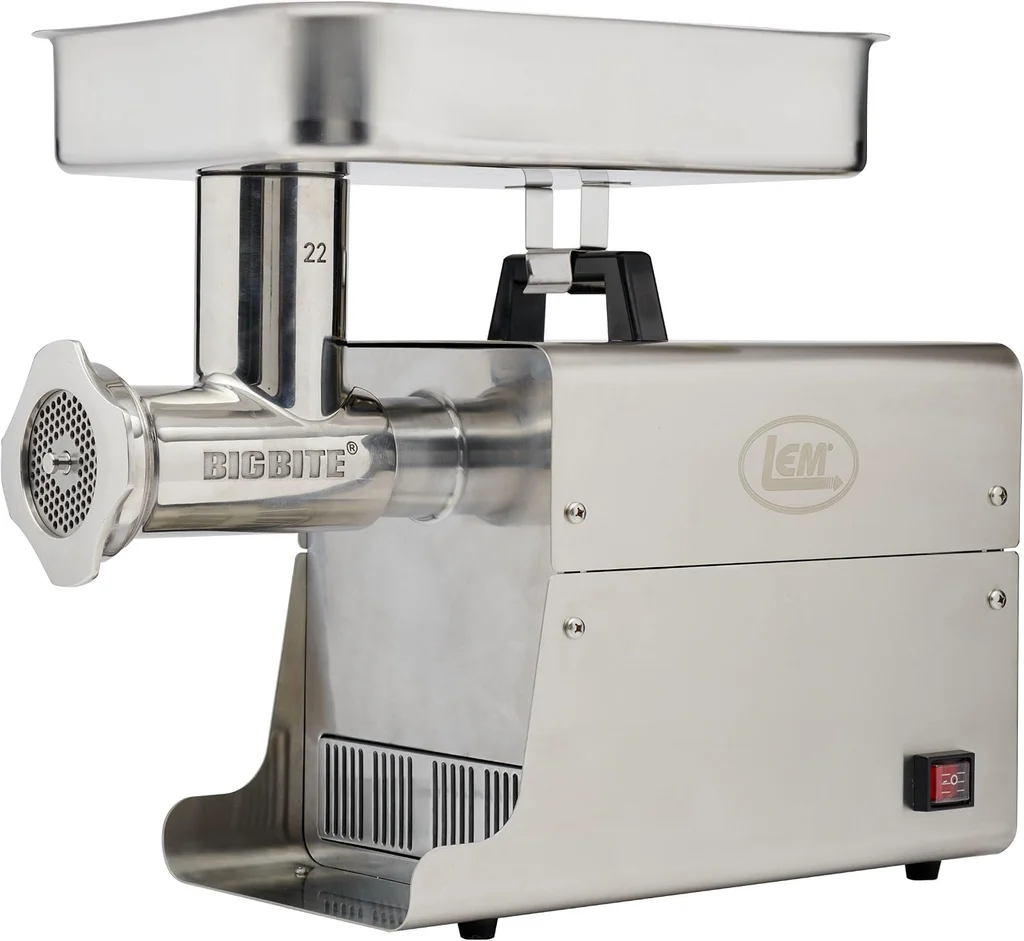
Best for: three or more deer, an elk, or a whole camp’s harvest. Specs (LEM): 1 HP, size #22 head, rated at about 13 lb per minute.
A bigger head and a bigger motor let you feed it continuously without stopping to let it cool. If you fill two freezers a year, the extra cost pays back in hours saved.
What owners report: Hunters who grind elk and several deer a season say it pulls meat into the head with little help from the stomper, and some report years of heavy use with nothing more than blade and plate sharpening. No complaint repeats across sources, and overheating reports are rare.
For the full owner-report breakdown, see our LEM Big Bite review. Torn between brands? Read LEM vs Weston.
Check today’s price on the LEM Big Bite Dual Grind #22 → The standard Big Bite #22 is currently sold only by third-party sellers on Amazon; the Dual Grind #22 uses the same 1 HP motor and is rated at about 13 pounds per minute.
3. Weston Pro Series #22: Most Power for Big Batches
Best for: high volume and big sausage days. Specs (Weston): 1.5 HP, 1,120 W, size #22 head, listed at up to 14 lb per minute.
It has the highest rated horsepower in this group, and it’s sold as a grinder and sausage stuffer set. If your season ends with a sausage-making weekend, that combination earns its counter space.
What owners report: Owners praise the heavy, commercial-feeling build. The complaint that comes up is wear: a few owners describe the auger end or its bushing wearing and running hot after long sessions, and forum advice is to keep that area lubricated. Overheating reports: some.
Check today’s price on the Weston Pro Series #22 →
4. LEM Big Bite #8: Best for One Deer a Season
Best for: a single deer and a small kitchen. Specs (LEM): 0.5 HP, size #8 head, up to 7 lb per minute.
If you take one deer and grind maybe half of it, a #8 does the job without taking over a cabinet. You’ll feed it more slowly, but you’ll also clean it faster.
What owners report: Owners like how easily it comes apart for cleaning, and several report a decade or more of use. Some mention the head warming up on the second, fine grind, so chill the meat and the parts between passes. No other complaint repeats across sources.
Grinding beef and pork as often as venison? Our best meat grinders roundup compares the #8 with smaller kitchen grinders for everyday batches.
Check today’s price on the LEM Big Bite #8 →
5. STX Turboforce II 4000 (#12): Best on a Tight Budget
Best for: an occasional deer on a strict budget. Specs (STX): size #12 head, “2,000 W peak output,” rated at 175–225 lb per hour on high, 3 speeds including reverse, foot pedal. STX says the 2,000 W figure is locked-motor peak power; under load it normally draws 1,000–1,400 W.
This is the budget pick, not the speed pick. Its rated speed works out to about 3–4 lb per minute, which is fine for one deer but slow for three.
What owners report: Owners say it delivers a lot of power for the price. The repeated complaint is noise. STX’s own manual says to rest the motor after 10–15 minutes of continuous grinding and has a thermal shutoff with a reset button, so plan breaks into a big batch.
More options at this price: best meat grinder under $200.
Check today’s price on the STX Turboforce II 4000 →
Also Considered: Cabela’s Carnivore
Cabela’s rates its 1 HP Carnivore (750 W) at 11–13 lb per minute and its 1-1/2 HP model (1,125 W) at 14–18 lb per minute. Those specs are competitive with LEM and Weston, so it’s worth a look if you shop at Cabela’s or Bass Pro.
Not Recommended for Deer: The KitchenAid Grinder Attachment
It’s fine for a pound of chuck on burger night. A deer is a different job, and the attachment runs off your mixer’s motor, which isn’t built for a long grinding session. Our buying guide covers whether a KitchenAid attachment is enough in more detail.
Meat Grinder for Deer: Which Size Do You Need?
Grinder sizes describe the head and plate diameter, not the motor. A bigger number means a wider throat and a larger plate, so more meat moves with every turn of the auger.
| Size | Plate diameter (approx.) | Typical motor | Good for |
|---|---|---|---|
| #8 | 2-1/8 in | about 0.5 HP | 1 deer a season |
| #12 | 2-3/4 in | about 0.75 HP | 1–3 deer a season |
| #22 | 3-1/4 in | 1–1.5 HP | 3+ deer or an elk |
| #32 | 3-7/8 in | 1.5 HP and up | Group processing, multiple elk |
Plate diameters vary slightly by maker. The full breakdown is in our meat grinder size guide.
Why “2,000 Watts” on the Box Can Mislead You
Budget grinders often print peak wattage in large type. Peak is a brief maximum, not the power the motor can sustain while it grinds.
Compare the ratings. The STX Turboforce II 4000 lists 2,000 W of peak output and is rated at 175–225 lb an hour. LEM rates its 1 HP Big Bite #22 at roughly 13 lb a minute, about 780 lb an hour.
The rule: compare rated pounds per minute and horsepower. Ignore peak watts.
How to Choose a Meat Grinder for Deer
Rated Speed and Horsepower
Buy for your busiest day, not your average one. If a bad day means three deer hanging in a cold garage, size up.
Stainless or Aluminum Head
Stainless heads handle cleanup better. Aluminum parts should be hand-washed, because dishwasher detergent discolors aluminum.
Plates and Knives
You want at least a coarse plate (about 3/8 in, or 10 mm) and a fine plate (about 3/16 in, or 4.5 mm). The knife and plate wear as a pair, so sharpen or replace them together.
A Reverse Switch
Venison sinew wraps around the knife. Reverse clears the jam in seconds instead of forcing a full teardown.
Where It Will Live
A #22 is heavy and bulky. Measure the shelf before you buy, because a grinder that’s a pain to get out is one you won’t use.
5 Mistakes That Ruin Ground Venison, Even With the Right Grinder
- Grinding warm. Warm fat smears. Chill the meat close to freezing and put the head, auger, knife and plate in the freezer first. See how long to freeze meat before grinding.
- Leaving silver skin on. It wraps the knife and clogs the plate. Our deer butchering guide shows how to trim it off before grinding.
- Skipping the fat. Straight venison makes a dry burger. Get the venison burger fat ratio right, and read where to buy beef fat for venison.
- Starting on the fine plate. Coarse first, then fine. It moves faster and smears less. See meat grinder plate sizes.
- Mixing deer. Label every package by animal. See how to label frozen meat.
Does a Meat Grinder Pay for Itself?
Processors typically charge $100 to $250 per deer, and more for sausage or jerky. A grinder is one piece of a home setup, along with knives and a vacuum sealer.
Our deer processing cost calculator totals your gear against your processor fees and shows the season you break even. For the trade-offs beyond money, read Is It Worth Processing Your Own Deer.
There’s also a benefit no calculator shows: you eat your own deer. In areas with chronic wasting disease (CWD), CDC recommends testing your deer, and if a processor does the work, asking for it to be processed individually.
Food Safety While Grinding Venison
- Keep it cold. Hold meat at 40°F or below, and grind in small batches straight from the fridge.
- Cook it through. Cook ground venison to 160°F, the USDA safe minimum for ground meat.
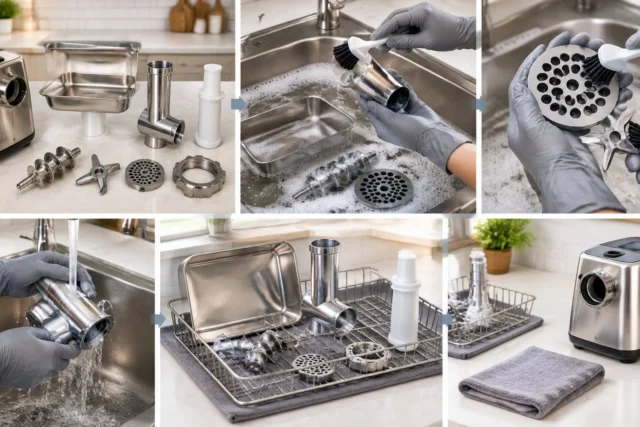
- Clean right away. Don’t leave meat in the auger overnight. Wash, sanitize and dry every part the same day.
- Test in CWD areas. Where CWD is present, have your deer tested before eating it.
Keeping Your Grinder Sharp and Rust-Free
Clean it the day you use it and dry every part completely. Here’s our step-by-step on how to clean a meat grinder.
Wipe steel parts with a light coat of food-grade mineral oil before storing them. When the grind turns ragged, sharpen the meat grinder blades and plates as a pair.
Meat Grinder for Deer: Quick Answers
Can you grind bones in a meat grinder?
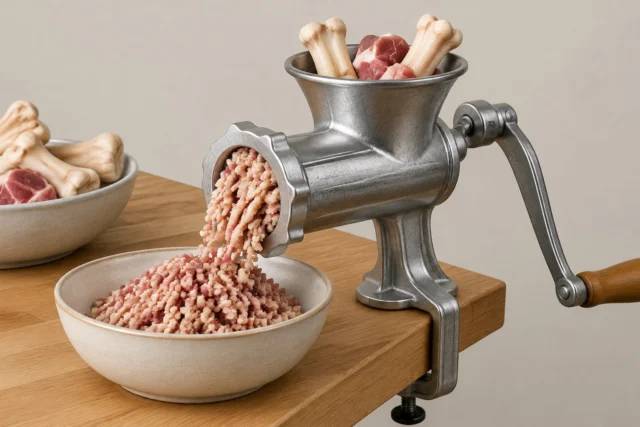
Only soft bones, and only in a heavy-duty grinder. Never put deer leg bones through a home grinder. Details: can you grind bones in a meat grinder.
Should you grind venison twice?
Yes, for burger: coarse first, then fine. Here’s why, in should you grind meat twice.
Can you grind partially frozen venison?
Partially frozen, yes; it grinds cleaner. Rock-solid meat strains the motor and can crack parts.
Is a KitchenAid attachment enough for a whole deer?
Not comfortably. It’s built for small batches. Our buying guide explains when a KitchenAid attachment is enough.
LEM or Weston?
Both make strong #22 grinders. The differences show up in speed, heat and cleanup, which is what we compare in LEM vs Weston.
The Verdict: The Best Meat Grinder for Deer for Most Hunters
For one to three deer a season, the LEM Big Bite #12 is the grinder I’d put on your counter. It’s big enough to keep up, small enough to store, and built around an auger designed to keep venison moving.
If you process three or more deer or an elk every year, step up to the LEM Big Bite #22 or the Weston Pro Series #22.
Get the LEM Big Bite #12 and grind your own deer this season →