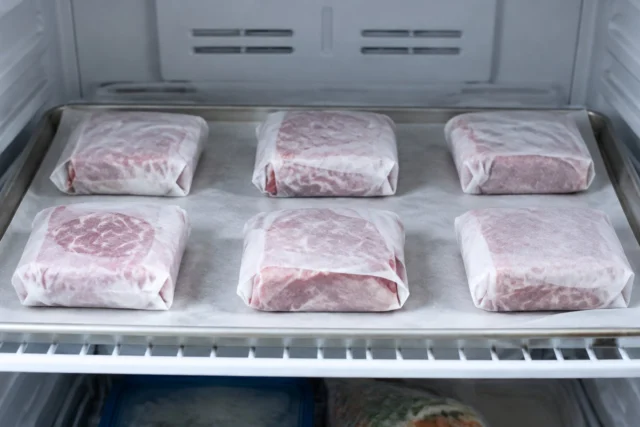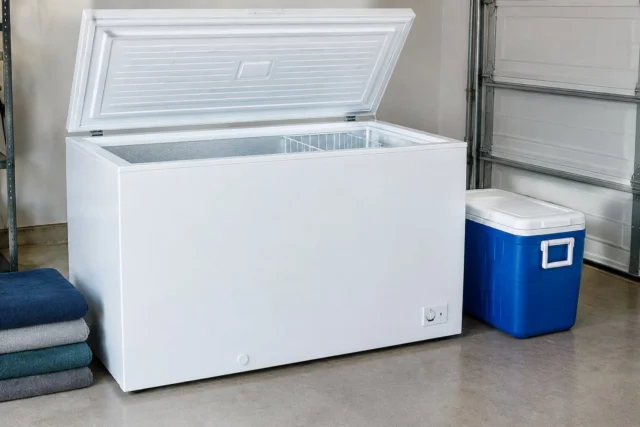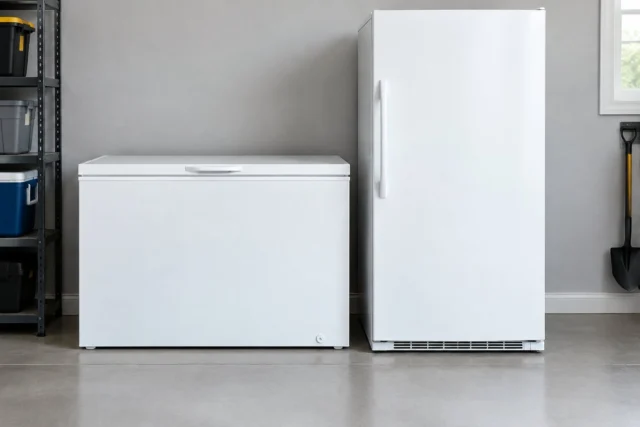

A full freezer holds its temperature for about 48 hours, and a half-full one for about 24 hours, as long as you keep the door or lid closed. USDA FSIS, FoodSafety.gov and NC State Extension all give these numbers. None of them gives a separate time for chest freezers, so plan your chest freezer around 48 and 24.
After reading, you will be able to prepare your freezer before the next outage, handle the first hours without power, and sort every package of meat once power returns. You also get the numbers from each food safety agency side by side, including dry ice guidance and refreezing temperatures, so you can see where they differ.
What You Need
You need three things before the power goes out: an appliance thermometer plus a food thermometer, frozen water containers to fill empty space, and a plan for ice or backup cold storage.
An Appliance Thermometer and a Food Thermometer
An appliance thermometer is a thermometer built to read air temperature inside a refrigerator or freezer, where it stays accurate in the cold. It is the single best tool for deciding whether your meat is safe after an outage.
Keep one in the freezer at all times. If the freezer lives in a garage, see can you put a chest freezer in the garage. FSIS says the freezer should run at 0°F or below. To check yours, set the thermometer between frozen packages and wait 5 to 8 hours. If it does not read 0 to 2°F, adjust the control and check again after another 5 to 8 hours.
The payoff comes later. FSIS states that if the freezer is still at 0°F or below when the power comes back, the food is safe.
A food thermometer does a different job. NC State Extension says to have one on hand to check the temperature of the food itself.
Frozen Water Containers
FSIS gives about 48 hours for a full freezer and about 24 hours for a half-full one. Empty space shortens the time. If you buy in bulk, see is buying half a cow worth it.
Fill gaps with frozen plastic jugs of water, bags of ice or gel packs. Group packages together, too. FSIS says grouping foods helps them stay cold longer.
If you are shopping for a new unit, size it to what you store. A freezer you can keep full is easier to protect; see our picks for the best chest freezer for meat.
Ice and a Safe Storage Plan
Find out where dry ice and block ice can be purchased (FSIS).
Your plan should include:
- A large insulated cooler and frozen gel packs.
- The name of a store that sells dry ice or block ice near you.
- A backup freezer or commercial locker you can move meat to if the outage runs several days.
Label every package with the cut and date; see how to label frozen meat. For how long vacuum-sealed meat keeps in the freezer, see how long vacuum-sealed meat lasts.
What Should You Do When the Power Goes Out?
Four steps cover the whole outage: keep the lid shut, line up ice or backup storage early, check temperatures when power returns, then sort every package to refreeze or discard.
Step 1: Keep the Lid Closed to Preserve the Cold
Keep the lid closed. Every opening lets cold air out.
The 48-hour and 24-hour figures only apply when the door stays shut. If you know an outage is coming, UMN Extension advises turning the freezer control to the coldest setting ahead of time. That gives you a colder starting point.
Your refrigerator is on a shorter clock. It keeps food safe for only about 4 hours. Move refrigerated meat to a cooler with ice if the outage will run longer.
Step 2: Arrange Ice or Alternate Cold Storage Before You Need It
Get dry ice or block ice early if the outage looks long. Add it before the food starts to thaw.
FSIS says 50 pounds of dry ice should hold an 18-cubic-foot freezer for 2 days. Use dry ice with care:
- Wear gloves. Never touch dry ice with bare hands.
- Lay cardboard on top of the food. Dry ice should never touch food directly.
- Set the dry ice on the cardboard and close the lid.
- Keep the room well ventilated. Carbon dioxide gas can build up and cause loss of consciousness.
If the power will be out more than a few days, move the meat to another freezer or a commercial locker.
Step 3: Check Temperatures When Power Returns
Read the appliance thermometer first. If the freezer is at 0°F or below, the food is safe.
If it reads higher, check the meat itself. Look for ice crystals and take the temperature of individual packages with a food thermometer. Start with packages in the front and small, thin ones. FSIS says they defrost faster.
Here is how fill level changes your planning window:
| Freezer fill level | Hold time, lid closed |
|---|---|
| Full | About 48 hours |
| Half full | About 24 hours |
Step 4: Sort Meat for Refreezing or Disposal
Judge each package on its own. Meat that still has ice crystals, or has stayed at 40°F or below, can be refrozen. Expect some loss of quality.
Meat exposed to 40°F or above for more than 2 hours goes in the trash (FoodSafety.gov).
SAFETY: Never taste food to decide whether it is safe. Discard meat, poultry and seafood held at 40°F or above for more than 2 hours. When in doubt, throw it out. Sources: USDA FSIS (never taste food; when in doubt, throw it out) and FoodSafety.gov (the 2-hour rule).
What Does Each Food Safety Source Say?
The agencies agree on the 48- and 24-hour hold times, but they differ on dry ice math and the refreezing temperature. The first table puts hold times and dry ice side by side; the second compares refreezing wording so you can see where they differ.
Compare Hold Times and Dry Ice Guidance Side by Side
All four sources give the same hold times. FoodSafety.gov lists 48 hours full and 24 hours half full with the door closed, the same as FSIS.
| Source | Full freezer | Half-full freezer | Dry ice guidance |
|---|---|---|---|
| USDA FSIS | About 48 hours | About 24 hours | 50 lb holds an 18 cu ft freezer for 2 days |
| FoodSafety.gov | About 48 hours | About 24 hours | Not given on the chart |
| NC State Extension | Up to 48 hours | Up to 24 hours | Not given |
| UMN Extension | About 2 days | May not stay frozen more than a day | 50 lb keeps a full 20 cu ft freezer frozen about four days |
The FSIS and UMN dry ice figures differ. They describe different freezer sizes, and we report each as written. Plan with the shorter one.
Compare Refreezing Wording and Use the Stricter Limit
The sources draw the refreeze line at slightly different temperatures.
| Source | Safe to refreeze if |
|---|---|
| USDA FSIS | Still has ice crystals, or stayed at 40°F or below |
| FoodSafety.gov | Has ice crystals and feels cold as if refrigerated |
| UMN Extension | Raw meat and poultry still at 40°F or less |
| NC State Extension | Still has ice crystals or is at 41°F or below |
Use the 40°F line that FSIS and UMN give. A package at 41°F passes one source and fails another, so treat it as a fail.
What Do You Do When Something Goes Wrong in an Outage?
Four problems come up most: a half-full freezer, packages that thawed unevenly, no temperature record, and the urge to use snow as a freezer. Each has a clear rule.
The Freezer Is Half Full: Use the Shorter Planning Window
Plan on 24 hours, not 48.
If an outage is forecast, fill empty space now with jugs of water or bags of ice. Push meat packages together into one block. If you already lost power, get dry ice sooner, since you have half the time to act.
Some Packages Thawed First: Assess Them Individually
Check each package. Thaw is uneven.
FSIS notes that food in the front, in the door, or in small, thin packages thaws faster than large, thick items or food in the back or bottom. Probe the small packs first and sort them one by one.
The Temperature History Is Unknown: Do Not Guess
If you were away and had no thermometer running, you cannot know how warm the meat got.
NC State Extension describes a simple check for when you cannot monitor the freezer and the power may have been off less than two days. Set it up ahead of time:
- Fill a bottle partway with water.
- Freeze it lying on its side.
- Once frozen, stand it upright in the freezer.
- After an outage, check the bottle. If the ice is still frozen upright, NC State Extension calls that a good indicator the food did not thaw. If the water has melted, assume the food did too.
Even this check does not tell you how warm it got. When in doubt, throw it out.
Outdoor Snow Looks Like Cold Storage: Do Not Use It
Keep meat out of the snow. FSIS says outside temperatures can vary, and food can be exposed to unsanitary conditions and animals.
FSIS suggests a better use for cold weather. Fill buckets, empty milk jugs or cans with water, set them outside to freeze, then put that ice in your freezer or coolers.
What Do Owners Ask About Chest Freezer Outages?
These answers cover the questions owners ask most after an outage.
Does a chest freezer stay cold longer than an upright freezer?
One source says yes. The Oregon Department of Emergency Management (March 2026) estimates that a full chest freezer stays safely frozen 36 to 48 hours and a full upright about 24 hours; half full, it gives 24 to 36 hours for a chest and 12 to 24 hours for an upright. Its page cites no underlying study. USDA FSIS (page updated 2013) gives one figure for any freezer: about 48 hours full and about 24 hours half full with the door closed. The other food safety and extension sources we reviewed do not compare the two types. Plan with the shorter window and keep the door closed. For a full chest-versus-upright comparison, see chest freezer vs upright freezer.
Can I refreeze meat after a power outage?
Yes, if the meat still contains ice crystals or has stayed at 40°F or below. That is the FSIS line. FSIS says quality may suffer. Discard any meat, poultry or seafood that sat at 40°F or above for more than 2 hours (the FoodSafety.gov rule).
Can I use dry ice to keep my chest freezer cold?
Yes. USDA FSIS says 50 pounds of dry ice should hold an 18-cubic-foot freezer for 2 days. UMN Extension says 50 pounds keeps a full 20-cubic-foot freezer frozen about four days. Wear gloves, put cardboard between the dry ice and the food, and keep the room well ventilated.
What if my chest freezer is only half full?
Plan on about 24 hours instead of 48, and keep the lid closed. Group packages into a tight block so they hold cold longer. Before the next outage, fill empty space with frozen jugs of water, bags of ice or gel packs. UMN Extension notes a half-full freezer may not stay frozen more than a day.
Should I taste thawed meat to check whether it is safe?
No. USDA FSIS is clear: never taste food to decide whether it is safe. Use a freezer thermometer and a food thermometer, look for ice crystals, and follow the 40°F rule. When in doubt, throw it out.
For help picking a freezer that is easier to keep full, start with our freezers and freezer storage guides.
This is general guidance based on USDA recommendations. When in doubt, follow the USDA FSIS source linked above.