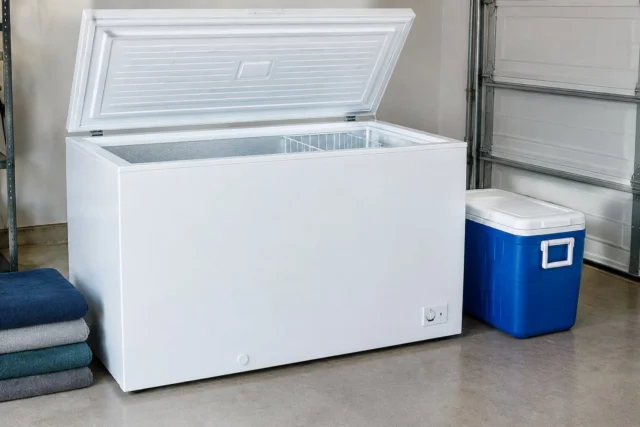

Most buyers of bulk meat choose a chest freezer. The DOE says chests are more efficient, ENERGY STAR cites about 215 kWh a year against 395 for an upright, and Oregon’s emergency agency estimates a full chest holds 36 to 48 hours in an outage against about 24. Uprights win on shelf access.
A chest freezer opens from the top, while an upright has a front-mounted door like a refrigerator, according to ENERGY STAR. This guide pulls the sourced differences into one table and links out for the details: product picks, outage steps, sizing and garage use each have their own page.
Which Is Better for Meat, a Chest Freezer or an Upright?
It depends on what matters more to you: running cost and outage hold time, or easy access and a small footprint. The table shows what each source says.
| Factor | Chest freezer | Upright freezer | Source |
|---|---|---|---|
| Energy use (ENERGY STAR certified) | About 215 kWh and about $30 a year | About 395 kWh and about $60 a year | ENERGY STAR |
| Why the difference | More insulation; cold air does not sink out when opened | Front door lets more cold air escape | DOE FEMP, ENERGY STAR |
| Full, door closed, power out | 36 to 48 hours | About 24 hours | Oregon OEM estimate |
| Half full, power out | 24 to 36 hours | 12 to 24 hours | Oregon OEM estimate |
| Space for 142 lb of beef | At least 4.5 cubic feet | 5.5 cubic feet | UMN Extension |
| Floor space and access | Typically needs more floor space | Shelves “allow for easy organization” | ENERGY STAR |
For specific chest models, see our best chest freezer for meat roundup.
Which Uses Less Energy?
ENERGY STAR says a certified chest freezer uses about 215 kWh of electricity and costs about $30 a year to run, while a certified upright uses about 395 kWh and costs about $60 a year. Those figures are for ENERGY STAR certified models. The DOE’s federal purchasing guidance says chest freezers are more efficient because they typically have more insulation and cold air does not sink out of them when they are opened.
ENERGY STAR also says that, generally, the larger the freezer, the greater the energy use, and the DOE says oversized freezers increase purchase cost, need more space and waste energy because of unused capacity.
Which Keeps Meat Frozen Longer in a Power Outage?
The two sources we opened give different numbers, and we show both rather than pick one.
| Freezer state, door closed | Oregon OEM (March 2026) | USDA FSIS (page updated 2013) |
|---|---|---|
| Full | Chest 36 to 48 hours; upright about 24 hours | About 48 hours (any freezer) |
| Half full | Chest 24 to 36 hours; upright 12 to 24 hours | About 24 hours (any freezer) |
The Oregon Department of Emergency Management says uprights warm up faster because cold air escapes more quickly, and chests hold cold air longer because of the top-opening design and deeper insulation. Its page cites no underlying study, so treat these as an agency estimate. The FSIS emergency page gives one figure for any full freezer and is older. Plan with the shorter window and keep the lid or door closed. For what to do during and after an outage, see how long a chest freezer stays cold without power.
How Much Space Do You Need?
University of Minnesota Extension says you need at least 4.5 cubic feet in a chest freezer or 5.5 cubic feet in an upright for 142 pounds of beef, its figure for a quarter. Oklahoma State Extension gives a rule of thumb of one cubic foot for each 35 to 40 pounds of cut and wrapped meat, with slightly more space for odd shapes.
For a half or whole beef, our guide on whether buying half a cow is worth it has the sizing table for chest and upright freezers.
Which Upright or Chest Freezer Is Easier to Organize?
ENERGY STAR says an upright has a front-mounted door like a refrigerator and shelves that allow for easy organization, while a chest freezer typically requires more floor space. For freezer organization in either type, dated labels make packages easier to find; see how to label frozen meat.
Does Manual Defrost or Frost-Free Matter?
ENERGY STAR says manual defrost freezers use half the energy of automatic defrost models, but must be defrosted periodically to get that saving. It says not to let frost build up more than one-quarter of an inch.
What Temperature Should Either One Hold?
The FSIS freezing page says food stored constantly at 0°F will always be safe, and recommends a standalone (free-standing) freezer set at 0°F or below for long-term storage, with an appliance thermometer to check it. The DOE says to set a freezer between -5°F and 0°F. See what temperature a chest freezer should be for checking it with a thermometer.
SAFETY: USDA FSIS: a full freezer holds its temperature for about 48 hours (24 hours if half full) if the door remains closed. Oregon OEM says food safety experts recommend discarding frozen items that have thawed and stayed above 40°F for more than two hours.
Can Either Go in a Garage?
That depends on the model, not the type. Check the maker’s manual for the temperature range it is rated for; our guide on putting a chest freezer in the garage covers what to look for.
How Do You Choose Between Them?
Work through these in order, using the sources above:
- Estimate how much meat you store at once, then size the freezer: Oklahoma State Extension gives one cubic foot per 35 to 40 pounds of cut and wrapped meat.
- Pick the type: a chest uses less energy and holds cold longer in an outage by the figures above; an upright gives shelves and a smaller footprint.
- Avoid buying too big: the DOE says oversized freezers cost more, need more space and waste energy.
- Decide on defrost: ENERGY STAR says manual defrost uses half the energy of automatic defrost, if you defrost it.
- Plan for 0°F and an appliance thermometer, per FSIS.
Chest vs Upright Freezer: Quick Answers
Is a chest freezer cheaper to run?
For ENERGY STAR certified models, yes: ENERGY STAR gives about $30 a year for a chest freezer and about $60 for an upright. Those figures are for certified models only.
Which one survives a power outage better?
Oregon OEM estimates a full chest stays frozen 36 to 48 hours and a full upright about 24 hours. USDA FSIS gives about 48 hours for any full freezer and 24 hours if half full. Plan with the shorter window and keep the door closed.
Should I get a chest or upright freezer for a deer?
No source we opened gives a deer-specific answer. Use the space rules: Oklahoma State Extension gives one cubic foot per 35 to 40 pounds of cut and wrapped meat, and Minnesota Extension says a chest needs less space than an upright for the same beef.
Does the freezer type change how long meat keeps?
The FSIS freezer storage times are listed by type of meat, not type of freezer. Food kept constantly at 0°F stays safe; see how long vacuum-sealed meat lasts in the freezer for the times.
Your next step: compare models in our best chest freezer for meat roundup.