
Set your chest freezer so a thermometer between the packages reads 0°F (-18°C) or below. Food held steadily at that temperature stays safe for as long as it stays there. Storage times only describe flavor, color and texture. The number to watch is on the thermometer, not the dial.
After reading, you will be able to check your freezer with an appliance thermometer, adjust it in steps, and read the result correctly. You will also see what USDA FSIS, a university extension and two freezer makers each say, side by side.
What Do You Need to Check the Temperature?
You need two things: a thermometer made to read cold air, and the control knob plus the manual for your model.
An Appliance Thermometer Suitable for Freezer Use
An appliance thermometer is a thermometer built to measure the air temperature inside a refrigerator, freezer or oven, and it stays in the unit.
USDA FSIS says appliance thermometers are specially designed to measure the temperature of the air in the refrigerator/freezer or the oven; most are liquid-filled or bimetallic-coil types.
Your Freezer’s Temperature Control and Owner’s Manual
Your control knob sets how hard the freezer works. It does not report the temperature. The two maker manuals we opened give a control range, not a target. The Frigidaire FFCS0562AW manual lists freezer temperature settings from 10°F (-12°C) to -11°F (-24°C). The Hamilton Beach HBFRF510/513 manual lists a temperature range of 10°F to -11°F, with the dial running from 1 (warmest) to 7 (coldest). Neither names a single setting to aim for. For dial-by-dial wording on four more models, see can you put a chest freezer in the garage. If you are shopping for a new unit, see the chest freezers for meat we compared.
How Do You Measure and Adjust the Temperature?
The process is a short loop: measure between packages, trust the thermometer, adjust, and leave the thermometer in place.
- Place the thermometer between frozen food packages.
- Wait 5 to 8 hours and read it.
- If it does not read 0 to 2°F, adjust the control and read again.
- Leave the thermometer in the freezer.
1. Place the Thermometer Between Frozen Food Packages
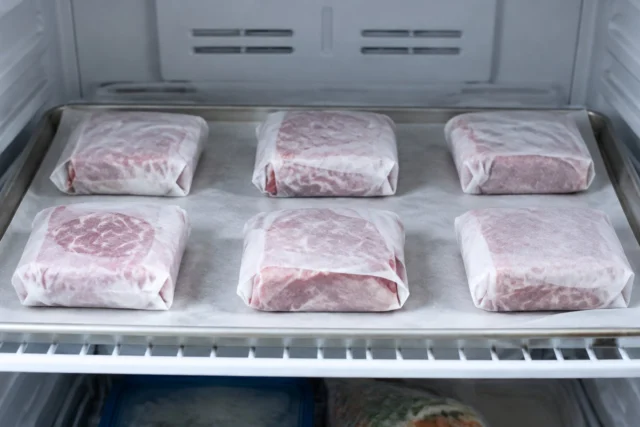
Set the thermometer between two frozen packages. Then wait 5 to 8 hours before you read it.
2. Read the Thermometer Rather Than the Dial
Read the number on the thermometer.
A dial setting is not a temperature. The manuals list a range of settings, not a target, so the thermometer reading is the number that answers the question.
3. Adjust the Control to Reach 0°F or Below
4. Leave the Thermometer in the Freezer
Keep the thermometer in the freezer for good. FSIS says an appliance thermometer can stay in the freezer to monitor the temperature at all times.
What Do the Safety Sources and Manuals Actually Say?
The safety sources agree on 0°F, the FSIS thermometer page words its check as “0 to 2°F,” and the maker manuals give only a control range, not a target. Nothing in these sources ranks colder settings.
Compare the Storage Targets and Control Ranges
| Source | Target or range | What it is for |
|---|---|---|
| USDA FSIS, Freezing and Food Safety | 0°F or below | Long-term storage; safety, plus vitamins, color, flavor and texture |
| USDA FSIS, Appliance Thermometers | 0 to 2°F is the check range; top quality when the freezer maintains 0°F | Adjusting the control; quality (page last updated Aug 2013) |
| USDA FSIS, Keep Your Food Safe During Emergencies | 0°F or below | Power-outage planning |
| UNL Extension, Refrigerator and Freezer Storage | 0°F (-18°C) or lower | Home storage |
| Frigidaire FFCS0562AW manual | Settings from 10°F (-12°C) to -11°F (-24°C); no single target stated | What the control can set |
| Hamilton Beach HBFRF510/513 manual | 10°F to -11°F; dial 1 warmest to 7 coldest; no setpoint | What the control can set |
FSIS states that food stored constantly at 0°F will always be safe, and only quality suffers over long storage.
SAFETY: Per USDA FSIS, food stored constantly at 0°F will always be safe; only the quality suffers with lengthy storage. Once thawed, microbes can become active again, so handle thawed items as you would any perishable food.
Is Colder Than 0°F Better?
None of the sources above says a setting colder than 0°F is better or worse. They set 0°F as the line and stop there. Hold your freezer at or below it.
Troubleshoot Readings That Do Not Match the Setting
Most confusion comes from two mix-ups: a dial that looks right while food runs warm, and a package date read as a safety deadline.
The Dial Number Looks Right, but the Thermometer Reads Too Warm
Trust the thermometer and adjust the control. Then wait 5 to 8 hours and read again, as FSIS says.
The Storage Date Is Being Treated as a Safety Deadline
Freezer storage times are for quality only. UNL Extension says that because freezing keeps food safe indefinitely, freezer storage times are recommended for quality (flavor, color, texture) only. For the times themselves, see how long vacuum-sealed meat lasts in the freezer.
For labeling, see how to label frozen meat.
Chest Freezer Temperature: Quick Answers
These four come up most often once the thermometer is in place.
Does the dial number equal the temperature in degrees?
No. The manuals we opened list the dial as a control range, not a temperature; Hamilton Beach, for example, numbers its dial from 1 (warmest) to 7 (coldest). Put a thermometer between frozen packages, wait 5 to 8 hours, and adjust the control based on that reading. For dial wording by model, see can you put a chest freezer in the garage.
How often should I check my chest freezer’s temperature?
FSIS says to keep an appliance thermometer in the freezer to monitor the temperature at all times. With one in place, you can read it whenever you open the lid. It matters most after a power outage, when a reading of 0°F or below tells you the food is safe. No fixed checking schedule appears in that guidance.
Do frozen foods go bad above 0°F?
FSIS ties 0°F to safety and links storing food at 0°F or lower to keeping vitamins, color, flavor and texture. No source here gives a number for how fast quality drops at 5°F or 10°F above. If your thermometer reads warm, turn the control colder and recheck after 5 to 8 hours.
When your freezer holds 0°F, your next step is our guide to freezers and freezer storage.
This is general guidance based on USDA recommendations. When in doubt, follow the USDA FSIS source linked above.