
As an Amazon Associate I earn from qualifying purchases.
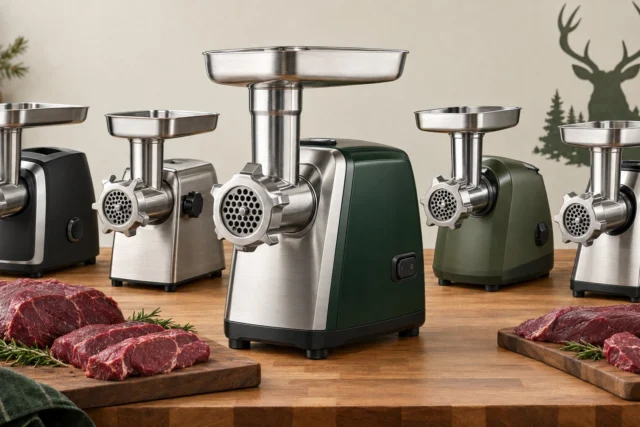
Compare like-sized electric models from LEM and Weston, and let your batch size decide. When evaluating a LEM vs. Weston meat grinder for home meat processing, your workload dictates which electric meat grinder makes sense.
For batches of roughly 25 lb or less, a #8 fits most home cooks; for a whole elk or a half beef, a #22 is the better match. LEM’s BigBite #8 is rated at 7 lb per minute, and its #22 is rated at 13 lb per minute.
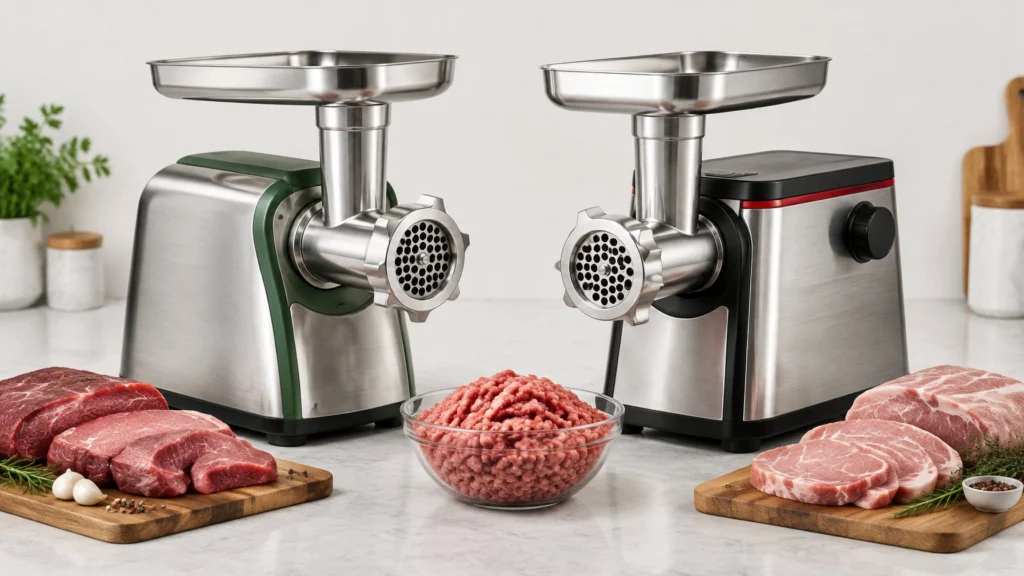
After reading, you will be able to size a grinder by the pounds you process and compare spec sheets line by line. You will also be able to set up the grinder correctly and fix the common jams. The comparison draws on current manufacturer specs, warranty and parts terms, and patterns in owner reports. It does not rely on brand loyalty. The food-safety numbers come from USDA FSIS.
Which Grinder Size Fits Your Batch?
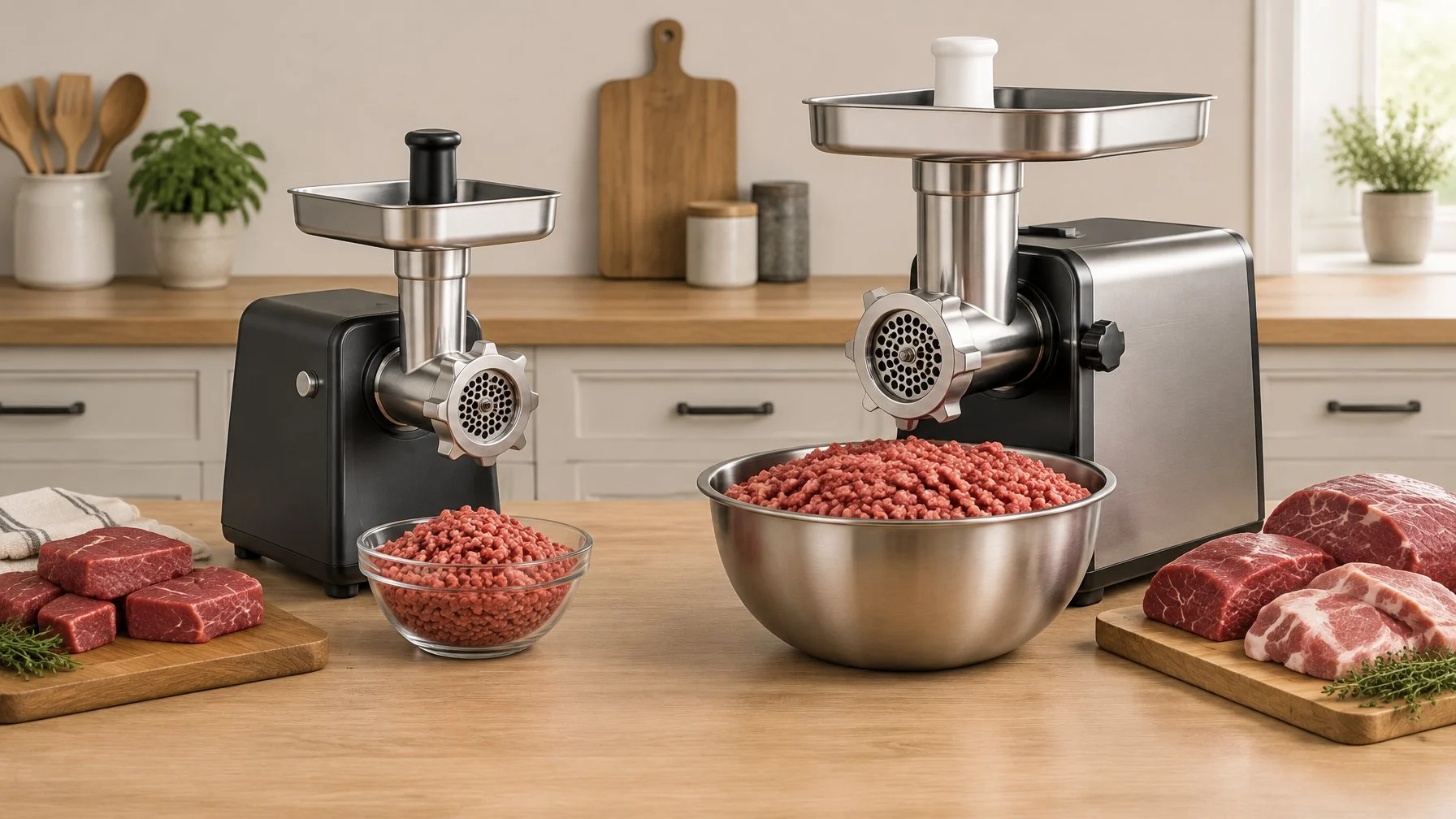
Three head sizes cover nearly every home job. A #8 handles weekly grinding, a #12 suits a deer or two each season, and a #22 is built for bulk days.
Choosing the right size is central to any LEM vs Weston meat grinder assessment. A grinder’s head number is a size code for the plate diameter and throat. A higher number means a wider plate and faster feeding for your LEM meat grinder or Weston machine.
| Spec (LEM BigBite) | #8 | #12 | #22 |
| Motor | 0.5 HP | 0.75 HP | 1.0 HP |
| Rated capacity | 7 lb/min | 11 lb/min | 13 lb/min |
| Head opening | 2″ | 2.25″ | 3″ |
| Weight | 28.66 lb | 33.07 lb | 49.6 lb |
| List price (Oct 2026) | $439.99 | $599.99 | $759.99 |
| Warranty | 5 years | 5 years | 5 years |
Is a #8 Enough for Home Grinding?
Yes, for most households. The LEM Big Bite #8 runs a 0.5 HP motor rated at 7 lb per minute. At that rate, a 20 lb batch of chuck needs about 3 minutes of grinding time, plus loading.
It suits home cooks grinding burger, breakfast sausage or a single deer. At 28.66 lb, this compact LEM meat grinder is also the easiest of the three to lift onto a counter and store.
If your routine focuses on grinding beef in manageable batches, the LEM Big Bite #8 delivers steady performance. For cooks weighing a LEM vs. Weston meat grinder, this size hits the sweet spot between counter space and power. One long-time owner on a smoking forum describes grinding chuck for burger and vacuum sealing it. That is the typical #8 job.
Check today’s price on the LEM Big Bite #8 on Amazon →
When Does a #12 Make Sense?
A #12 fits once you process one or two deer each season or grind 25 to 50 lb at a time. The #12 BigBite steps up to 0.75 HP and 11 lb per minute, with a 2.25″ head opening.
Its wider throat takes larger chunks, so you spend less time cubing meat. Forum buyers often say they “need an 8 but want a 12.” That usually means their batches are growing. If you grind venison twice a year in big sessions, the #12 is the safer pick. When evaluating a LEM vs. Weston meat grinder in the #12 category, both brands offer dependable workhorses for seasonal game. If your routine centers on grinding beef weekly in small amounts, the #8 is plenty.
Check today’s price on the LEM Big Bite #12 on Amazon →
Who Needs a #22 for Bulk Processing?
Choose a #22 if you buy a half or whole beef, process elk, or run group grinding days. When grinding beef from bulk primal cuts, a #22 saves hours of work. The LEM Big Bite #22 has a 1.0 HP motor rated at 13 lb per minute and a 3″ opening. LEM lists it as backordered, with an expected ship date of Oct 15, 2026.
That high grinding capacity makes short work of serious bulk meat grinding tasks. At this heavy-duty tier of the LEM vs. Weston meat grinder debate, both brands provide commercial-grade power that prevents motor stalling.
At 49.6 lb, the LEM Big Bite #22 is heavy, so plan a permanent spot for it or keep a cart nearby.
Check today’s price on the LEM Big Bite Dual Grind #22 on Amazon → The standard Big Bite #22 is currently sold only by third-party sellers on Amazon; the Dual Grind #22 uses the same 1 HP motor and is rated at about 13 pounds per minute.
In a commercial kitchen, the grinder that handles the volume without overheating earns its space. The same logic applies to heavy home meat processing days. See the meat grinder size guide for more batch math.
What Do You Need to Compare Before Buying?
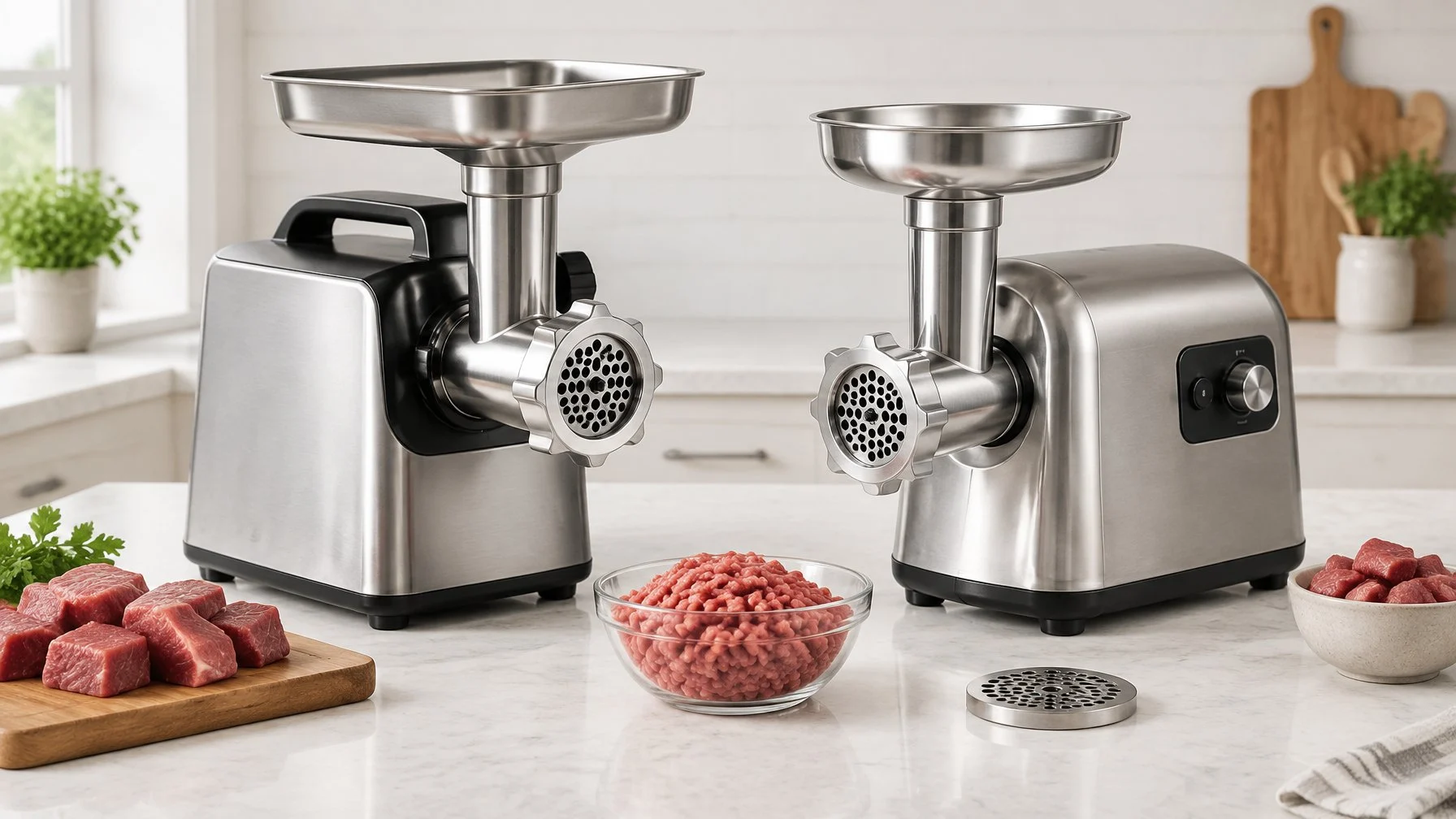
For anyone outfitting a home meat processing station, four checks decide a fair LEM vs. Weston meat grinder comparison. You need to examine matching models, motor specs, bundled accessories, and long-term ownership costs. That last check covers price, cleaning, warranty coverage, and parts.
Which Current Models Are Fair to Compare?
When weighing a LEM vs. Weston meat grinder, compare the same head size and the same power type. An electric LEM meat grinder such as the BigBite #12 lines up against an electric Weston #12 from the Weston Pro Series. It does not line up against a Weston #22 manual tinned meat grinder.
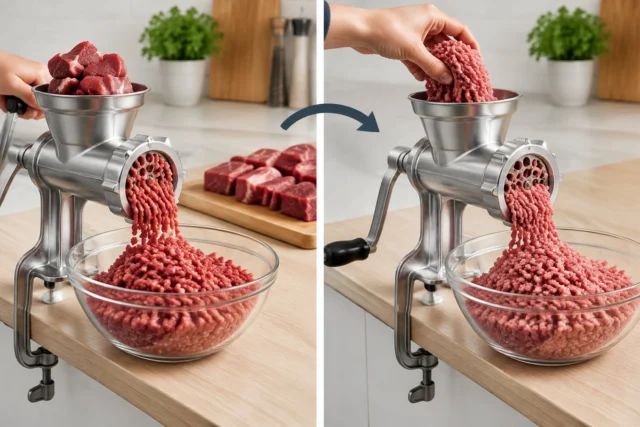
The manual #22 is hand-cranked. It shares the plate size, but not the speed or effort. LEM also sells smaller lines, like the MightyBite #8, so check which series you are looking at before you compare prices.
What Do the Motor, Feeding Tube, and Rated Capacity Tell You?
Horsepower tells you how much load the motor handles before it slows down. Rated grinding capacity in lb per minute is the maker’s best-case speed with chilled meat that has been cut to fit. Throat and feeding tube width tell you how large your chunks can be.
Whether evaluating an all-metal build or a stainless steel meat grinder, durable materials ensure longevity. LEM’s BigBite line pairs an extended auger with a rifled head to pull meat in smoothly.
In any LEM vs Weston meat grinder comparison, read each spec sheet for those three numbers before choosing a model.
What Comes with the Grinder for Sausage Making?
All three LEM BigBite models include three stainless plates: fine (4.5 mm), coarse (10 mm) and a stuffing plate. They also come with a sausage stuffing kit featuring three plastic stuffing tubes and a meat stomper. The #8 tubes measure ½”, 1″ and 1⅜”, while the #12 and #22 use ⅝”, 1″ and 1⅜”.
Those parts let you stuff casings through the grinder. For more than a few pounds of links, a dedicated stuffer works faster.
Check whether each brand provides a complete sausage stuffing kit with multiple funnel sizes. Count the plates and tubes in any Weston box against this list. In a LEM vs. Weston meat grinder matchup, bundled accessories can vary. Our sausage making guides cover tube sizes by casing.
How Do Price, Cleaning, Warranty, and Parts Support Compare?
LEM backs BigBite grinders with a 5-year warranty and lifetime customer support. The fine print matters. The BigBite manual’s warranty terms say coverage drops to 90 days if you do not return the warranty card with your receipt. Parts must be hand-washed, because they are not dishwasher safe.
If you bought from a retailer like Amazon or Scheels, you must register the warranty online. LEM’s customer service team answers calls Monday through Friday, 8 am to 6 pm Eastern, and runs a separate parts email. Weigh Weston’s published warranty terms and customer service responsiveness the same way at the same head size.
Long-term parts availability and warranty support often settle the LEM vs. Weston meat grinder decision.
Weston’s product pages list three Pro Series sizes. The Pro Series #8 has a 3/4 HP, 560-watt motor rated at 4 to 6 pounds per minute. The Pro Series #12 has 1 HP and 750 watts, rated at 6 to 9 pounds per minute. The Pro Series #22 has 1.5 HP and 1,120 watts, rated at 14 pounds per minute. Weston backs all three with a 5-year limited warranty, the same length as LEM’s BigBite coverage.
How Do You Choose and Set Up the Grinder?
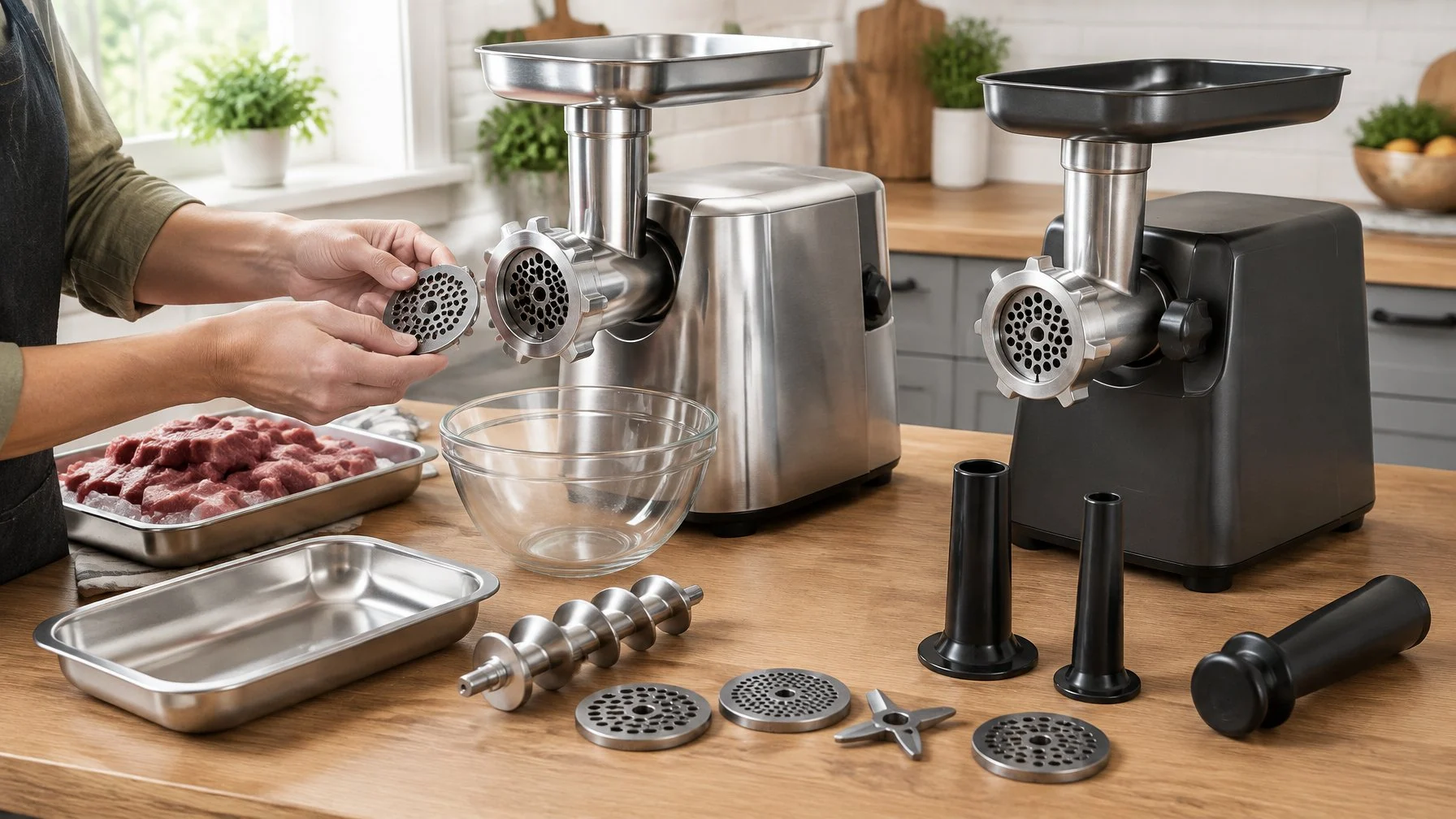
No matter which model you choose in the LEM vs. Weston meat grinder comparison, four steps take you from purchase to a clean first grind: size the batch, check the exact model, chill and assemble, then grind safely.
Before you start, gather this equipment:
- A grinder sized for your batch (in lb)
- A kitchen scale
- Meat lugs or sheet pans
- An instant-read thermometer
- A freezer with clear shelf space
- A sausage stuffer for link batches
1. Weigh the Batch and Match the Grinder Size
Weigh your typical batch in pounds. Then divide it by the rated lb per minute to estimate grinding time. A 60 lb batch takes about 9 minutes on a 7 lb/min #8 and about 5 minutes on a 13 lb/min #22, before you count loading time.
Calculating your seasonal volume makes resolving the LEM vs Weston meat grinder decision much simpler.
2. Check the Exact Model’s Specifications and Included Parts
Read the spec sheet for the exact SKU. Model names repeat across product lines. Confirm the head size, plates, tubes and warranty terms. Find the manual on LEM’s product manuals page or on Weston’s site.
3. Chill the Meat and Assemble the Cutting Parts
Follow these steps in order:
- Cube the meat to fit the throat. Smaller pieces feed without stomping.
- Chill the meat to 40°F or colder, and put the head, auger, knife and plate in the freezer. Cold steel keeps fat from smearing.
- Fit the auger, then the knife with the flat side facing the plate. A reversed knife mashes meat.
- Add the plate and snug the ring by hand. If it is too tight, the parts bind.
Our guide on how long to freeze meat before grinding gives timing.
4. Grind Safely and Use a Dedicated Stuffer When Needed
Feed meat with the stomper only, never your fingers. Do not run the grinder empty, and never grind bones or deep-frozen meat. LEM’s manual also warns against using an extension cord. While a bundled sausage stuffing kit handles small runs, switch to a vertical stuffer for long link batches to maintain steady pressure.
SAFETY: Grinding spreads surface bacteria through the whole batch. Keep meat at 40°F or below while you work. Cook ground beef, pork and venison to 160°F, and ground poultry to 165°F, per the USDA FSIS safe temperature chart. No grinder makes mishandled meat safe.
What If Grinding or Stuffing Goes Wrong?
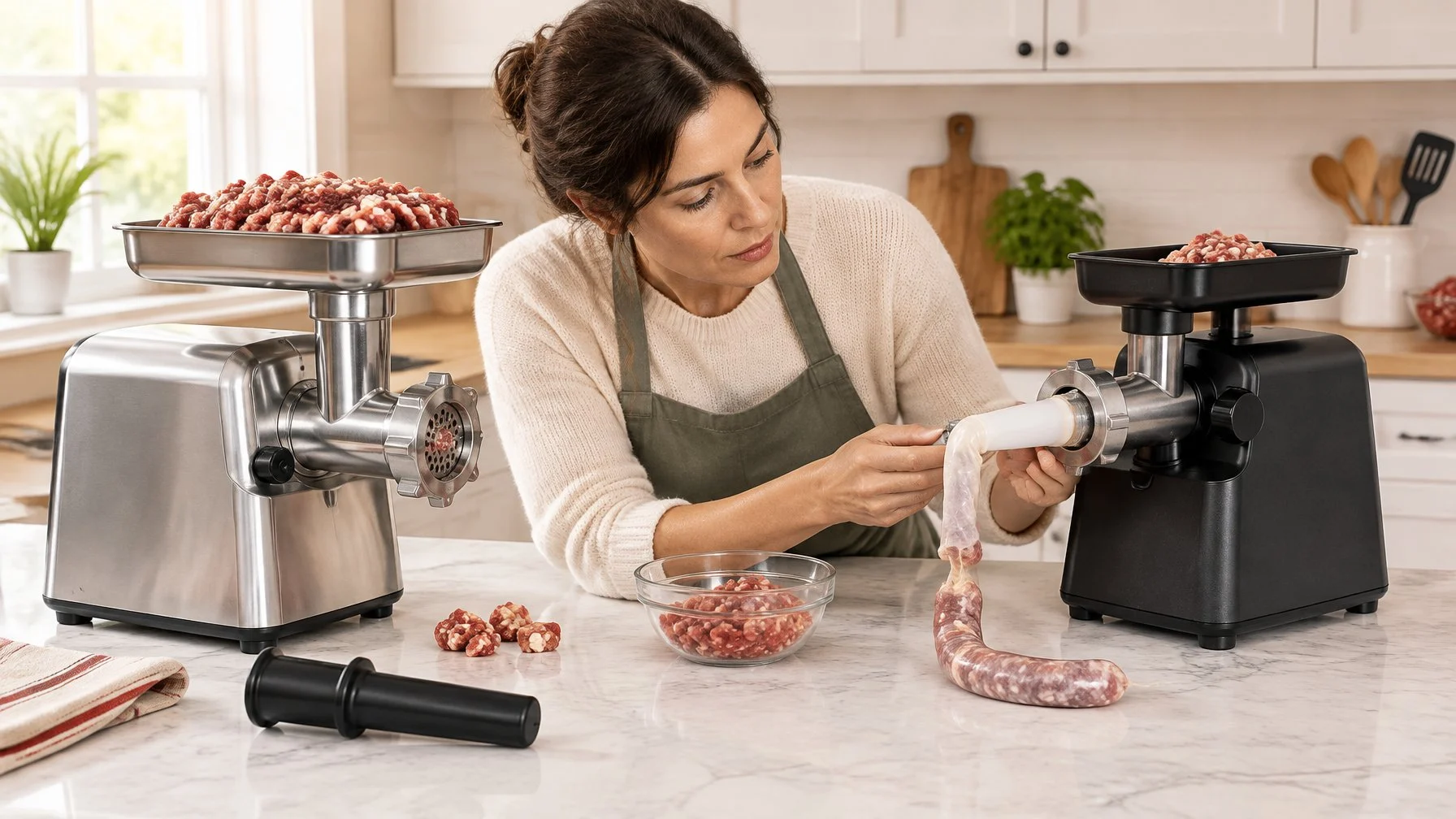
Most problems come from four issues: smearing, clogs, uneven texture and slow stuffing. Diagnose the cause first, then fix it.
Meat Smears Instead of Grinding Cleanly
Smearing means warm meat, a loose setup or a dull edge. LEM’s troubleshooting guide says to chill meat to 40°F and confirm the plate and knife are seated correctly. Also check that the bushing sits in the back of the head. A dull knife or grinding plate causes mashing too, so replace or sharpen both as a pair.
The Feeding Tube Clogs or the Motor Strains
Stop and unplug the grinder before you clear anything. Clogs usually come from oversized chunks or silver skin wrapping the knife. Cut the meat smaller, trim the sinew, and trickle meat into the head. Do not pack it.
If the housing or plug feels hot, stop the job and call the maker. LEM’s grinders include a built-in circuit breaker for overloads.
The Grind Comes Out Uneven
Uneven texture points to a gap between the knife and plate, or to meat that has warmed partway through the batch. Tighten the ring by hand, re-chill the head, and work in smaller batches. For a fine texture, grind once through the 10 mm plate and again through the 4.5 mm plate.
LEM’s grinder manual lists a dull knife or plate as one cause of meat mashing instead of coming out in clean strands. It also says over-tightening the retaining ring wears both parts faster, so tighten it by hand only. LEM’s #10/12 knife page advises replacing the plate whenever you replace the knife. Neither LEM nor Weston publishes a fixed sharpening interval, so watch for mashing or clogging that continues after you reassemble correctly.
Sausage Stuffing Runs Too Slowly
Stuffing through a grinder is slow because the auger churns the meat. Remove the knife, fit the stuffing plate, and choose the largest tube your casing allows. For batches over a few pounds, a dedicated stuffer moves faster and keeps the texture intact. Keep the mix cold the whole time.
LEM vs. Weston Grinders: Quick Answers
These answers cover quality, price, home sizing, plate fit and manual versus electric #22 models.
Are Weston meat grinders good quality?
Weston builds well-known electric and manual grinders, including the Pro Series. Judge any single model by its motor rating, rated capacity, included plates and warranty terms.
In any LEM vs. Weston meat grinder evaluation at the same head size, the spec sheet and parts support decide which one fits your batch.
Are LEM Big Bite grinders worth the higher price?
They are worth it when your batches justify the capacity. As of October 2026, the #8 lists at $439.99, and it includes three stainless plates, a 5-year warranty and lifetime support.
If you grind only a few pounds a month, a smaller unit may serve you fine. For hunters and homesteaders weighing a LEM vs. Weston meat grinder, investing in a heavy-duty LEM meat grinder pays off through durable parts and responsive customer service.
Which size meat grinder is best for home use?
In a practical LEM vs. Weston meat grinder comparison, a #8 suits most home kitchens. It is rated near 7 lb per minute and weighs under 30 lb, which makes it easy to store. Move up to a #12 if you process one or two deer each year. Choose a #22 for half-beef purchases, elk or group grinding days where you run 50 lb or more.
Can LEM and Weston grinding plates be interchanged?
Do not assume they will fit. When comparing a LEM vs. Weston meat grinder, plate compatibility is not guaranteed across brands.
Plates are sized by head number, but hub size and thickness vary by maker and even by model. LEM notes that its plate for #10 hand grinders is smaller than its #10/12 plates. Buy replacement plates from your grinder’s maker, or confirm the fit with their parts team.
Is a #22 manual Weston grinder comparable to a #22 electric LEM?
They share a plate size, but they work very differently. The Weston #22 manual tinned meat grinder is hand-cranked, so speed depends on your arm. The LEM Big Bite #22 runs a 1.0 HP motor rated at 13 lb per minute. A manual #22 suits off-grid or occasional use. For bulk batches, the electric model is the fit.
Ultimately, choosing a LEM vs Weston meat grinder comes down to matching motor specs, warranty support, and plate sizes to your harvest.
When you are ready to narrow the field, our roundup of the best meat grinders sorts current models by batch size.