
As an Amazon Associate I earn from qualifying purchases.
As an Amazon Associate I earn from qualifying purchases.
The BOMATA Large Kitchen Scale is our top pick for home curers who weigh cure and spices for bacon, summer sausage, or snack sticks. For most U.S. home curers and deer hunters, the BOMATA Large is the scale to buy: it reads to 0.1 g, holds 11 lb, comes with a 100 g calibration weight, and lets you turn auto-off off for long batch sessions.
Cure is dosed by the weight of the meat, so follow the dosing on your cure product’s label and a trusted recipe.
That is why we recommend 0.1 g resolution for cure and spices. This is SaltRail’s research-based advice, not a rule set by any regulator. Weigh your cure every time, never scoop it with spoons, and follow the dosing on your cure product’s label.
Before you buy, check four specs. The first is resolution, meaning the smallest step the scale displays. Then look at the smallest load it will register, whether auto-off can be disabled, and how much bowl space the platform holds.
Using a reliable gram scale keeps your curing salt and seasonings consistent. Use a second, higher-capacity scale that reads in 1 g steps for the meat itself. The three scales below cover cure, spices, and small batches.
How we ranked these
SaltRail did not hand-test these scales. We compared each Amazon listing’s stated readability, minimum load, capacity, power and washability (the makers publish no spec pages), and set them against the size of a small cure dose using extension-service arithmetic (table below). Only one of the three listings states a tolerance. Two of the three picks are BOMATA models, so this is a narrow comparison. Commission rates play no part in the order.
| Pick | Stated readability | Min load | Capacity | Power | Source |
|---|---|---|---|---|---|
| BOMATA Large (B0C7162144) | 0.1 g | 0.5 g | 5 kg | USB-C / 2 AAA | Amazon listing (no maker page) |
| BOMATA IPX6 (B0FMRBJRJY) | 0.1 g | 0.5 g | 5 kg | 2 AAA | Amazon listing (no maker page) |
| Bonvoisin 6000g (B0DM55TNZ3) | 0.1 g readability; ±0.3 g tolerance stated | 1 g | 6 kg | AC adapter + AA | Amazon listing (no maker page) |
Best Scale for Curing Meat
Best for most home curers: BOMATA Large Kitchen Scale
Best for messy raw-meat work areas: BOMATA Waterproof IPX6 Scale
Better for larger batches: Bonvoisin 6000g Lab Scale
BOMATA Large Kitchen Scale
BOMATA Large Kitchen Scale
listed 0.1 g, 0.5 g to 5 kg · 7.2 x 7.2 in platform · 100 g calibration weight
Check today’s price on Amazon
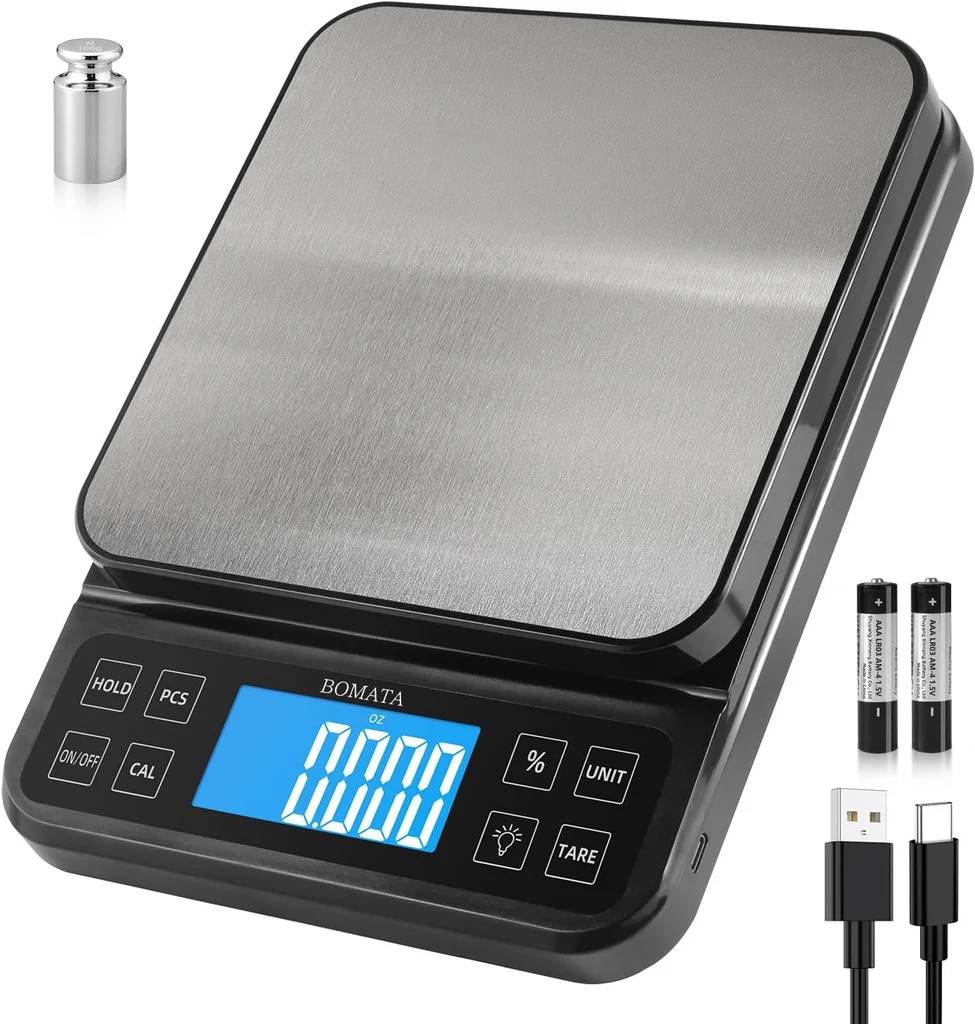
Buy this one if you want a single precise scale that also fits a large mixing bowl.
Pros
- 7.2 x 7.2 inch platform with a hold function for oversized bowls (per the Amazon listing)
- Comes with a 100 g calibration weight, and auto-off can be disabled (per the Amazon listing)
- Runs on USB-C rechargeable power or two AAA batteries (per the Amazon listing)
Cons
- Not a small scale: 9.8 x 7.2 x 1.5 inches overall, per the listing
- The included AAAs must come out before you charge it
The Amazon listing rates this scale at 0.1 g resolution from 0.5 g to 5 kg (11 lb). It includes a tare function, counting, and a percentage mode.
The percentage mode lets you work from ratios instead of calculating each weight; Amazon describes it as a baker’s helper.
The listing describes a full-view-angle backlit LCD. Skip it if your storage drawer is shallow. Check today’s price.
BOMATA Waterproof IPX6 Scale
BOMATA Waterproof IPX6 Scale
listed 0.1 g, 0.5 g to 5 kg · IPX6 washable · 5.8 x 7.8 in stainless pan
Check today’s price on Amazon
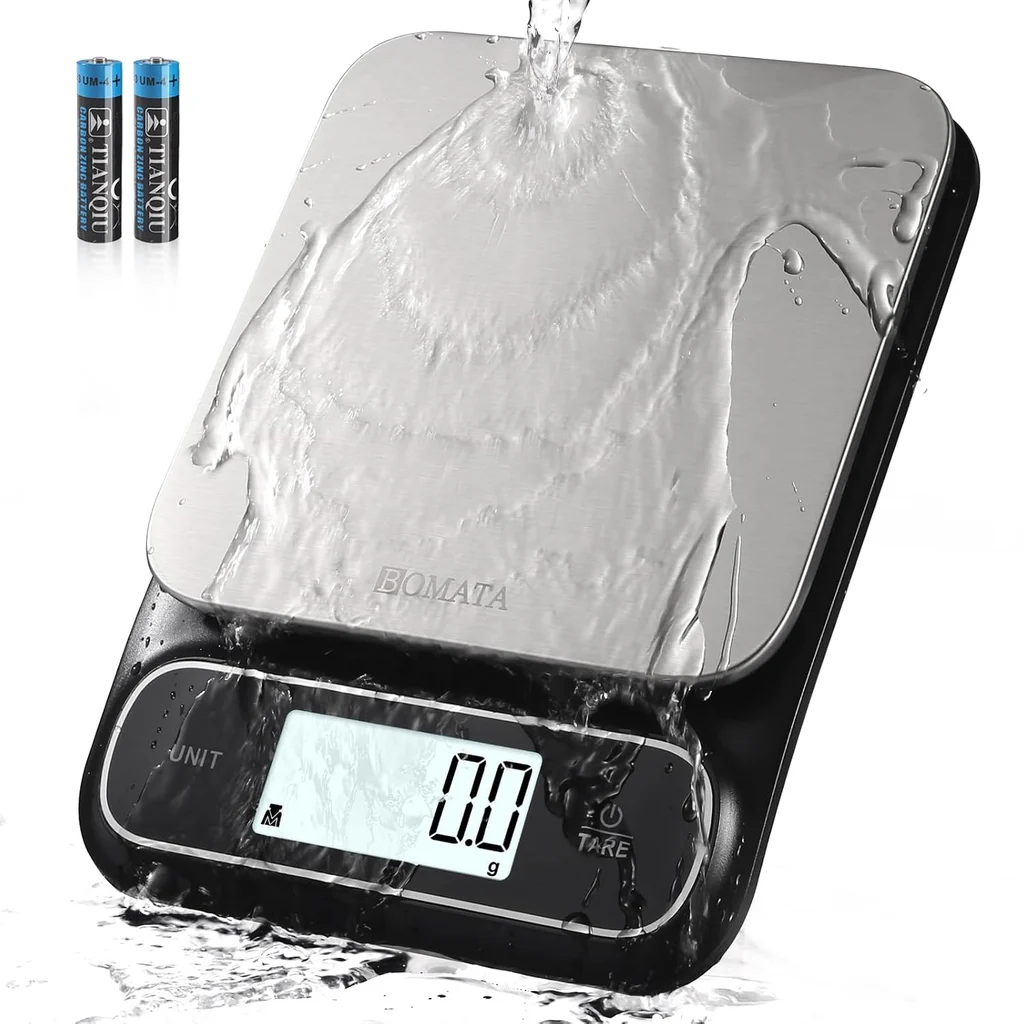
Pick this scale if your curing station gets wet and greasy and you want to rinse the scale after each session.
Pros
- Listed as IPX6 washable; the listing says it can be rinsed under running water
- 5.8 x 7.8 inch stainless pan (per the Amazon listing)
- Offers seven units, including milk-density modes
Cons
- Touch-sensitive buttons, per the listing
- Relatively few Amazon ratings
The Amazon listing rates this scale at 0.1 g from 0.5 g to 5 kg. It runs on two AAA batteries and has a calibration option. Raw meat juice and brine end up everywhere when you break down a deer, so a rinsable scale is a real plus. IPX6 is a spray rating, so rinse it rather than soaking it.
Skip it if you dislike touch buttons.
Bonvoisin 6000g Lab Scale
Bonvoisin 6000g Lab Scale
6 kg capacity · listed ±0.3 g tolerance, 1 g minimum · AC adapter included
Check today’s price on Amazon
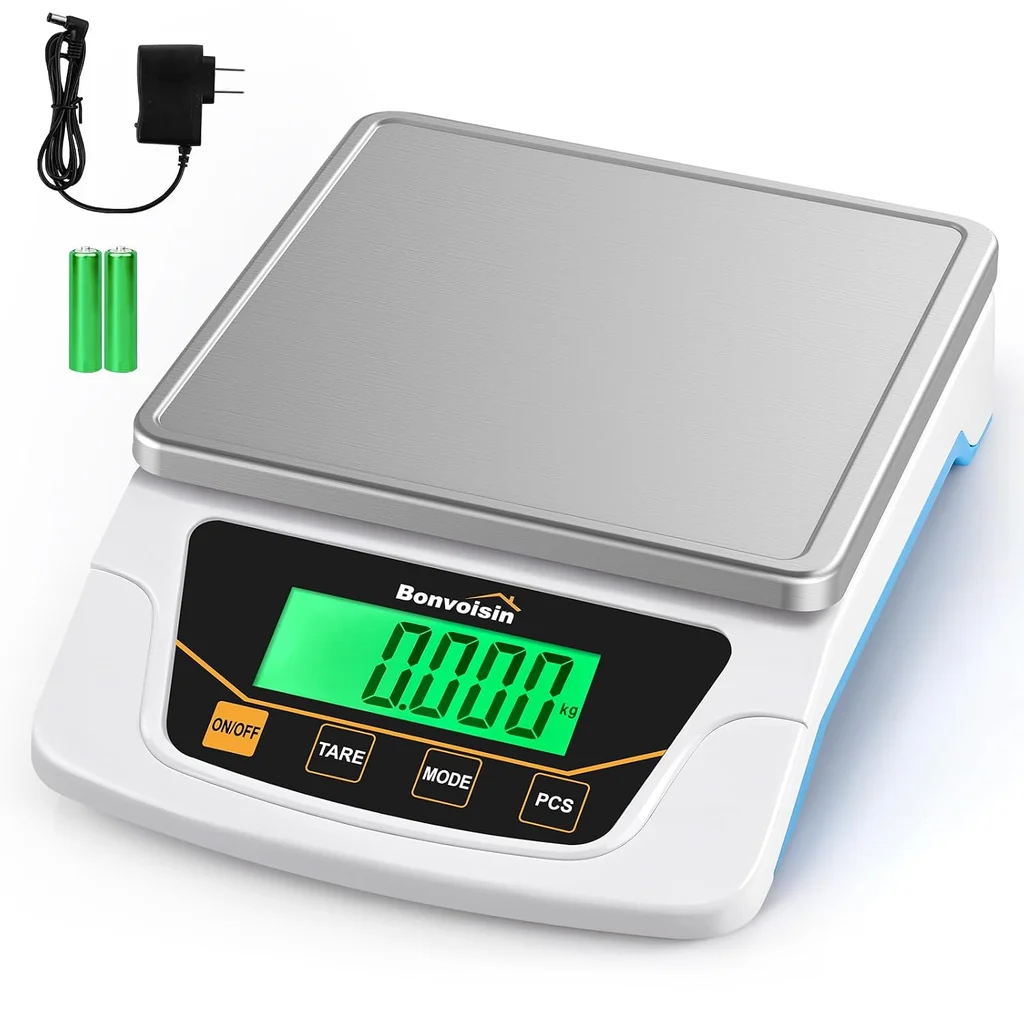
Choose this scale for larger batches, not small cure doses: the listing states a 1 g minimum start weight and a ±0.3 g tolerance.
Pros
- Highest capacity here at 6 kg (per the Amazon listing)
- Includes an AC adapter plus 2 AA batteries (per the Amazon listing)
- Auto-off can be adjusted or disabled (per the Amazon listing)
Cons
- 1 g minimum start weight
- Stated tolerance of ±0.3 g
The Bonvoisin listing states a tolerance of ±0.3 g and a 1 g minimum start weight; no maker page exists. On the small doses used for 1 to 2 lb batches (a gram or two), that tolerance is a large share of the dose, so this scale suits bigger batches better. The 5.71 inch square pan is the smallest platform of the full-size picks.
It reads in g, oz, lb, kg, tl, and ct. Skip it if you mostly weigh cure for 1 to 2 lb test batches.
Buying Guide
A bowl scale such as the Etekcity EK5250 lists 0.1 g steps below 1 kg in its manual but 1 g steps above, and Amazon lists a 1 g minimum, so it is not a fit for doses near 1 g.
Buy a 0.1 g gram scale for cure and spices, and a separate 1 g scale for meat. That two-scale setup covers every batch size, from one pork belly to a full season of deer. Once the batch is cured, check it with an instant-read thermometer, and use a leave-in probe if you smoke it.
How we researched
We compared Amazon listings for resolution, capacity, minimum load, units, and power; the makers publish no spec pages for these scales. SaltRail did not test these products.
Quick picks
| Pick | Best for | Key spec | Maker-rated spec |
|---|---|---|---|
| BOMATA Large | Most home curers | 7.2 x 7.2 in platform | 0.1 g, 0.5 g to 5 kg |
| BOMATA IPX6 | Wet work areas | IPX6 rinsable | 0.1 g, 0.5 g to 5 kg |
| Bonvoisin Lab | Larger batches | AC adapter | 0.1 g, 1 g to 6 kg, ±0.3 g |
Specs that count for curing
- Resolution: 0.1 g steps let you dose cure for small batches.
- Minimum load: check the stated minimum. Below it, readings may be unreliable; Bonvoisin lists 1 g, BOMATA lists 0.5 g.
- Tare function: This zeroes the bowl so you read only the cure.
- Units: Work in grams. Ounces round too coarsely for cure: a 0.01 oz step is about 0.28 g, roughly a quarter of the 1.13 g figure above for 1 lb of meat.
- Auto-off: A 2-minute shutoff can erase a reading mid-batch. Disabling it helps.
- Power: Check whether it runs on batteries, USB or an adapter, and keep spares on hand.
- Platform: a wider platform leaves room for a small bowl; check the listed pan size.
How big is one scale step compared with the cure dose?
Calculated by SaltRail from the UW-Madison Extension formula for 6.25% curing salt in comminuted product: pounds of curing salt = (ppm / 1,000,000 x meat weight) / 0.0625. The ceiling for sausage is 156 ppm (MSU Extension). That works out to about 1.13 g of cure per pound of meat.
| Meat | Cure at 156 ppm (6.25% cure) | One 0.1 g step is | One 1 g step is |
|---|---|---|---|
| 1 lb | 1.13 g | 8.8% of the dose | 88% |
| 2 lb | 2.26 g | 4.4% | 44% |
| 5 lb | 5.66 g | 1.8% | 18% |
| 10 lb | 11.32 g | 0.9% | 8.8% |
This is why the 1 g-step scales are the wrong tool for a 1 to 5 lb batch. Bonvoisin’s listing states ±0.3 g; against the 1 lb figure above that is about 27% (0.3 / 1.13).
These figures illustrate step size only. They are not a recipe or a dose. 156 ppm is the legal ceiling for processors (MSU Extension); use the dose on your cure product’s label and a trusted recipe.
Legal nitrite limits are small: MSU Extension lists 200 ppm for ham and whole muscle products, 156 ppm for sausage and 120 ppm for bacon, which is why the amount you weigh matters.
Weigh the meat too
Weigh trim before it goes into the grinder. The meat grinder size guide matches grinder plates to the same batch sizes. Weighing trim also keeps your venison burger fat ratio on target.
Who this is not for
If you never cure, a standard 1 g kitchen scale is enough and none of these is worth the money. If you cure by volume with a recipe that gives teaspoons, a scale changes your method, so check the recipe’s source first. A 0.1 g scale does not make a dose safe on its own: it must also be accurate, used with the right cure and recipe, and kept clean of raw meat.
Check accuracy at home (SaltRail’s suggestion)
- Set the scale on a level, dry counter.
- Let it power on and press tare.
- Place an object of known mass on it, such as a calibration weight.
- Repeat three times and compare the readings. If they differ, follow the scale’s own calibration instructions.
If readings creep, follow the scale’s calibration instructions or swap the batteries.
SAFETY: Keep cure in a labeled container away from table salt. Cover the scale or wipe it clean before raw meat goes near it, and wash your hands between handling meat and weighing cure.
Frequently Asked Questions
What is the best 0.1 g scale for weighing meat-curing ingredients?
The BOMATA Large Kitchen Scale is our pick for most home curers. It pairs 0.1 g resolution with a large platform, a calibration weight, and an auto-off you can disable.
Does a scale that reads to 0.1 g measure accurately enough for curing salt?
It depends on the dose. A 0.1 g step is the display resolution, not a stated accuracy. Only the Bonvoisin listing gives a tolerance (±0.3 g). Check the scale with a known weight near your dose, stay above its minimum load, and follow your cure product’s label.
Which 0.1 g kitchen scales can also handle large batches of meat?
None of these should weigh a full grind. They top out at roughly 5 to 6 kg by their listings, so pair one with a 1 g scale sized to your trim. Weigh the meat before it goes through one of the best meat grinders for deer.
Is a waterproof scale worth buying for meat curing?
Yes, if your scale sits near raw meat and brine. IPX6 is a spray rating, and the listing says the scale can be rinsed under running water. A dry spice station away from the cutting board needs it less.
How much cure do I weigh out for a batch?
Cure is dosed by the weight of the meat, so the amount depends on your cure product and recipe. Follow your cure product’s label, and weigh both the meat and the cure. Recipes like the ones in our sausage stuffer guide list the cure in grams.