You make venison sausage by trimming off all deer fat and grinding the venison with pork fat to 15 to 20% fat. Then you add salt at 1 to 2% of batch weight and mix cold until the meat binds. Keep everything below 40°F, stuff or shape it, and cook it to 160°F internal.
After reading, you can weigh a batch, do the salt and fat math yourself, and grind without smearing. You will also know how long fresh deer sausage keeps in the fridge and freezer. The guide gives you real gram figures for a 5 lb batch and separates fresh sausage from cured summer sausage. It also points you to SaltRail’s CWD testing guidance before your wild game sausage goes in the freezer.
What You Need: Equipment, Meat, Fat, and Seasoning
You need three core tools, pork fat at a set ratio, and salt weighed by the gram. Seasoning is the one part you can shape to your taste.
Which Tools Are Essential, and Which Are Optional?
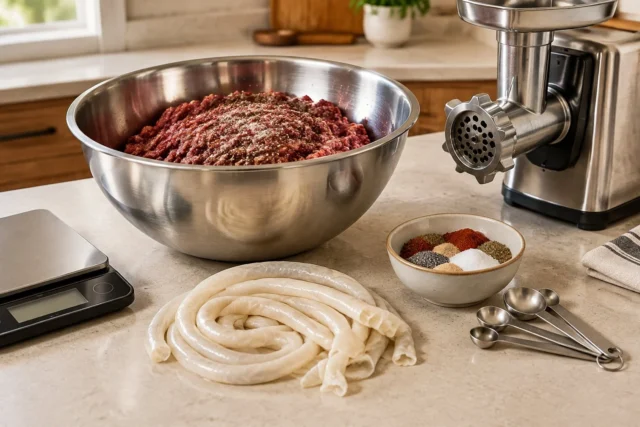
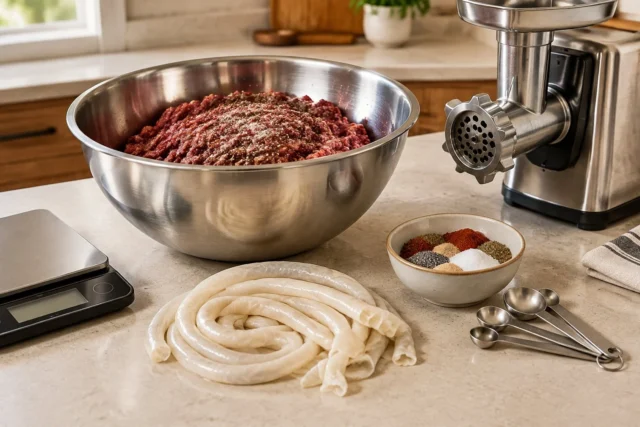
UConn Extension names a thermometer, a scale and a meat grinder as the three most important pieces of equipment for sausage making. Everything else makes the job easier. For stuffers compared, see best sausage stuffer.
| Tool | Status | Why it matters |
|---|---|---|
| Meat grinder | Essential | Sharp knife and plate cut fat cleanly |
| Digital scale (grams) | Essential | Salt is set by percentage of weight |
| Instant-read thermometer | Essential | Doneness is judged by temperature, not time |
| Sausage stuffer | Optional | Needed only for links |
| Large chilled bowl, sheet pans | Helpful | Keep meat cold between steps |
| Casings | Optional | Skip them for patties or bulk |
For a deer-sized batch, a grinder that holds up to cold, sinewy meat saves time. Our best meat grinder for deer roundup sorts models by motor rating and plate size. If you plan links, a manual sausage stuffer gives you steadier pressure than a grinder’s stuffing tube. Look for a scale that reads in single grams, like the ones in our best scale for curing meat guide.
How Much Pork Fat Should You Add?
Aim for 15 to 20% fat in the finished sausage, the range UConn Extension gives for game sausage. SaltRail’s grinding guide uses a higher rule of 20% or more. The two agree only at 20%, so 20% fits both.
Deer fat goes. UConn notes that most “gamey” flavor comes from the fat, not the lean. It also notes a sausage with no fat turns out dry. Use unsalted pork fat. UConn names pork shoulder butt as a common fat source for game sausage. Pork back fat and pork trim also work, and ground pork is fine if that is what you have.
SaltRail arithmetic, 5 lb batch:
- 4 lb venison + 1 lb pork fatback = 20% fat tissue by weight
- 4.25 lb venison + 0.75 lb pork fatback = 15% fat tissue by weight
Fatback is not pure fat. It holds some water and connective tissue, so the true fat percentage lands a little lower than the tissue weight. If you use pork shoulder, which is part lean, you need more of it to hit the same target. If you can’t find pork, our page on where to buy beef fat for venison covers the other route.
How Much Salt Does Your Batch Need?
UConn Extension puts salt at 1 to 2% of total batch weight. Salt does more than season. It pulls out the muscle proteins that make sausage bind. For manual mixers that do the mixing, see best meat mixer for sausage.
Here is the math for a 5 lb batch (labelled as SaltRail arithmetic):
- 5 lb x 453.6 g = 2,268 g total meat and fat
- 2,268 g x 0.01 = about 23 g salt (1%)
- 2,268 g x 0.015 = about 34 g salt (1.5%)
- 2,268 g x 0.02 = about 45 g salt (2%)
| Salt level | Grams per 5 lb batch | Taste |
|---|---|---|
| 1.0% | 23 g | Mild |
| 1.5% | 34 g | Middle, a good first batch |
| 2.0% | 45 g | Fully seasoned |
SaltRail’s suggestion: weigh the salt in grams rather than spooning it, so the batch lands on the percentage you picked.
Which Seasonings Can You Choose?
The sources opened for this guide give no standard venison sausage seasoning, so this part is yours. A store-bought venison sausage seasoning mix works. Check whether it already contains salt, and count that salt toward your 1 to 2%.
A simple breakfast-style starting point (SaltRail’s suggestion, not a sourced recipe) per 5 lb batch:
- 34 g kosher salt (1.5%)
- 2 tbsp dried sage
- 1 tbsp ground black pepper
- 2 tbsp brown sugar
- 1 tsp paprika
- 1 to 2 tsp crushed red pepper flakes
Cook a small test patty before you stuff, and adjust then.
Follow These Steps From Trimming to Cooking
The process runs in eight steps, from cold trimming through freezing. Each one gives the action first, then the reason.
Yield: 5 lb, or about 20 patties of 4 oz each (SaltRail arithmetic)
Target temperatures: meat below 40°F while working; cook to 160°F internal
1. Trim and Cube the Meat
Remove all deer fat, silver skin and heavy sinew, then cut the venison and pork fat into cubes that fit your grinder’s throat. UConn says to remove all external fat from game meat, because most “gamey” flavor comes from the fat.
Our guide on how to remove silver skin from venison shows the knife angle. Cut the pork fat into the same size cubes so it feeds evenly.
2. Weigh the Meat, Fat, and Salt
Weigh the trimmed venison, then the pork fat, then add them for your total batch weight. Your salt amount comes from that total, so weigh after trimming.
Write the numbers down. For 4 lb venison (1,814 g) plus 1 lb fatback (454 g), you get 2,268 g, and 1.5% salt is 34 g.
3. Chill the Ingredients and Grinder Parts
Spread the cubes on a sheet pan and chill them in the freezer until the edges are firm (SaltRail’s suggestion). Put the grinder head, auger, knife and plate in the freezer at the same time. UConn warns that heat from dull equipment can melt the fat and smear the grind.
Keep the meat under 40°F, the line UConn Extension uses for safe handling.
4. Grind the Venison and Pork Fat
Grind the venison and pork fat together through a coarse plate, such as 3/8 inch. For a finer breakfast sausage, chill again and run it through a 3/16 inch plate. UConn lists 1/4, 3/8 and 1/2 inch holes as coarse, and 1/8 or 3/16 inch as fine. Feed fat and lean in turns so they mix as they grind.
If you see white smears on the plate, stop. Our how to grind venison guide covers plate choice and double grinding in more depth.
5. Mix Cold Until the Meat Binds
Sprinkle salt and seasoning over the ground venison and mix by hand or with a stand mixer paddle. UConn says salt extracts the muscle proteins that make sausage bind.
UConn Extension describes the right temperature well: your hands should feel uncomfortably cold. SaltRail’s suggestion: the mix is ready when it turns tacky and holds together as a ball.
6. Stuff Casings or Form Patties
SaltRail’s suggestion: for patties, shape 4 oz portions about 1/2 inch thick on parchment. For links, load the stuffer and fill sausage casings firm but not tight, then twist into 5 to 6 inch links.
| Casing | Prep | Best for |
|---|---|---|
| Natural hog casings | Rinse and soak per package | Brats, Italian-style links |
| Collagen casings | Usually used dry; follow package | Breakfast links, uniform size |
7. Cook and Check the Internal Temperature
Cook patties or links in a skillet over medium heat, turning often, until the center reads 160°F. USDA FSIS uses 160°F for sausage made with ground pork or beef, and since this blend includes pork, 160°F is your target.
Push the thermometer probe into the center from the end of a link. A dependable probe from our best meat thermometers for sausage and jerky list reads in a few seconds.
8. Refrigerate or Freeze Your Portions
Package what you won’t cook in 1 to 2 days and freeze it right away. Fresh sausage has a short fridge window.
Lay patties or links flat on a sheet pan to freeze, then bag or vacuum seal them, the method in our how to flash freeze meat guide. Label each package with the date and the deer it came from.
Keep Fresh Sausage Safe and Separate From Summer Sausage
Fresh sausage stays safe when it stays cold, gets cooked to 160°F, and comes from a deer handled with CWD guidance in mind. Below are the safety rules, the storage times, and how fresh sausage differs from a cured summer sausage.
SAFETY: Keep It Cold, Cook It Fully, and Check CWD Guidance
SAFETY
- Keep meat and fat below 40°F from trimming to packaging (UConn Extension).
- Fresh sausage is uncured and must be kept refrigerated and fully cooked before eating (USDA FSIS).
- Cook sausage containing pork or beef to 160°F internal; poultry blends go to 165°F (USDA FSIS).
- Keep work surfaces clean, cold and covered. UConn calls this the “3-Cs.”
- CWD: if your deer came from an area with chronic wasting disease, check the testing guidance in our post is venison safe to eat with CWD before you grind.
SaltRail’s suggestion: mark each package with the deer it came from, so you can pull one animal’s meat if a test comes back positive. Our guide on how to label frozen meat gives a simple labeling system.
How Long Can Raw and Cooked Sausage Be Stored?
USDA FSIS gives fresh, uncooked sausage 1 to 2 days in the fridge and 1 to 2 months in the freezer. Montana State University Extension gives a different figure: eat within three days or freeze. We follow the shorter FSIS window.
| Fresh sausage | Refrigerator (40°F or below) | Freezer (0°F) |
|---|---|---|
| Uncooked | 1 to 2 days (FSIS) | 1 to 2 months (FSIS) |
| Cooked | 3 to 4 days (FSIS) | 2 to 3 months (FSIS) |
FSIS says food kept frozen continuously stays safe indefinitely, so its freezer times are about quality, not safety. Our how long does sausage last guide covers other sausage types. For an all-pork fresh sausage, see how to make bratwurst. For a pork Italian sausage, see homemade Italian sausage.
Fresh vs. Summer Sausage: Which Process Are You Following?
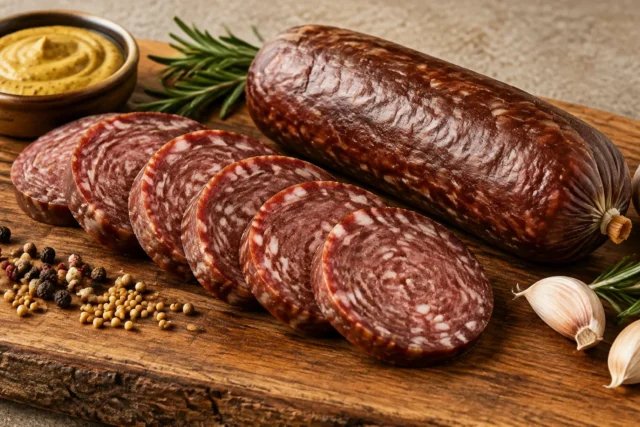
Fresh sausage is ground, seasoned meat that is neither cured nor smoked and must be fully cooked before you eat it. Venison summer sausage is a different process, built on curing salt and a smoker.
| Feature | Fresh venison sausage | Venison summer sausage |
|---|---|---|
| Curing salt | None | Required, measured exactly |
| Smoking | No | Yes, slow smoke to a set temperature |
| Cooking | Cooked by you before eating | Cooked during smoking |
| Fridge life | 1 to 2 days raw (FSIS) | Longer; follow the recipe |
Do not add curing salt to this recipe by guesswork. If you want a sliceable smoked venison summer sausage, follow our venison summer sausage recipe and the timing in how long to smoke summer sausage.
Troubleshooting: Fix Common Texture and Stuffing Problems
Most problems with homemade venison sausage trace back to four things: heat, salt, fat and stuffing pressure. Each one has a direct fix.
Smeared Fat: Stop and Chill Before Continuing
Smearing shows up as white paste on the plate and a gray, greasy grind. UConn Extension points to dull equipment, which builds heat and melts the fat.
Stop grinding. Put the meat and grinder parts back in the freezer until they are cold again. Check that the knife is seated flat against the plate and that both are sharp.
Crumbly Sausage: Check the Salt Calculation and Mixing
Crumbly sausage falls apart in the pan because the proteins never bound. The two usual causes are too little salt and too little mixing.
Recheck your math against batch weight. Check that you used at least UConn’s 1% (23 g per 5 lb), since salt is what pulls out the binding proteins. Then mix longer, keeping it cold, until it turns tacky. If you used a seasoning mix with no salt, add it.
Dry Cooked Sausage: Review the Fat Blend and Final Temperature
Dry sausage usually points to low fat or overcooking. UConn notes that a sausage made without fat turns out dry. Pull the pan as soon as the center reads 160°F.
If your temperature was right, raise the pork fat toward 20%. Fatback with lots of lean attached, or pork shoulder counted as pure fat, leaves you below your target. Weigh the next batch at 4 lb venison to 1 lb fatback.
Split Casings: Check Filling Pressure and Casing Instructions
SaltRail’s suggestion: casings split when stuffed too tight, so fill until firm but still soft to a gentle squeeze, leaving room to twist.
Follow the casing package for soaking. To choose a casing type, see natural vs collagen casings. SaltRail’s suggestion: prick air pockets with a clean pin and cook links over medium heat.
Frequently Asked Questions
Can I make venison sausage from already-ground meat?
Yes, you can make it from ground venison if it was ground plain, with no fat added yet. Weigh it, mix in ground pork or finely ground pork fat to reach 15 to 20% fat, then add salt at 1 to 2% of the total weight. Keep it below 40°F and mix cold until it binds.
What part of a deer can I use for sausage?
You can use almost any lean trim, including the venison neck, shoulders, shanks and scraps from steaks and roasts. Sausage is a good way to use trimmings with less waste, as Montana State University Extension notes. Save the backstrap and tenderloins for whole cuts, and trim off fat and silver skin first.
Do I have to add pork to venison sausage?
You need to add some fat, and pork fat is the most common choice. UConn Extension notes that sausage made without fat turns out dry. Beef fat works if you prefer it or can’t find pork. Aim for the same 15 to 20% fat range either way.
Can I make venison sausage without casings?
Yes, you can skip casings and make patties or bulk sausage. This is the easiest way to make breakfast sausage. Form 4 oz patties about 1/2 inch thick, freeze them flat on parchment, and cook each one to 160°F. Bulk sausage also works well crumbled into gravy, chili or pasta.
Do I need to age deer meat before making sausage?
No, UConn Extension says aging is not necessary for sausage making. The meat is ground and seasoned, so the tenderness gained from aging matters less here. What you do need is meat kept under 40°F, the line UConn uses, before and during processing. Venison sausage recipes start with clean, cold meat.
If you are cutting meat for your next batch, our guide on how to debone a deer is the next step.
This is general guidance based on USDA recommendations. When in doubt, follow the USDA FSIS source linked above.